The Indian delegation visited Qatar to reinforce India’s zero-tolerance stance on cross-border terrorism and rally support following the Pahalgam incident and Operation Sindoor.
A high-level Indian parliamentary delegation has concluded a two-day visit to Doha as part of a diplomatic outreach to build international consensus against cross-border terrorism following last month’s deadly attack in Indian-administered Kashmir.
The multi-party delegation, led by Member of Parliament Supriya Sule, wrapped up the Qatar leg of a four-nation tour on Tuesday, aimed at articulating New Delhi’s “zero-tolerance policy” on terrorism in the wake of the April 22 Pahalgam attack and the launch of Operation Sindoor, India’s military response.
In a statement issued by the Indian Embassy in Doha, the delegation “conveyed India’s firm position on countering cross-border terrorism” and briefed Qatari officials on developments since the attack, which New Delhi has blamed on Pakistan-based armed groups.
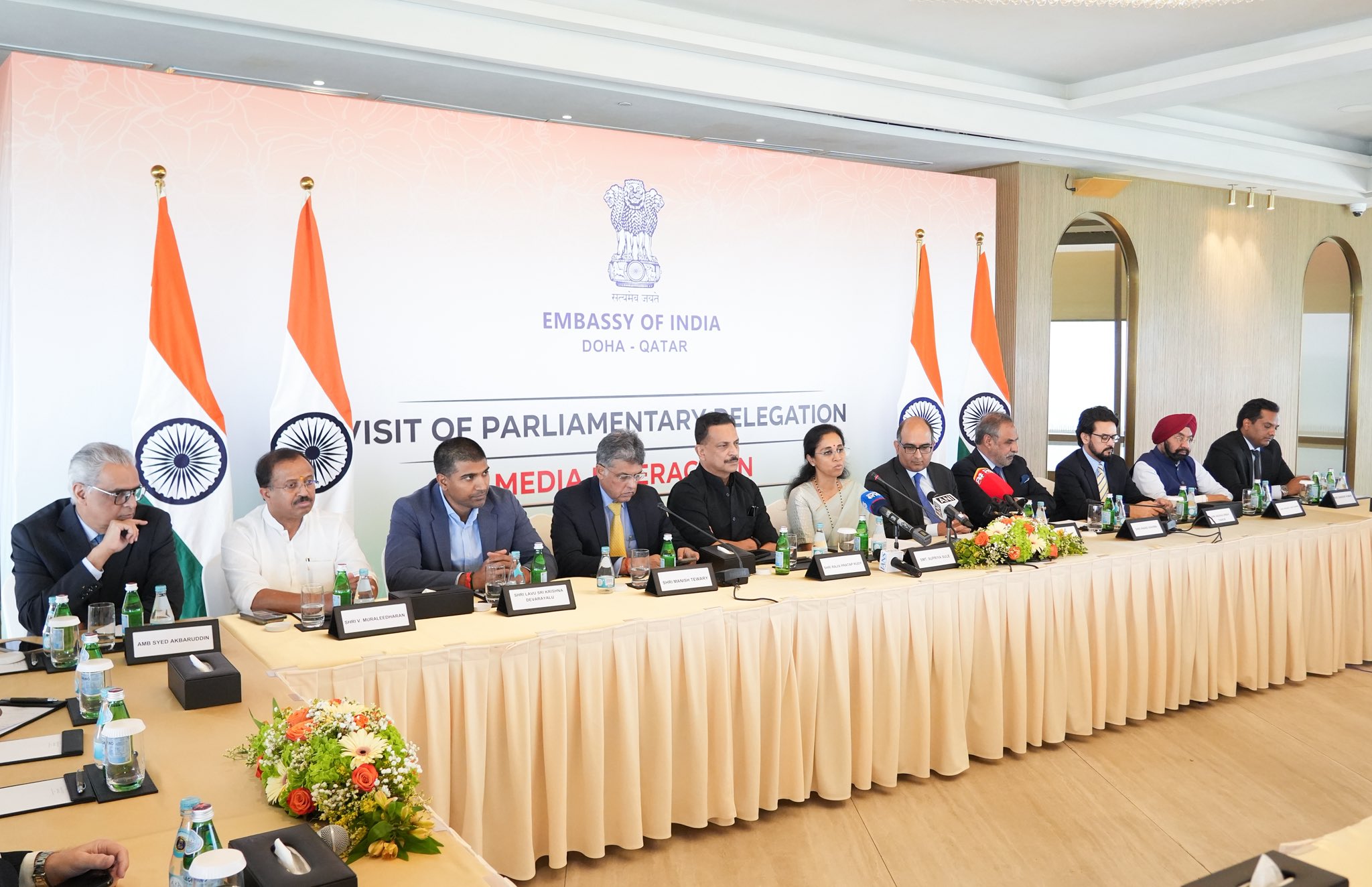
The delegation included a broad political spectrum of Indian lawmakers and figures: Rajiv Pratap Rudy, Anurag Thakur, V. Muraleedharan, Manish Tewari, Anand Sharma, Lavu Sri Krishna Devarayalu, Vikramjeet Singh Sawhney, and former UN envoy Syed Akbaruddin.
During their time in Doha, the Indian representatives held meetings with Dr Mohamed bin Abdulaziz Al Khulaifi, Minister of State for Foreign Affairs; Sheikh Abdulaziz bin Faisal Al Thani, Minister of State for Interior Affairs; and Dr Hamda Al Sulaiti, Deputy Speaker of Qatar’s Shura Council, among other senior officials.
The Qatar stop marks the first leg of a regional tour that will also take the delegation to South Africa, Ethiopia, and Egypt. The initiative reflects India’s growing efforts to secure international alignment on counterterrorism, especially amid rising tensions in the South Asian region.
During a media roundtable held on May 26, the delegation reiterated India’s position as a long-standing victim of cross-border terrorism, which it alleged was orchestrated by groups supported by Pakistan.
Opening the discussion, delegation leader Supriya Sule said: “We must put the facts on the table. India has been hurt by an unprecedented attack on its soul. The incident that happened has shaken India. Innocent Indians were affected.”
The delegation urged international partners to take a firmer stance against what it described as state-backed militant activity, calling for greater global coordination on counterterrorism efforts.
“We have enough evidence to prove that all this training, unfortunately, has taken place in the neighbourhood — a neighbourhood we have nurtured, valued, and respected, and with which we have always sought good relations,” Sule said, referring to Pakistan.
Anand Sharma, former Union Cabinet Minister and Member of Parliament, added that while terrorism is a global issue, India faces a distinct challenge. “Terrorism is a global phenomenon, but the kind India is subjected to is different. It is supported and financed by a state. What we are dealing with is cross-border terrorism emanating from our neighbour,” he said.
India-Pakistan tensions and Operation Sindoor
India launched a military operation inside Pakistan earlier this month — Operation Sindoor — in response to a deadly militant attack on April 22 that killed 26 people, most of them Indian tourists, in the Pahalgam region of Indian-administered Kashmir. India claims the assailants included at least two Pakistani nationals.
Pakistan denied involvement, calling for an independent investigation and urging India to share credible evidence.
The incident triggered four days of escalating cross-border shelling and drone attacks, culminating in missile strikes on military installations on both sides. The exchanges raised fears of a wider conflict between the two nuclear-armed neighbours.
A ceasefire brokered on May 10 by the United States helped de-escalate tensions and brought both sides back from the brink.
In an interview with Sky News, Pakistan Information Minister said that “India has no evidence to link Pakistan to the terror attack on April 22nd”.
Furthermore, Pakistan’s Foreign Minister Ishaq Dar confirmed on social media, stating: “Pakistan has always strived for peace and security in the region, without compromising on sovereignty.”
The Indian delegation reaffirmed that Operation Sindoor, launched in response to last month’s deadly attack in Pahalgam, was a “restrained, proportionate and targeted” military action, aimed solely at what it described as the command centres of armed groups. The officials stressed that the operation avoided civilian or military casualties inside Pakistan.
The Doha visit also built on a string of recent high-level diplomatic engagements between New Delhi and Doha, including a May 6 phone call between Indian Prime Minister Narendra Modi and Qatar’s Amir Sheikh Tamim bin Hamad Al Thani, during which both leaders condemned terrorism in all its forms.
Despite a widely circulated tweet by former U.S. President Donald Trump on May 10 — claiming the ceasefire was the result of U.S.-mediated talks — the Indian delegation rejected any suggestion of formal third-party intervention.
“The Ministry of External Affairs has made it clear: there was no third-party mediation,” said Anand Sharma, a senior Indian MP. “Yes, many friends across the world — including Qatar — called for calm. But it was Pakistan that escalated the situation, not India.”
He added that it was Pakistan’s Director-General of Military Operations (DGMO) who first requested a ceasefire, following what he described as “significant damage” to a Pakistani Air Force base targeted in India’s retaliatory strikes on the morning of May 10. “It is on record — Pakistan sought the ceasefire. India’s DGMO agreed,” Sharma claimed.
The delegation emphasised that India’s military response was defensive in nature, aimed exclusively at what it described as terrorist infrastructure, and reiterated calls for the international community to hold Pakistan accountable for “weaponising terrorism as state policy.”