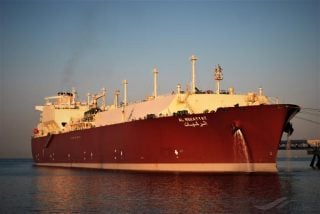
Restrictions in the Strait of Hormuz have forced shipping companies to divert vessels and seek alternative routes.
Leading shipping and logistics company Mediterranean Shipping Company (MSC) is launching a new Europe–Red Sea–Middle East Express service starting from 10 May 2026 amid the ongoing restrictions on shipping through the Strait of Hormuz.
In a statement on Saturday, MSC said the service will call at key European ports with direct connections to King Abdullah Port, Jeddah and Aqaba, as well as onward links to ports in the Gulf, particularly the United Arab Emirates and the Upper Gulf.
The inaugural sailing is scheduled to depart from Antwerp on 10 May.
“It is designed to provide reliable, efficient, and competitive shipping options, with improved transit times to suit all kinds of cargo,” MSC said in its statement.
The eastbound rotation will be: Gdansk–Klaipeda–Bremerhaven–Antwerp–Valencia–Barcelona–Gioia Tauro–Abu Kir–King Abdullah–Jeddah–Aqaba.
“All European origins, from NWC–Scan Baltic to West Med Adriatic and East Med Black Sea will be served through MSC’s capillary network of services,” the company added.
The announcement comes as Iran continues to impose restrictions on shipping movements through the Strait of Hormuz following the outbreak of war with the United States and Israel on 28 February.
The restrictions have forced shipping companies to divert vessels and seek alternative routes.
The Strait of Hormuz, situated between Oman and Iran, is one of the world’s most critical routes for crude oil shipments, and its closure has become a key issue in the stalled ceasefire negotiations.
The strait handles around 20% of the world’s oil and liquefied natural gas (LNG) trade, with at least 3,000 vessels passing through each month before the war began, according to Lloyd’s List Intelligence.
Traffic has significantly dropped in the final weeks of April after Iran reinstated restrictions in response to the U.S. naval blockade on its ships.
By 27 April, weekly transits through the strait had fallen from 78 to 35 — a decline of about 55% week-on-week — according to Lloyd’s List Intelligence.
As of 28 April, over 150 non-sanctioned crude oil and product tankers remained stranded in the Gulf, including 62 very large crude carriers (VLCCs), the majority of which arrived before the beginning of the war.
Meanwhile, Red Sea tanker traffic surpassed 2023 levels, with 379 crude oil tanker transits recorded in March, marking a 66% month-on-month increase.
“Resurgence in crude oil tanker transits driven by Strait of Hormuz shutdown, but no evidence of a Red Sea revival as Bab el Mandeb traffic down 45% on 2023 volumes,” Lloyd’s List said on Friday.