This was the first time a sitting Canadian prime minister has travelled to Doha.
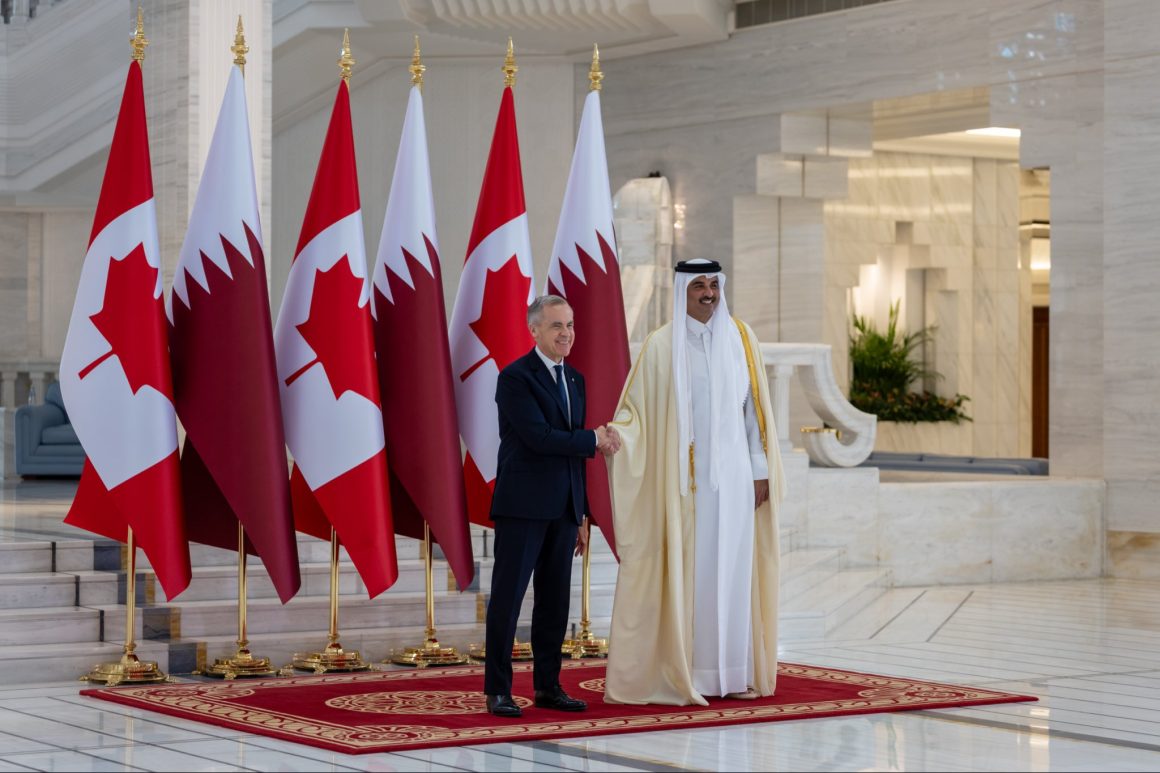
Canada’s Prime Minister Mark Carney made his first official visit to Qatar on Sunday, becoming the first sitting Canadian prime minister to travel to Doha.
In Doha, Carney met with Qatar’s Amir Sheikh Tamim bin Hamad Al Thani, who expressed hope that the visit would broaden bilateral cooperation and further strengthen relations between the two countries, wishing for continued growth and prosperity in Qatar-Canada ties.
During the meeting, Carney thanked Sheikh Tamim for the warm welcome and generous hospitality, emphasising Canada’s commitment to strengthening ties with Qatar and expanding cooperation across multiple sectors.
The two leaders discussed ways to enhance and develop collaboration between their countries, issuing a joint statement of commitment to boosting two-way investment and collaboration across artificial intelligence, quantum computing, aerospace, defence technologies, advanced manufacturing, agriculture, and agri-food.
They also exchanged views on promoting regional security and stability, as well as supporting global peace initiatives.
Qatar’s Amir also hosted a luncheon in honour of Carney and his accompanying delegation.
During a press conference in Doha, Carney confirmed that Qatar had made new commitments to investment in Canadian projects.
“I am pleased to announce that Qatar has committed to make significant strategic investments in Canada’s nation-building projects.”
“This capital will help the projects get built faster and supercharge our energy industries while helping to create thousands of high-paying careers for Canadians,” Carney announced.
“We’re also announcing an ambitious new partnership where we deepen our ties across trade, investment, defence, and AI.”
The Canadian Prime Minister also revealed that a new investment promotion and protection agreement between Doha and Ottawa would be finalised by the summer, the Canada-Qatar Foreign Investment Promotion and Protection Agreement (FIPA).
“This agreement will enable Canadian businesses to more easily expand their operations in and attract investment from this dynamic $290 billion economy,” he told the press in Doha.
Carney added that representatives from Qatar Investment Authority, the nation’s sovereign wealth fund, would be visiting Canada to explore new investment opportunities after Ramadan.
“In the coming months, a delegation of Canada’s leading pension funds will visit here to do the same,” he added.
Carney announced a new double-taxation agreement aiming to ease the process for Canadians wishing to work and invest in Qatar and vice versa, with negotiations starting soon.
The visit also saw the announcement of an expanded air services agreement between under the Canada-Qatar Air Transport Agreement.
A Canadian Defence Attaché office would also be established in Doha, and the two nations would be exchanging best practices and lessons as Canada gears up to host the FIFA World Cup 2026 alongside the U.S. and Mexico.
He also praised Qatar for being a partner with Canada in “pursuits of peace and stability, from Ukraine to the Middle East.”
“It is a relationship forged over many years by profound acts of friendship, including the Qataris’ effort to evacuate more than 200 Canadians from Afghanistan in 2021.”
The visit follows a preparatory trip by Canada’s Minister of International Trade, Maninder Sidhu, who concluded the first leg of his Gulf tour in Qatar on January 8.
During his visit, Sidhu met with representatives of the Qatar Investment Authority, co-hosted a Canada-Qatar trade and investment roundtable, and held bilateral talks with Qatar’s Minister of State for Foreign Trade Affairs Ahmed Mohammed Al Sayed.
The two ministers agreed to launch a Canada-Qatar business council and discussed negotiations toward a foreign investment promotion and protection agreement.
“I met with investors and businesses in Qatar to strengthen key industries and deliver long-term growth. I was proud to showcase Canadian innovation to our Qatari partners and highlight the proven reliability, stability, and new opportunities that come with choosing Canada as a trusted destination for investment,” Sidhu said.
Sidhu’s delegation, which included Canadian companies from sectors such as infrastructure, aerospace, ICT, and finance, also highlighted opportunities for deeper trade and investment in the rapidly expanding Gulf market efforts aligned with Ottawa’s objective of doubling Canada’s non-U.S. exports over the coming decade.
Qatar-Canada relations
Canada and Qatar have maintained positive bilateral relations for decades, collaborating on defence, trade, and humanitarian issues, and engaging in diplomatic support during global crises.
Bilateral merchandise trade between Canada and Qatar stood at approximately $325 million in 2024, with Canadian exports including machinery and agricultural products and Qatari exports comprising chemicals and industrial goods, according to government data.
In 2024, Canada and Qatar reinforced their bilateral ties by signing a memorandum of understanding establishing an annual mechanism for political consultations.
The relationship was further advanced during the Amir’s visit to Canada in September 2024, the first official visit by a Qatari head of state.
During the trip, the two governments concluded an MOU focused on enhancing cooperation to support social and economic development in third countries, and agreed to expand the Canada–Qatar Air Transit Agreement.
By November 2025, Qatari nationals became visa-exempt for short visits and can travel to Canada by air using an electronic travel authorisation (eTA).
Qatar has also played roles in facilitating evacuations and repatriations, underscoring its strategic engagement with Ottawa.
Qatar also announced that Canada, alongside Mexico, would be partners for the 2026 Year of Culture.