Qatar warned Iran against closing the Strait of Hormuz as Tehran threatened “new fronts” over Israel’s escalating war on Lebanon.
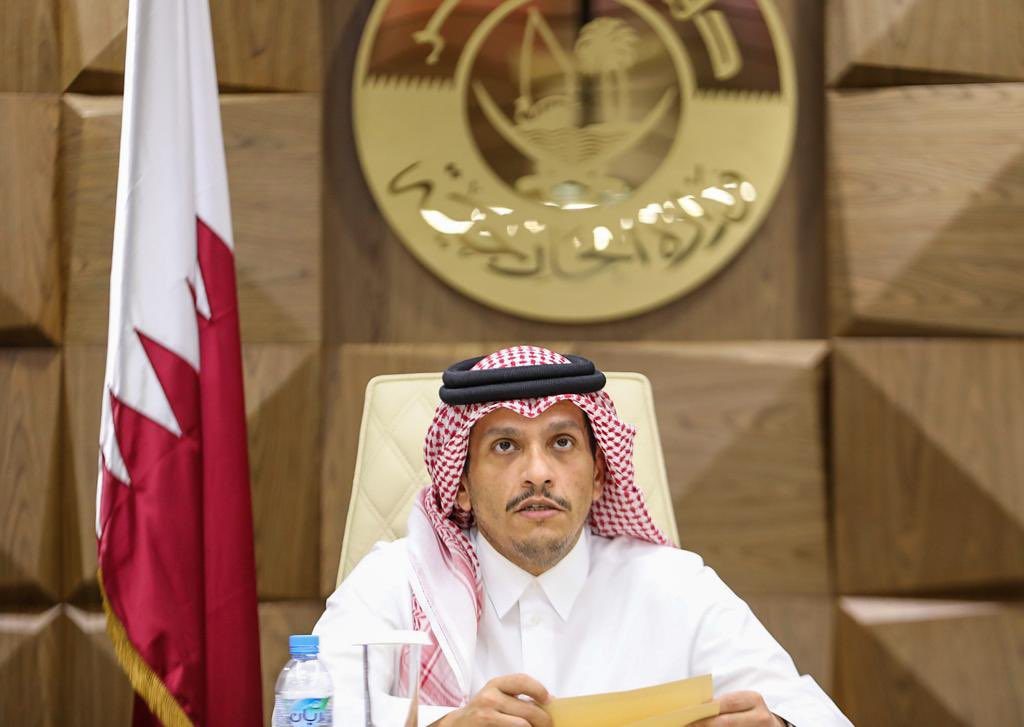
Qatar’s Prime Minister and Foreign Minister Sheikh Mohammed bin Abdulrahman Al Thani warned Iran on Monday against closing the Strait of Hormuz, saying freedom of navigation was a non-negotiable principle, as Tehran threatened to open “new fronts” over Israel’s escalating offensive in Lebanon and U.S. President Donald Trump insisted negotiations with the Islamic Republic were continuing “at a rapid pace”.
During a phone call with Iranian Foreign Minister Abbas Araghchi, Sheikh Mohammed reiterated Qatar’s support for mediation efforts aimed at ending the regional crisis and warned that using the strategic waterway as leverage would deepen tensions and endanger the vital interests of countries across the region.
According to Qatar’s foreign ministry, the two ministers discussed Pakistani mediation efforts between the United States and Iran, as well as the latest developments in Lebanon.
Sheikh Mohammed renewed Qatar’s full support for efforts aimed at reaching a comprehensive agreement to end the crisis and stressed the need for all parties to engage constructively in order to achieve lasting peace and regional stability.
The call came amid growing tensions over Lebanon, where Israel has intensified its military campaign despite a ceasefire announced in April.
Iranian officials warned on Monday that Israel’s continued attacks on Lebanon and Gaza risked undermining efforts to end the wider regional war.
Iran’s semi-official Tasnim news agency reported that Tehran’s negotiating team had suspended exchanges of messages with Washington through mediators in protest at Israel’s escalating offensive in Lebanon.
The report, which cited an informed source, said Iranian officials had insisted on an immediate halt to Israeli military operations in Lebanon and Gaza, as well as a full Israeli withdrawal from occupied areas in southern Lebanon.
According to Tasnim, Iran and its allies were also considering additional measures, including maintaining the closure of the Strait of Hormuz and activating other fronts, including the Bab al-Mandab Strait at the entrance to the Red Sea.
Iranian Armed Forces spokesperson Abolfazl Shekarchi warned that “the continuation of the brutal crimes in Lebanon is something the Iranian Armed Forces cannot tolerate”, according to Tasnim.
State television also quoted the Revolutionary Guards’ intelligence organisation as saying that Iran viewed the crossing of “red lines” in Lebanon and Gaza as tantamount to direct war.
“Iran considers crossing the red lines in Lebanon and Gaza to mean direct war,” the statement said.
“In return, it is determined to carry out defensive operations by taking meaningful actions and opening new fronts, in addition to preserving the Strait of Hormuz equation.”
Iranian Parliament Speaker Mohammad Bagher Ghalibaf accused Washington of failing to uphold the ceasefire.
“The naval blockade and escalation of war crimes in Lebanon by the genocidal Zionist regime are clear evidence of US noncompliance with the ceasefire,” he wrote on X.
Foreign Minister Araghchi similarly warned that the ceasefire between Iran and the United States applied across all fronts, including Lebanon.
“A violation on one front is a violation of the ceasefire on all fronts,” he wrote on X, adding that the United States and Israel would bear responsibility for any consequences.
Despite the rising tensions, Trump sought to project optimism about diplomacy.
“Talks are continuing, at a rapid pace, with the Islamic Republic of Iran,” the US president wrote on Truth Social on Monday evening.
Earlier in the day, Trump said he had held a “very productive” call with Israeli Prime Minister Benjamin Netanyahu and claimed there would be “no troops going to Beirut” after Israeli forces threatened to expand operations around the Lebanese capital.
Trump also claimed that, through intermediaries, he had held a “very good call” with Hezbollah and that the group had agreed that “all shooting will stop” and that “Israel will not attack them, and they will not attack Israel”.
There has been no confirmation of those claims from Israel, Hezbollah or Iran.
The United Nations has meanwhile expressed alarm over the deteriorating situation in Lebanon, with Secretary-General Antonio Guterres’s spokesman warning on Monday that the organisation was “deeply alarmed” by the escalation in military activity across southern Lebanon and beyond.