The Arab Ministerial Committee, meeting at the Arab League in Cairo with Qatar and other nations, reaffirmed East Jerusalem as the capital of Palestine, condemned Israeli settlement expansion and attacks on holy sites, and called for a just peace based on ending the occupation.
The Arab Ministerial Committee, tasked with international action to confront Israel’s illegal policies and measures in occupied Jerusalem, convened its tenth session at the headquarters of the Arab League in Cairo.
With the participation of Qatar, the committee reiterated that Israel has no sovereignty over Jerusalem and its Islamic and Christian holy sites, affirming that East Jerusalem remains the capital of Palestine.
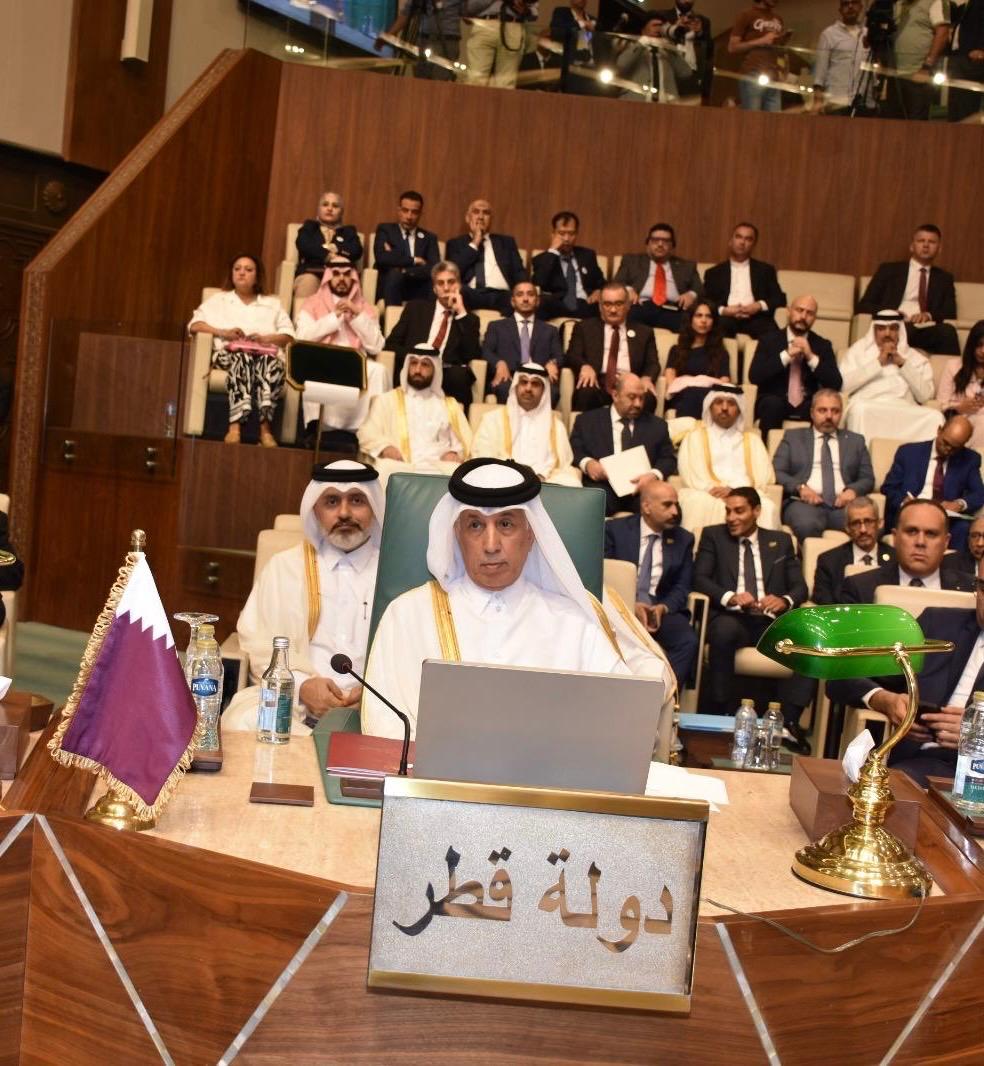
According to the MOFA press release, the meeting, held on the sidelines of the 164th ordinary session of the Arab League Council at the ministerial level, was chaired by Jordan and attended by delegations from Iraq, Qatar, Palestine, Algeria, Somalia, Saudi Arabia, Egypt, Morocco, Tunisia, and the Arab League Secretary-General.
The Qatari delegation was headed by Minister of State for Foreign Affairs Sultan bin Saad Al Muraikhi, reflecting Doha’s steadfast support for the Palestinian cause.
The committee declared that it “rejects any attempt to undermine the Palestinian right to sovereignty” and dismissed all unilateral aggressions or measures that threaten the legal status of Jerusalem.
A key point of emphasis during the session was the reaffirmation of the principle of a just and comprehensive peace, which the committee stressed must be contingent on ending the Israeli occupation.
The final statement reiterated the Arab position that peace is only viable with the establishment of an independent, sovereign, and geographically contiguous Palestinian state, with East Jerusalem as its capital along the 1967 borders, in line with international law, the Arab Peace Initiative, and relevant international references.
The committee condemned Israeli settlement expansion, particularly the approval of the plan in Area E1, which they described as an attempt to isolate Jerusalem, sever its Palestinian surroundings, and undermine the establishment of a viable Palestinian state.
Such measures, they said, constitute “a blatant assault on the Palestinian people’s right to realise their independent state.”
They further denounced Israeli efforts to alter the demographic composition and the historical and religious character of the occupied city, declaring these actions to be in clear violation of international law, UN resolutions, and the advisory opinion of the International Court of Justice, which invalidated Israel’s annexation of occupied Palestinian territories.
Particular outrage was expressed over the unprecedented escalation of violations against Al-Aqsa Mosque/Al-Haram Al-Sharif, including incursions by extremist Israeli ministers and officials, incitement statements, and provocative attempts to enforce temporal and spatial division.
The committee condemned the storming of Al-Haram Al-Sharif by the Israeli Minister of National Security alongside settlers, where religious rituals, dancing, and the raising of Israeli flags were reported.
They strongly opposed extremist calls for sacrifices within the sanctuary. They denounced measures restricting Muslim worshippers’ access, such as closures, checkpoints, physical assaults, and discriminatory age restrictions, especially during Ramadan and other religious occasions.
Attention was also drawn to recent Israeli actions threatening the Christian presence in Jerusalem. The committee condemned the freezing of the Greek Orthodox Patriarchate’s bank accounts, escalating settler attacks on the city’s Christian population, and repeated incidents of vandalism targeting churches, monasteries, and cemeteries.
Among the notable incidents cited were the desecration of the Church of Saint George and the historic Christian cemetery in Taybeh, as well as assaults on clergy, nuns, and worshippers.
In its resolutions, the committee called for the full implementation of relevant United Nations Security Council Resolutions, including Resolutions 252 (1968), 267 (1969), 476 and 478 (1980), and 2334 (2016).
They also reaffirmed UNESCO’s recognition of Al-Aqsa Mosque/Al-Haram Al-Sharif in its entirety as an exclusively Muslim place of worship, part of a World Heritage Site that remains under threat due to ongoing violations.
The importance of the Hashemite custodianship over Jerusalem’s Islamic and Christian holy sites was emphasised, affirming the exclusive authority of the Jordanian Ministry of Endowments’ Jerusalem Endowment Council to oversee all affairs related to Al-Aqsa Mosque/Al-Haram Al-Sharif.
The committee further acknowledged the role of the Jerusalem Committee and its executive arm, the Bayt Mal Al-Quds Agency, in safeguarding the city’s religious and cultural heritage.
It agreed to strengthen cooperation with the Organization of Islamic Cooperation (OIC) and other regional and international bodies to document violations, resist attempts to alter the status quo, and mobilise global pressure to halt settler violence.
The committee also urged Arab League missions and ambassadors to intensify their efforts internationally, highlighting extremist Israeli practices and working toward the adoption of a unified international stance that warns of the risks posed to regional and global peace and security.