Iranian artist hopes a fleeting image from Qatar’s World Cup becomes a lasting message of football’s ability to connect.
Even in the rare company of those who chronicle a game watched by billions, Fatemeh Zarei’s approach can be termed singular.
The Iranian painter’s ode to football comes in the form of portraits, and perhaps the only known archive of the sport, painted not on canvas but on match balls, unique to respective editions. Each one of the 300 artworks carries a moment, according to Zarei, symbolic of each tournament that has been contested since 1930.
And the latest one, the FIFA World Cup 2022, is what Zarei considers the favourite among her extensive work. Not just because it happened across the Gulf from her home nation, but because of the striking cultural symbolism that her chosen moment carried. A bisht, a gesture and a smile.
“Since childhood, human faces have fascinated me,” Zarei told Doha News. She attributes the yearning and early interest in art to her native city of Shiraz, a place she prefers to describe as a confluence of poetry and culture.
As Qatar’s Amir Sheikh Tamim bin Hamad Al Thani draped a bisht on Lionel Messi, who had just quenched his longing for the World Cup, she had found the moment.
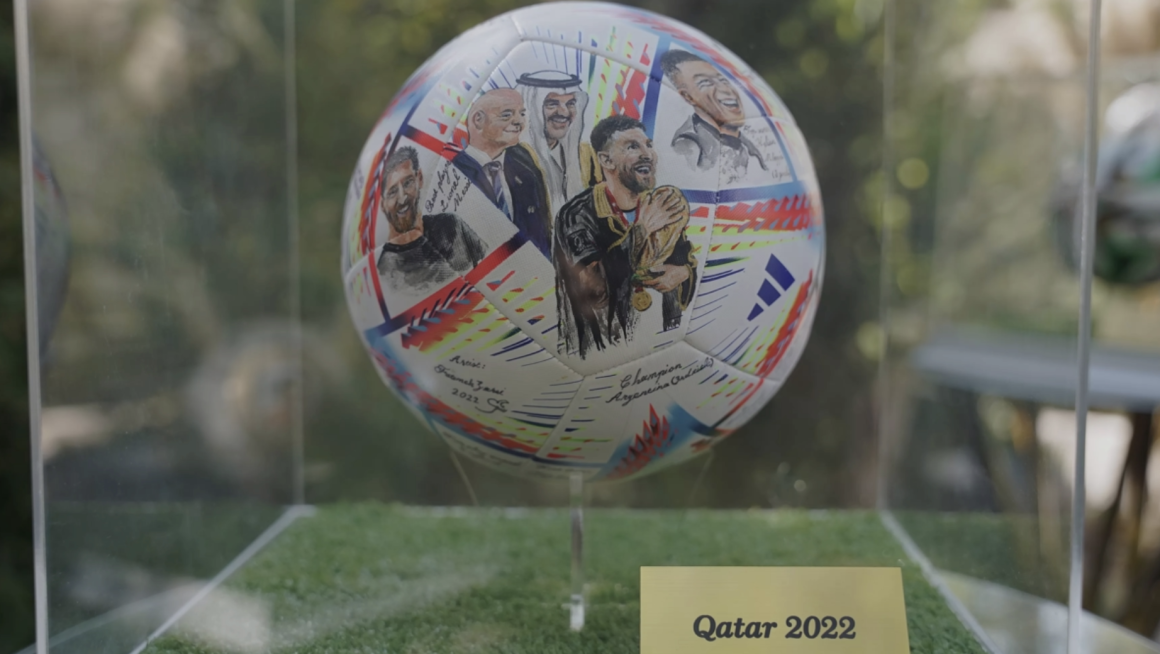
“That wasn’t just a photo,” Zarei recalled. “It was a fusion of tradition, grandeur, and cultural symbolism.”
It is also the only portrait in her World Cup series that features a head of state, an exception made for a moment that was, in many corners of the world, frowned upon. Critics saw it as an intrusion and a politicised flourish at the peak of football’s most universal ritual.
“Beyond being a host or a political leader, [the Amir] embodied the dignity and identity of the first Arab and Muslim nation to host a World Cup,” she said of the choice. “His expression, gestures, and smile all conveyed that historic encounter.”
Painted in Al Rihla, the official ball used in the Qatar edition, that portrait is now a part of a collection, developed with her creative collaborator Amin Mohajer Sheikhi, recognised by the global governing body FIFA and its president, Gianni Infantino.
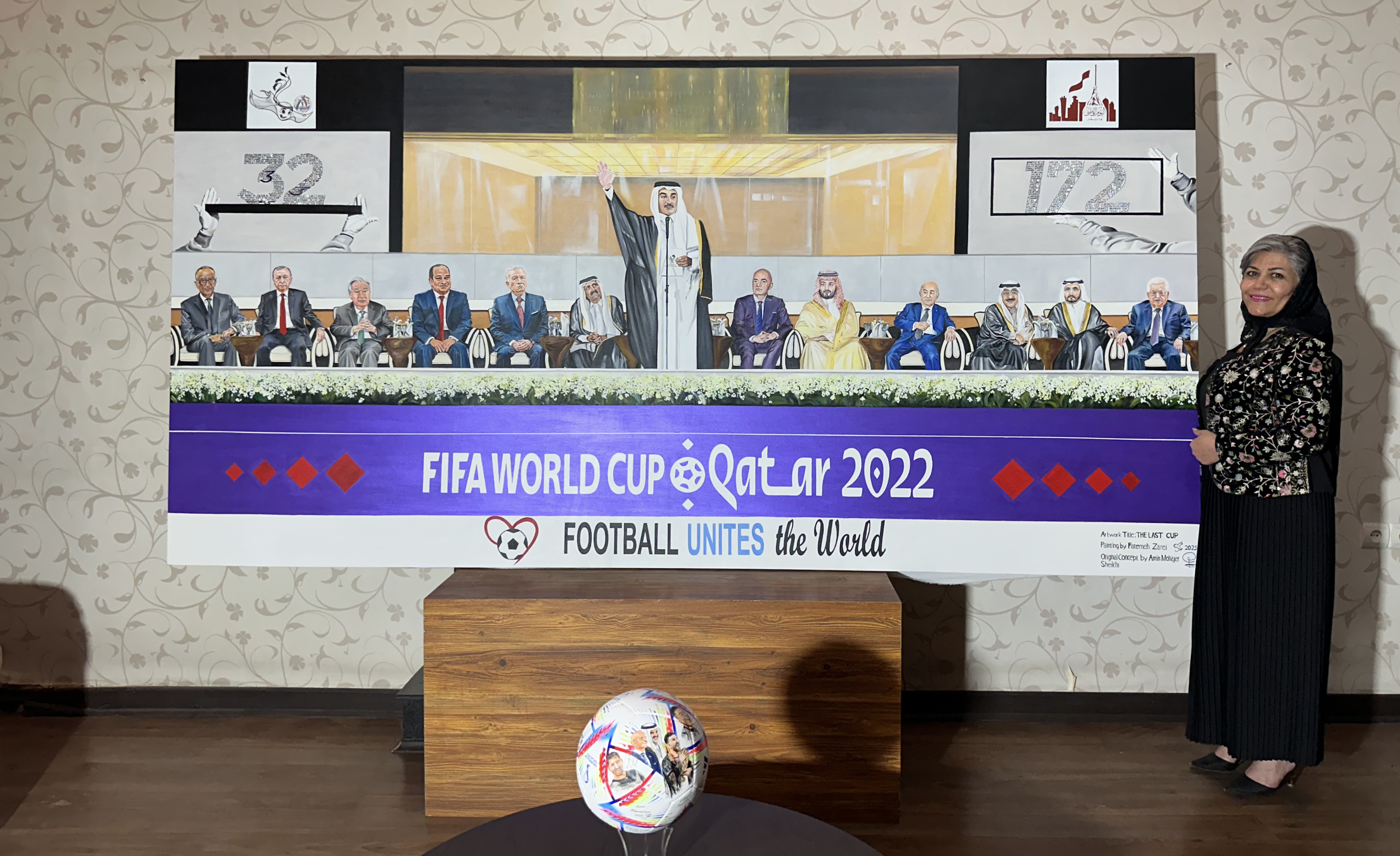
That recognition, she said, became both validation and a spark that pushed her to create something deeper and more symbolic. The Last Cup, her latest work from the Qatar World Cup, was born from that impulse, this time on a canvas.
Unlike the previous one, however, it depicts the opening moments of the World Cup. At the centre stands Qatar’s Amir, surrounded by 12 regional and global leaders, including the man he inherited the throne from: Father Amir Sheikh Hamad bin Khalifa Al Thani.
It is her take on the moment Sheikh Tamim delivered the welcome speech, and she intends to gift the artwork to the Amir and the people of Qatar as a gesture of gratitude for “his role as a mediator during a time of regional tensions.”
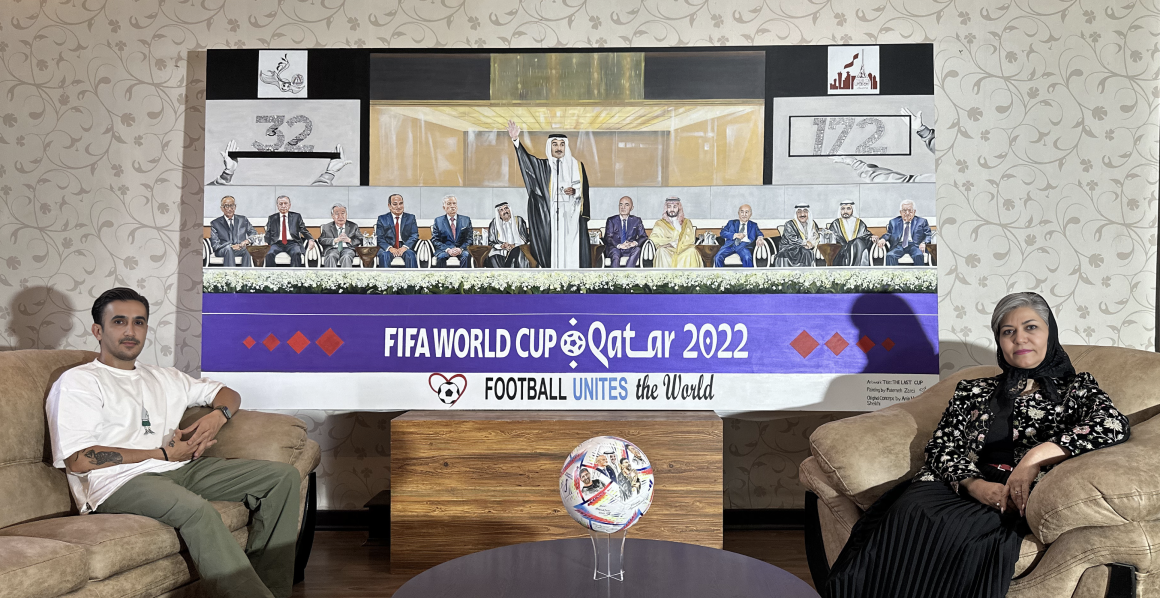
While artistically inspired by Leonardo Da Vinci’s The Last Supper, the message she aims to give is the contrary.
“Da Vinci’s original depicted a moment of betrayal, decision, and destiny,” Zarei said. “In my version, the leaders gather not for judgment or division, but as a symbolic reflection on global responsibility, cultural dialogue, and the pressing need for peace.”
Its title is similarly thought out, too. It is a reference to the last tournament to have 32 participating teams, as well as the first tournament to have been hosted in the region. Other numbers are included in the artwork: 172 for the goals scored and 18 as the day the World Cup finale between Argentina and France was played, which also happens to be Qatar’s National Day.
Although painted in a medium different to her last acclaimed project, the underlying theme remains the same, according to Zarei. As a supporter of the Iranian national team herself, Zarei thinks the sport and the moments she has depicted across her projects serve something more than what meets the eye.
“To me, a football is a metaphor for the Earth itself,” she said. “It is a spinning sphere of emotions, rivalries, and dreams. In the World Cup, this ball rolls across nations, carrying a message of unity.”
Peace and diplomacy are the recurring themes in her work because “the world needs them now more than ever,” according to Zarei.
“It is an invitation to reflect on how peace, play, and creativity can become our shared language even in a world full of differences,” she added.