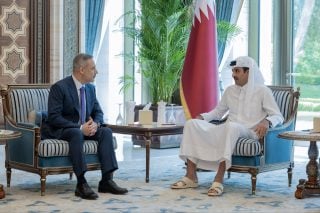
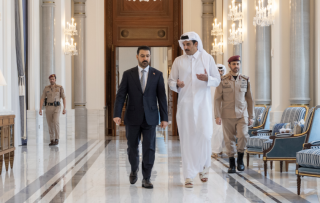
Sheikh Mohammed travelled to Washington, DC, on Friday where he met with U.S. Vice President to discuss the latest developments in the region.
Qatar’s Prime Minister and Minister of Foreign Affairs Sheikh Mohammed bin Abdulrahman Al Thani met on Saturday with U.S. Secretary of State Marco Rubio and U.S. President Donald Trump’s top Middle East envoy Steven Witkoff in Miami.
The officials discussed Doha and Washington’s ties, particularly in defence and energy, in addition to the latest regional developments, according to a statement by Qatar’s Ministry of Foreign Affairs on Sunday.
The officials also discussed the latest developments in Pakistan’s mediation efforts between Iran and the U.S., aimed to de-escalate “in a manner that contributes to enhancing security and stability in the region”.
Sheikh Mohammed also “stressed the importance of all parties responding positively to the ongoing mediation efforts, in order to pave the way for addressing the root causes of the crisis through peaceful means and dialogue”.
Rubio hailed the strength of ties between the U.S. and Qatar.
“Met with Qatari Prime Minister and Foreign Minister [Sheikh Mohammed bin Abdulrahman Al Thani] to discuss U.S. support for Qatar’s defence. Our partnership is important to deterring threats and promoting stability in the Middle East,” Rubio wrote on X.
Sheikh Mohammed travelled to Washington, DC, on Friday where he met with Vice President JD Vance to discuss the latest developments in the region, with both sides voicing their support for Pakistan-led diplomatic efforts.
On Sunday, Sheikh Mohammed and Pakistan’s Prime Minister Shehbaz Sharif held a phone call discussing the latest updates in Islamabad’s mediation efforts.
“The Prime Minister and Minister of Foreign Affairs expressed the State of Qatar’s appreciation for the efforts of the Islamic Republic of Pakistan and all parties that undertook mediation and good offices that contributed to reaching a ceasefire,” Qatar’s foreign ministry said in a statement.
Sheikh Mohammed also spoke with Iran’s Foreign Minister Abbas Araghchi by phone on Sunday, during which he stressed the need for all parties to respond positively to mediation efforts in a way that creates favourable conditions for progress in negotiations.
He also emphasised the freedom of navigation, noting that it is “a firmly established principle that is not subject to compromise and that closing the Strait of Hormuz or using it as a pressure tool would only deepen the crisis and expose the vital interests of the countries in the region to danger”.
The Qatari engagements come amid a fragile truce between the U.S. and Iran, brokered by Pakistan on 8 April for an initial two weeks and was later extended until further notice by Trump on 21 April.
On Friday, a U.S. fighter jet attacked two Iranian-flagged tankers entering an Iranian port on the Gulf of Oman, accusing them of violating the blockade imposed by Washington on 13 April. The move fueled tensions amid diplomatic efforts to reach a comprehensive ceasefire in the war.
The U.S. presented a proposal to Pakistan last week, with Trump saying he believed Iran wanted an agreement.
“They want to make a deal. We’ve had very good talks over the last 24 hours, and it’s very possible that we’ll make a deal,” Trump told reporters in the Oval Office on 6 May.