Last year, Qatar and the U.S. signed a letter of intent over security cooperation during the upcoming World Cup, which will take place in the U.S., Canada and Mexico.
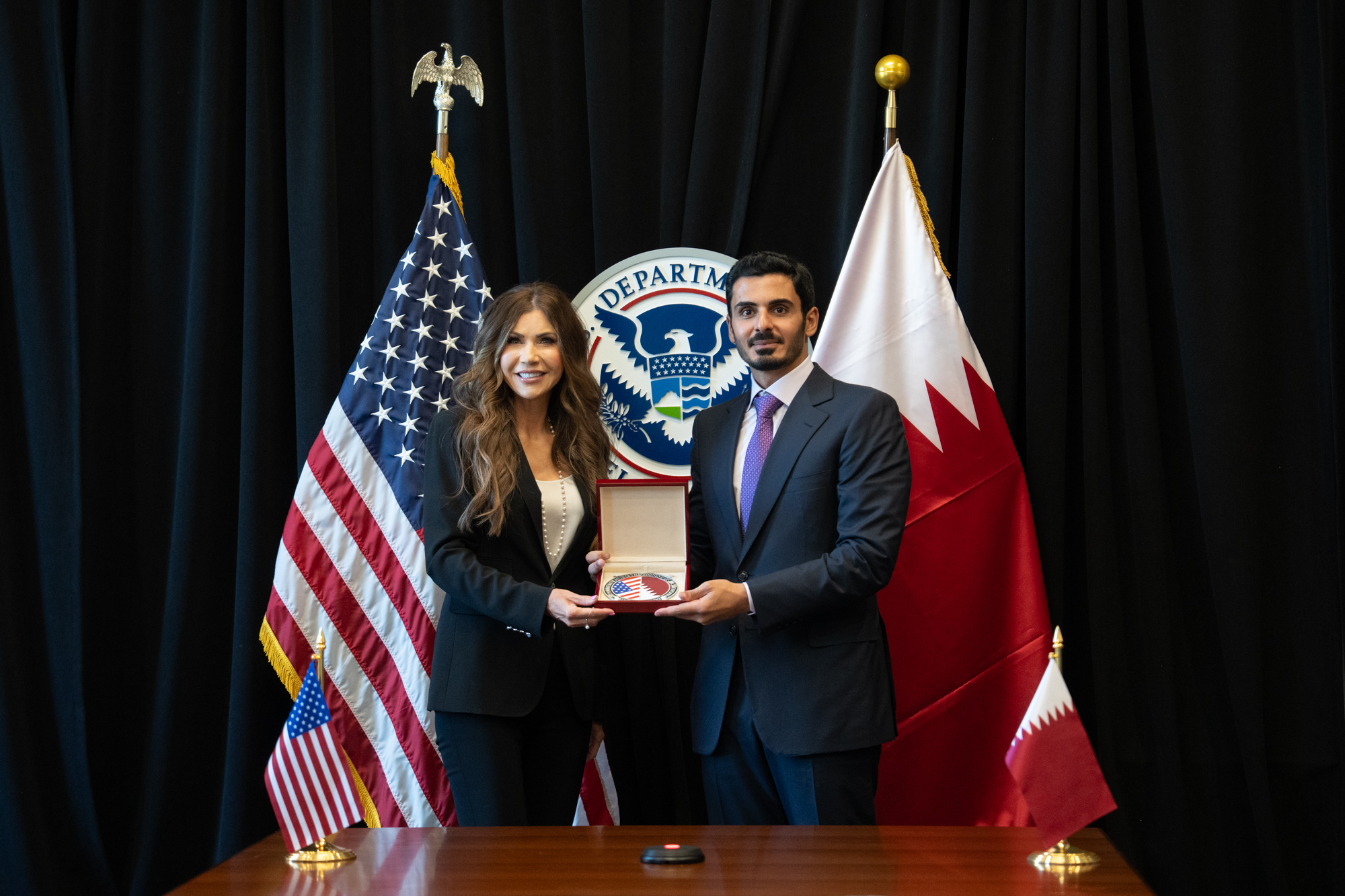
Qatar’s Ministry of Interior (MOI) and the United States Department of Homeland Security (DHS) have signed a memorandum of understanding over enhancing security cooperation in preparation for the FIFA World Cup 2026.
The signing took place on Wednesday during a meeting between Qatar’s Minister of Interior and Commander of the Internal Security Force (Lekhwiya), Sheikh Khalifa bin Hamad Al Thani, and the DHS Secretary, Kristi Noem, in Washington, D.C.
“This agreement underscores the shared commitment of both nations to advancing their strategic partnership and promoting the exchange of expertise in the field of major event security,” Qatar’s MoI said in a statement.
Last year, Qatar and the U.S. signed a letter of intent over security cooperation during the upcoming World Cup, which will take place in the U.S., Canada and Mexico.
Doha and Washington will be exchanging expertise following the former’s success in hosting the 2022 FIFA World Cup, widely described as the best and safest edition of the tournament. Qatar was the first Arab and Muslim country to host the major sporting event.
The U.S. was among Qatar’s international partners that helped secure the event, which included Türkiye, France, the United Kingdom and Italy.
Qatar’s Lekhwiya also contributed to the security organisation of last year’s summer Olympic Games in Paris.
Qatar-U.S. defence cooperation
Doha and Washington share strong security and defence relations that have grown over the past years.
The Gulf state also hosts the Al-Udeid Airbase, the largest American military post in the Middle East. In January 2024, the U.S. agreed to extend its military presence at the base in Qatar for another decade.
In 2022, former U.S. President Joe Biden designated Qatar as a Major Non-NATO Ally (MNNA) as he met with Qatar’s Amir Sheikh Tamim bin Hamad Al Thani in Washington, D.C.
The designation grants Washington’s foreign partners several benefits in areas concerning defence trade and security cooperation.
Meanwhile, in March, the State Department approved the potential sale of MQ-9B Remotely Piloted Aircraft to Qatar at an estimated cost of $1.96bn (QAR 7.16bn), a move that is set to improve the Gulf state’s capability in meeting “current and future threats”.
The U.S. accounts for 48 percent of Qatar’s arms supply, according to the latest Stockholm International Peace Research Institute’s (SIPRI) fact sheet. Between 2020-2024, Qatar’s imports included 42 combat aircraft from the U.S., 31 from the United Kingdom and 16 from France.