The region is set to surpass Asia in production by the end of the year and will continue to expand its capacity, aided by Qatar’s North Field expansion.
Qatar is on track to become the Middle East’s largest gas producer by the end of the next decade, according to a new report by consultancy firm Rystad Energy, with the region set to overtake the rest of Asia in gas output in 2025.
The Gulf nation is expected to surpass Iran, with which it shares the world’s largest non-associated natural gas field, by the “early 2030s” largely due to the ongoing expansions.
“Qatar is poised for significant growth,” Rystad said, “with production projected to rise nearly 50% to 24 Bcfd, driven by the ongoing development of its massive North Field.”
Qatar currently produces 16 billion cubic feet per day (Bcfd) out of the regional total of 70, compared to Iran’s 25 Bcfd and Saudi Arabia’s 8, according to the figures cited by the report.
The overall region, backed by several projects currently underway, will mirror Qatar’s growth trend and is on track to surpass the rest of Asia in production volume, the report added.
By the end of the decade, the Middle East will produce a further 20 Bcfd with a steady annual production increase of around 6%. Half of the added supply will be available for export, Rystad added.
“As more long-term gas contracts are signed and export volumes rise, the Middle East is on track to become a key energy hub for countries seeking stable and dependable sources of natural gas,” said Mrinal Bhardwaj, Senior Analyst at Rystad’s Upstream Research wing.
Qatar currently accounts for 18.8% of the global LNG exports, with about 77.23 metric tons exported in 2024 alone. Its primary markets include the likes of Japan and China in Asia, followed by Europe, which is likely to increase its demand, looking for alternatives following the Russian invasion of Ukraine.
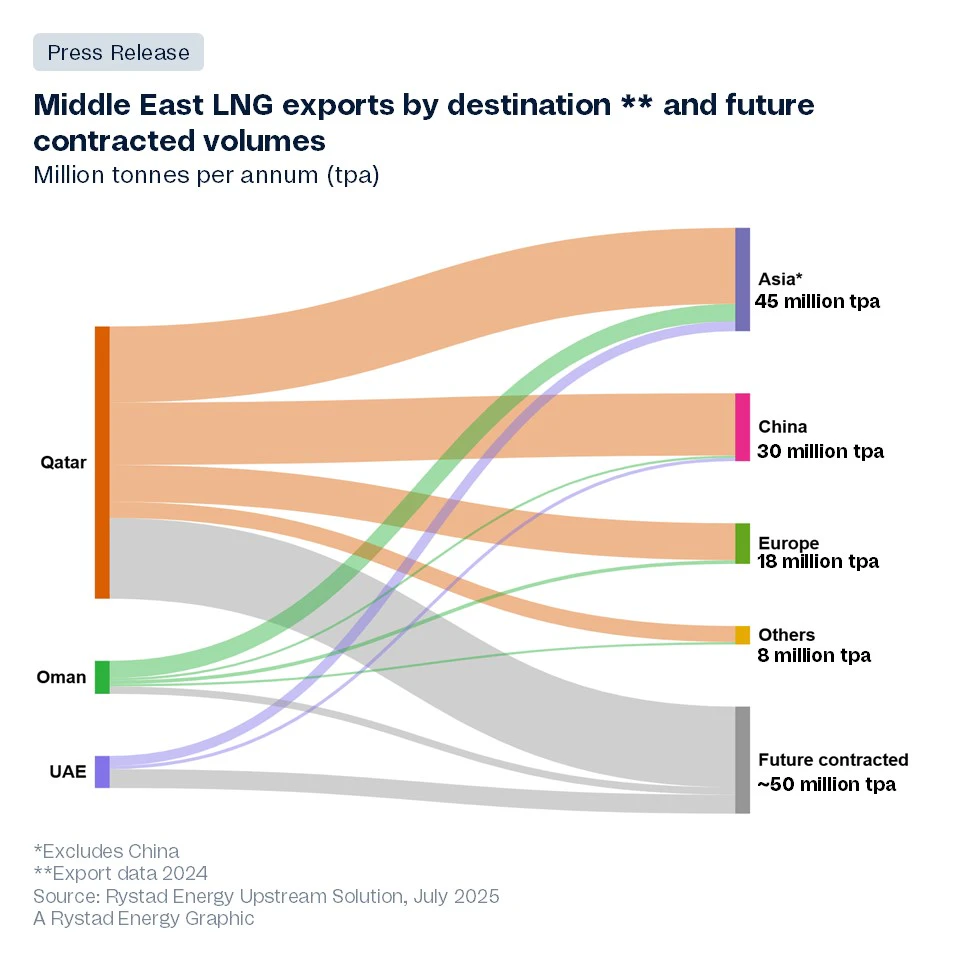
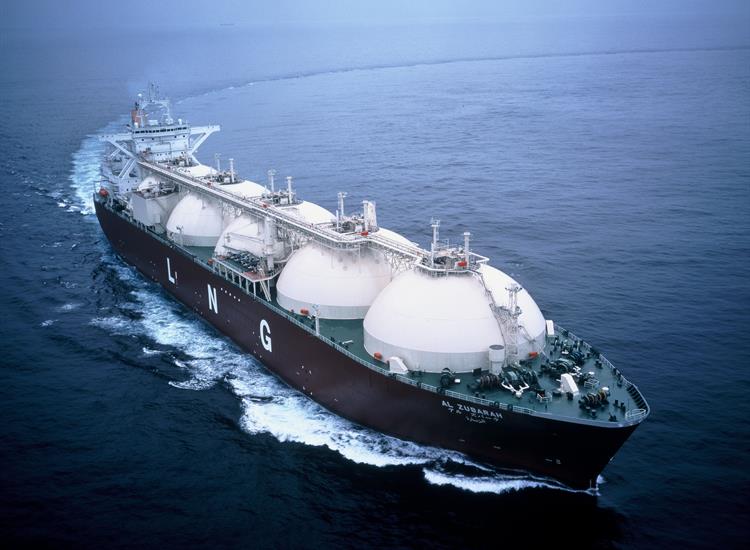
Primarily earmarked for the Asian and European markets, Qatar is “leading” the regional expansion, according to the report.
Out of the region’s 60 metric tons per annum (mtpa) production expected to be added by 2028, 48 will come from Qatar’s North Field.
In February 2024, QatarEnergy announced its ambitious expansion project, the North Field West, aiming to boost local production to 142 mtpa by 2030, an 85% increase in production compared to the current 77 mtpa.
It came after the discovery of a further 240 cubic feet of gas quantities in the North Field, raising the nation’s gas reserves from 1,760 to more than 2,000 trillion cubic feet.
Initially split into two parts, the North Field East (NFE) and the North Field South (NFS) were set to ramp up production from 77 mtpa to 126 mtpa by 2027.
QatarEnergy had also inked eight partnership deals with key energy giants globally throughout 2022-2023 for the project, namely TotalEnergies, Eni, ConocoPhillips, Shell, and ExxonMobil, aiming to provide 40 per cent of all new LNG supplies by the end of the decade.