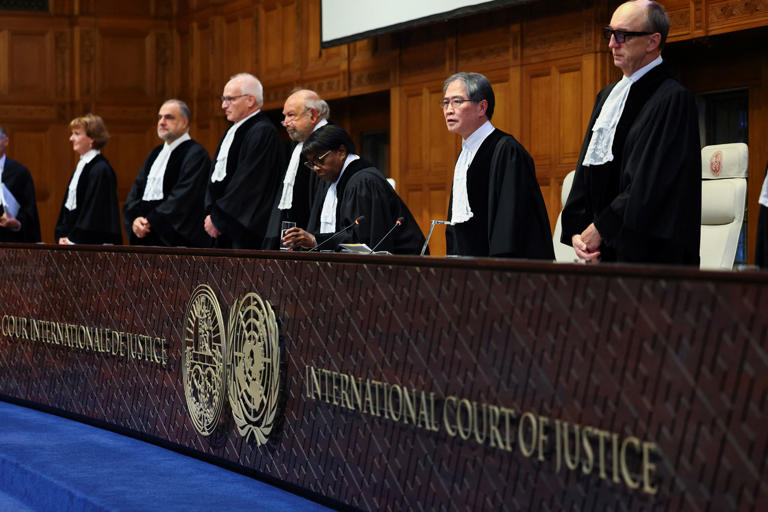
The United Nations top court, the International Court of Justice (ICJ), has said Israel is obligated to ensure the “basic needs” of the population in Gaza are met. In its findings, the ICJ said Israel has failed to provide evidence supporting its claim that a significant number of UNRWA employees were Hamas members.
The International Court of Justice (ICJ), said on Wednesday that Israel, as an occupying power, was under an obligation “to ensure the basic needs of the local population, including the supplies essential for their survival”.
The panel of 11 judges also emphasised that starvation must not be used as a method of warfare under international law.
Commenting on the ruling, Qatar’s Minister of State, Mohammed Al Khulaifi, said that the ICJ opinion confirms that international law fully applies to the occupied Palestinian territory.
“It underscores the duty to enable humanitarian relief — notably UNRWA’s vital operations — and to respect UN immunities, while reaffirming the Palestinian people’s right to self-determination. Justice must now guide action,“ Al Khulaifi said.
The ICJ ruling indicated that Israel is forced to support the relief efforts provided by the United Nations in the bombarded Gaza Strip and its entities, as reported by Al Jazeera.
The ICJ further found that Israel failed to substantiate its claims that UNRWA staff, the United Nations Relief and Works Agency for Palestine Refugees in the Near East, were affiliated with Hamas, rejecting the basis for Israel’s ban on the agency.
The ICJ ruling also noted that Israel has an obligation under the Geneva Convention to agree to and facilitate relief schemes provided by third states and impartial humanitarian organizations, including the UNRWA and the International Committee of the Red Cross (ICRC), to ensure that aid reaches the Gaza Strip.
Over the past two years of genocide, Israel has killed more than 68,000 Palestinians in Gaza. It has also imposed a near-total blockade on humanitarian and medical aid since March 2, allowing limited deliveries to resume on May 19.
The U.S.-brokered ceasefire agreement, which went into effect earlier this month, dictated the entry of 600 trucks of aid into Gaza daily. Despite that, however, Israel continues to block the entry of aid.
World Food Program: “Food supplies can only feed half a million people for only two weeks“
While the delivery of food aid continues in Gaza, the World Food Programme emphasised earlier this week that full humanitarian access through all crossing points is essential to reach everyone in need.
Abeer Etefa, Middle East spokesperson for the UN’s World Food Programme, reported that 530 of the organization’s trucks have entered Gaza since the ceasefire.
“So far, we’ve delivered over 6,700 tons of food, enough to feed nearly half a million people for two weeks. Daily deliveries continue, now averaging around 750 tons,” Etefa said, highlighting that the situation has improved compared to conditions before the ceasefire.
However, she noted that these numbers remain well below the target of 2,000 tons per day. According to Etefa, severe destruction on the ground makes it almost impossible to reach this target unless all crossing points are fully operational.
“People are showing up in large numbers, grateful for the efficient distribution of food assistance and the dignified manner in which rations are provided. This support is particularly vital for the most vulnerable, including women, female-headed households, and the elderly,” she added.
Etefa also explained that recipients often consume part of the food immediately and ration the rest for emergencies, reflecting their uncertainty about how long the ceasefire will last and what may happen next.
The ruling on Wednesday came after the UN General Assembly asked the ICJ in December 2024 to provide an advisory opinion on Israel’s responsibilities regarding the presence and activities of the UN, other international organizations, and third-party states in the occupied Palestinian territories.
Hearings for the case took place between April 28 to May 2, 2025.
While ICJ advisory opinions carry significant legal and political influence, they are not legally binding, and the court does not have the authority to enforce them.