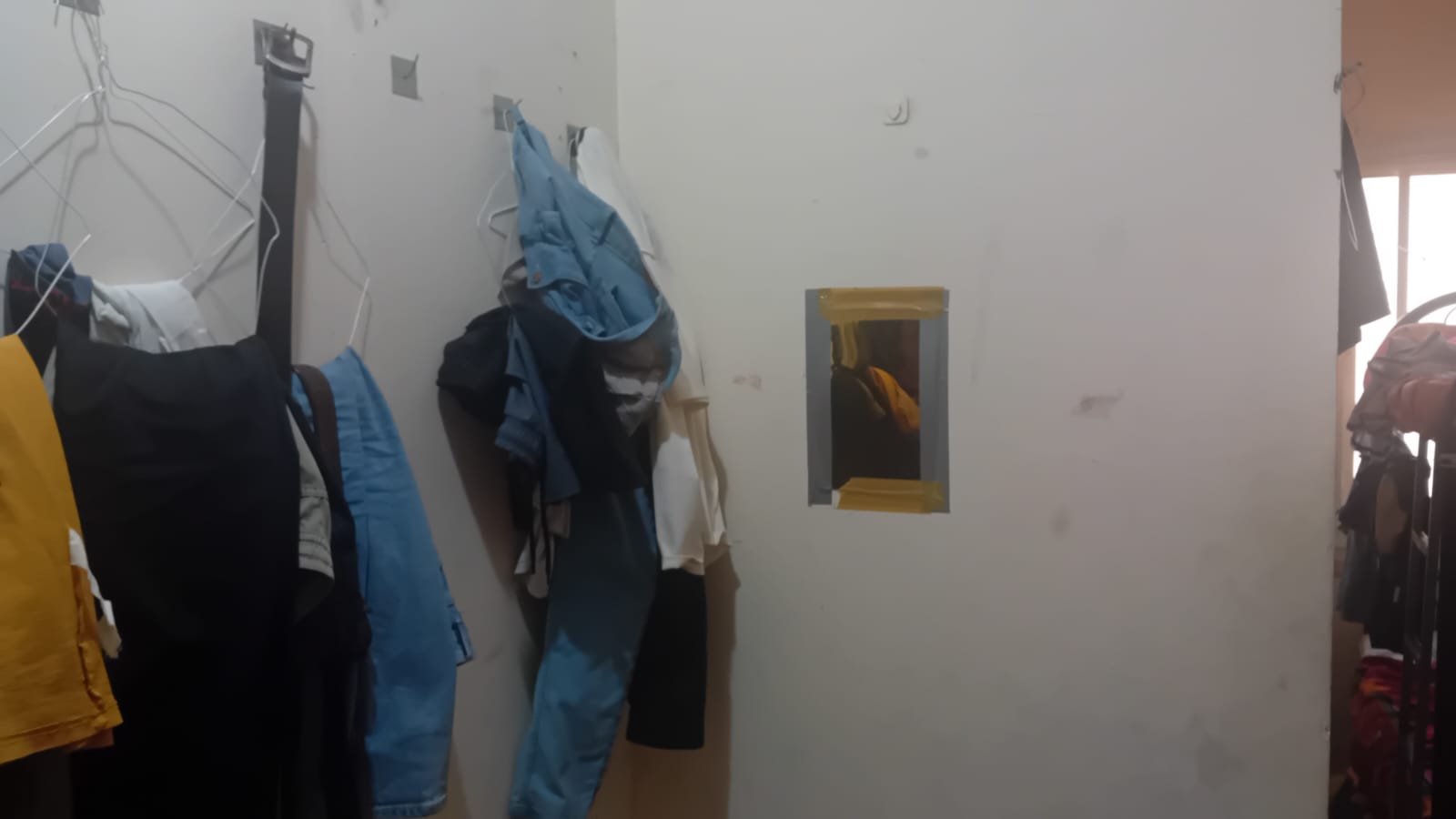
Illegal partitioning refers to the unauthorised division of apartments through unpermitted construction to house additional tenants. This dangerous practice not only violates building codes but also puts lives at risk.
Omar, who is using a pseudonym, has lived in Doha for two years, sharing a room in a building that has been subdivided with partitions.
“We live together, 12 people, and our room is too small. Our room is separated [by] partitions, two people on one [bunk] bed, and six beds in our room,” Omar says.
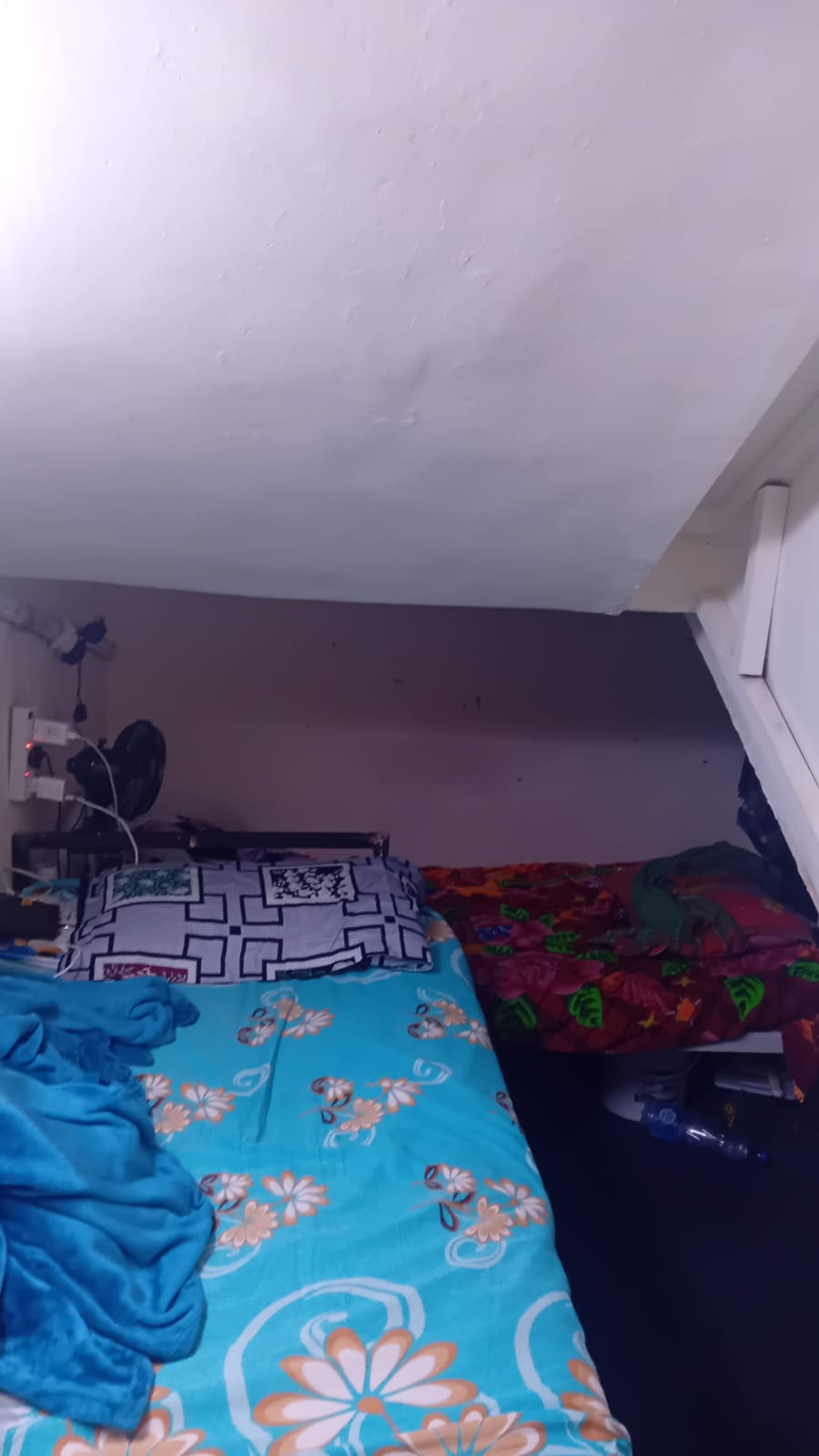
He works as a hotel waiter in Doha, earning QAR 2,200 a month. To save on costs, he pays QAR 300 for a small corner in a shared room, an arrangement he describes as “the only thing within my reach”.
“My room rent is 300 QAR, but it’s too much for me. I want to live here in Qatar, without anyone, to live alone. Because you know, now I live with 12 people…”
Afsal, also using a pseudonym, arrived from Bangladesh just a few months ago. He shares a studio with seven others, paying 350 QAR for his portion.
“Our room is very small. Though eight people [live here] together, rent is still high for me. Sharing [a] room with others is very difficult,” he tells Doha News.
With little space to himself, Afsal says that it’s very challenging to arrange his belongings.
“I pack my things in my bag. There is no place to store them.”
But the way Omar and Afsal live, inside partitioned rooms carved out of residential villas and buildings, is not permitted under Qatari law.
Many workers turn to such arrangements because rents far exceed their salaries. But the law is unambiguous: partitioned housing is illegal.
What is illegal partitioning?
Illegal partitioning refers to the unauthorised division of apartments through unpermitted construction to house additional tenants.
So how does it happen?
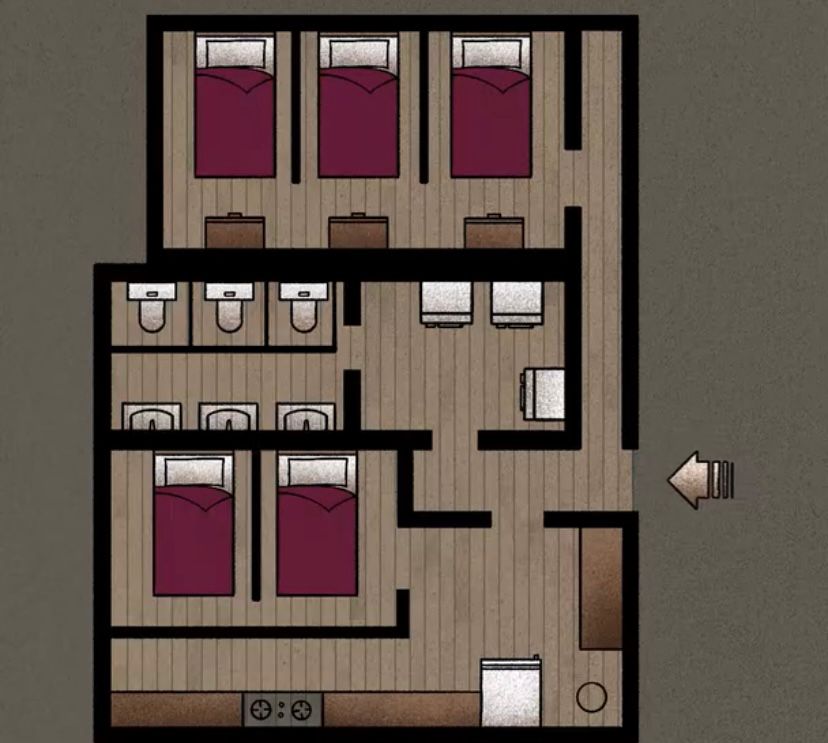
According to data shared with Doha News by the Ministry of Municipality, partitions are often erected inside the apartments or villas without permits or proper engineering oversight. Officials say they have observed numerous similar violations across the city.
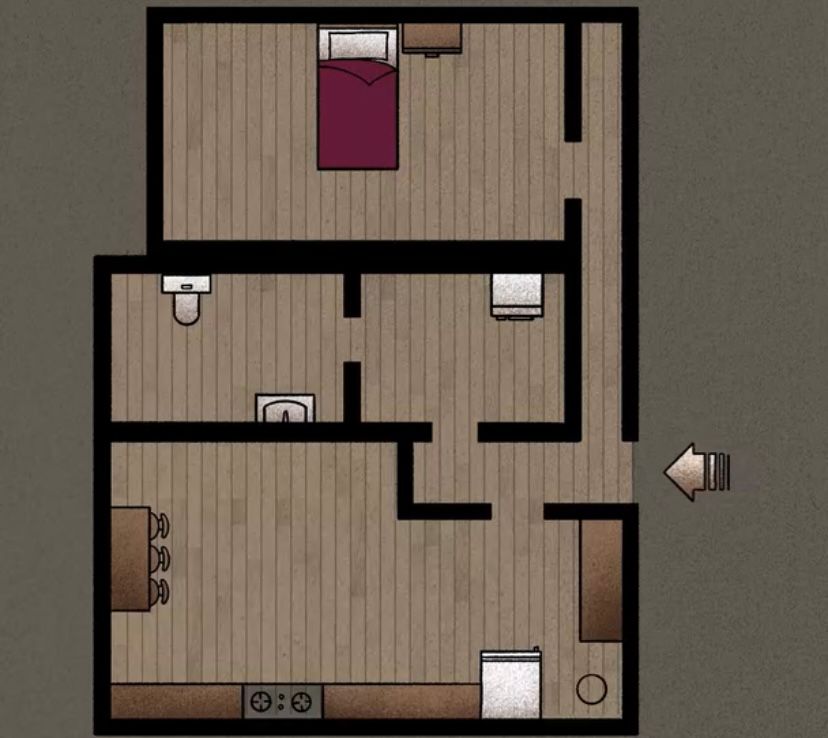
“Modifying internal plans by removing or adding load-bearing walls, executing unplanned structural additions, such as building extra rooms or modifying internal structures without engineering supervision, which poses risks to life and property,” officials from the ministry warn.
In some cases, residential homes are converted into workplaces or labour accommodations. Extra rooms are often carved out by altering structures without supervision.
Data from the Ministry of Municipality shows that illegal room partitions and building modifications were detected in 12 areas across the city, including Thumama, North and South Khalifa City, Fereej Kulaib, Umm Lekhba, Naija, Hazm Al Markhiya, Old Airport, and Fereej Abdul Aziz.
Between January 2025 and October 2025, authorities issued 121 violation reports. Of these, 41 have been resolved, while 80 remain under follow-up, according to the municipality.
What does the law say about Illegal partitions in Qatar?
The Ministry of Municipality told Doha News that the violations fall under two key regulations: Law No. 4 of 1985 on building regulations and Law No. 15 of 2010, which prohibits worker accommodations within family residential areas.
Article 1 of Law 4 of 1985 stipulates that no structural alteration may be carried out without a permit from the competent municipality. Engineers, contractors, and workers are barred from beginning such work unless the property owner has first secured the required permit.
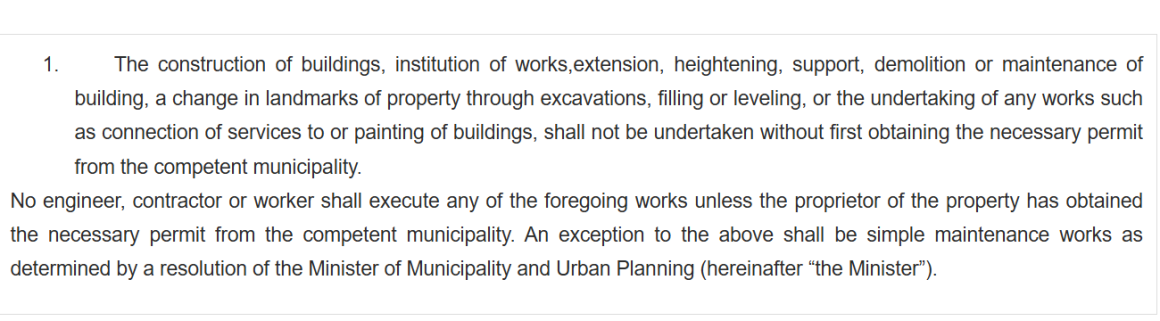
Article 12 of the same law stipulates that any modifications must adhere to previously approved plans and specifications. No changes to approved drawings are permitted without prior authorisation from the municipality.
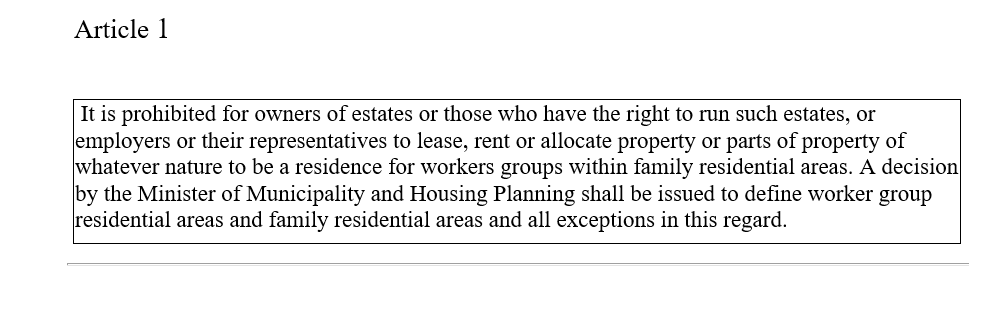
Beyond unauthorised modifications inside the property, Law No. 15 of 2010 prohibits worker accommodations in family residential areas.
Property owners are barred from renting out homes in these neighborhoods for worker housing.
Under Article 2 of the law, if workers are found occupying a property in a family residential area, the municipality must issue a written warning and grant 30 days for the premises to be vacated.
If workers do not vacate within that period, the municipality can enforce evacuation, as the law states:
“The offender or offenders are required to ensure that the building is vacated by such workers within 30 days of the date of receipt of the written warning.”
Violations carry heavy penalties, including fines of no less than QAR 50,000 and no more than QAR 100,000, or imprisonment for up to six months.
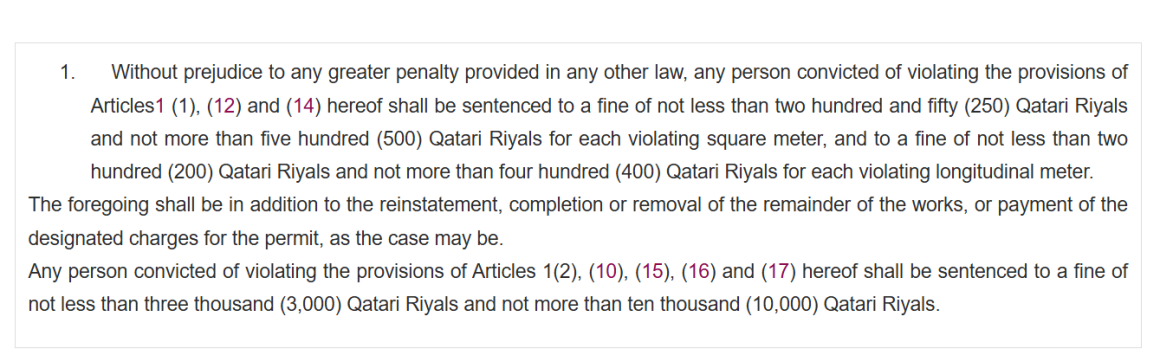
Under Article 19 of Law No. 4 of 1985, fines for illegal constructions range between QAR 250 and QAR 500 per square meter, while unauthorised extensions are penalised at QAR 200 to QAR 400 per linear meter.
For other serious violations, fines range from QAR 3,000 to QAR 10,000.
Even without illegal partitions, housing more people than a property was designed to hold violates regulations and exceeds its intended capacity.
According to Decree No. 17 of 2005, which sets conditions for appropriate employee housing, no more than four workers may be accommodated per room in residential units outside urban areas. In temporary residences, the limit is eight workers per room, with a minimum of 4 square meters of floor space required per person.

Landlords and tenants: Shared responsibility
Article 1 of Law No. 15 of 2010 clearly outlines the responsibility of “owners or those who have the right to run such states, or employers or their representatives to lease, rent or allocate property” to rent their properties according to the law.
In pursuit of higher profits, some landlords disregard housing regulations, renting out units without proper oversight or adherence to standards, explains Faisal, a landlord who requested that their last name be omitted.
“However, there are legal procedures in the municipality to which the property belongs, and it’s possible that all tenants could be evicted or the property owner could be fined,” he says.
Faisal adds that in some cases, agencies or individuals responsible for leasing properties fail to share full details of the rentals, either because they are too busy or neglect to properly inspect and monitor the properties.
“Of course, sometimes the landlord only cares about receiving the rent and doesn’t check or inspect the property from time to time,” he says. “If the landlord finds out [about a violation], he has the right to file a complaint, which could lead to the tenant’s eviction and make the tenant responsible for all expenses.”
Faisal notes, however, that he has never faced such issues himself, as he personally follows up on his properties and maintains direct communication with his tenants.
The hidden danger of partitioned housing: “It can lead to partial or total collapse”
The Ministry explained that dividing villas and residential units without permission, proper planning, or oversight can create serious safety and planning risks.
According to the Ministry, the most serious consequences of illegally subdividing housing and accommodating excess tenants include “increasing live loads on buildings, which may lead to partial or total collapse, overloading electricity and sewage networks, increasing the likelihood of fires while reducing the efficiency of evacuation routes and fire-fighting systems in emergencies”.
Other impacts include overcrowding, added strain on public services, distortion of the city’s urban landscape, and tenants losing their rights in the absence of documented contracts.
The Ministry of Municipality is carrying out an ongoing campaign targeting illegal modifications in residential buildings to ensure safety, protect residents, and preserve Doha’s urban character.
In a statement to Doha News, the Ministry said that its goal is “to maintain the structural and regulatory safety of buildings, preserve the city’s urban and aesthetic identity, and ensure a safe and healthy residential environment for residents”.
Before taking enforcement action, the Ministry follows a systematic process that begins with monitoring reports and complaints. Field teams, including engineers specialised in construction and safety, then conduct surveys to identify buildings in violation.
According to the Ministry, these campaigns are intended not only to address breaches of the law but also to protect tenants.
The goal is to strengthen the safety of residential structures, reduce the risks of overcrowding, and ensure that all rental agreements are properly documented to preserve tenant rights.
Finding balance between rules and reality
While the law is clear, the reality remains difficult for some workers with limited housing options. For Omar, paying extra for a small apartment is simply out of reach.
Officials continue to emphasise that Qatar’s housing regulations are designed to protect residents, maintain safety, and ensure proper urban planning as the country grows rapidly.
For workers like Omar and Afsal, however, the hope is that affordable and safe housing alternatives will expand in step with the city’s development.