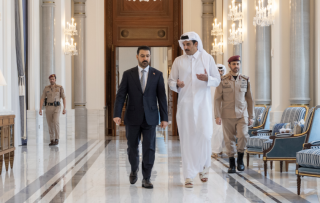
The Doha summit marks the first time the United Nations have convened outside of New York or Geneva.
Global leaders opened the Second World Summit for Social Development in Doha on Tuesday with the adoption of the Doha Political Declaration, a renewed pledge to confront poverty, inequality, and social exclusion amid mounting geopolitical and economic challenges.
The gathering, the largest of its kind in three decades, brings together more than 14,000 participants, including over 40 Heads of State and Government, 170 ministers, and representatives from civil society, youth organizations, and international institutions.
The Summit aims to advance a people-centered approach to development, emphasizing that social justice and equality are essential for peace and sustainable growth.
In his keynote address, UN Secretary-General António Guterres warned that global inequalities and divisions are widening, threatening hard-won progress since the first World Summit for Social Development in 1995.
“True development isn’t about prosperity for the few,” Guterres said. “It’s about opportunities for the many, grounded in social justice, full employment, and human dignity.”
Describing the Doha Political Declaration as a “booster shot for development” and “a people’s plan,” Guterres outlined four immediate priorities: accelerating action to end poverty, expanding decent work, unlocking finance for developing countries, and ensuring that no one is left behind, particularly vulnerable and marginalized groups.
The new Declaration builds on the 1995 Copenhagen Declaration, updating its principles to address modern challenges such as climate change, technological disruption, and demographic shifts.
It calls for universal social protection, gender-responsive policies, and equitable access to health and education, while urging governments to counter misinformation and hate speech that threaten social cohesion.
The Summit also unveiled the Doha Solutions Platform for Social Development, a new initiative designed to translate commitments into practical results.
Nearly 150 government and stakeholder submissions were received ahead of the Summit, showcasing innovative approaches to tackling poverty, employment, and social inclusion. Selected initiatives will be featured throughout the week in a dedicated “Solutions Studio.”
“The world doesn’t need more promises, it needs action that changes lives,” said President of the 80th Session of the UN General Assembly Annalena Baerbock.
“The Doha Solutions Platform is about turning commitments into concrete solutions and renewing hope by proving that social development is one of the smartest investments we can make.”
While global poverty rates have fallen sharply since 1995, with 1.5 billion people lifted out of extreme poverty and working poverty reduced from 27.9 percent in 2000 to 6.9 percent in 2024, officials cautioned that progress remains uneven.
As of 2023, 808 million people still live in extreme poverty, 1.1 billion experience multiple deprivations, and the gender pay gap persists, with women earning on average 78 percent of men’s wages.
“Social justice, decent work, and equal opportunities are indispensable for sustainable development,” said Li Junhua, UN Under-Secretary-General for Economic and Social Affairs and Secretary-General of the Summit.
“The Doha Political Declaration reaffirms that economic, social, and environmental progress must go hand in hand.”