About 93 percent of Qatar’s and 96 percent of the United Arab Emirates’ LNG exports transit through the Strait, representing 19 percent of global LNG trade.
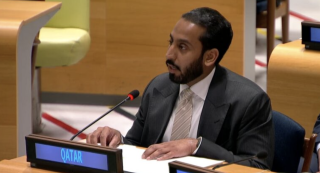
Qatar’s Deputy Prime Minister and Minister of State for Defence Affairs, Sheikh Saoud bin Abdulrahman Al Thani, has said that a temporary toll for passage through the Strait of Hormuz is negotiable while maintaining Doha’s opposition of a permanent one.
“About charging legal revenue, I think Qatar and also the partners in the Gulf stated very clearly that charging fees will always impact the consumer, so we are against this,” Sheikh Saoud told the Shangri-La Dialogue in Singapore on Saturday.
“But for certain times that they say they will use it for mine-clearing or some usage of the fees for a temporary time, this is something negotiable,” he added.
The Qatari official noted that a temporary toll “could be something that will help the transit of the Strait of Hormuz” to return to its normal stage.
“But I reiterate here that this should not be a legal fee that will impact even to other straits that will follow the same example and this again will bring us to a disorder of the maritime solution,” he explained.
Sheikh Saoud’s remarks were in response to a question over talks between Iran and Oman to impose a permanent toll system over maritime traffic through the Strait of Hormuz.
Iran closed the Strait of Hormuz since the beginning of the U.S.-Israel war on its territory on 28 February, impacting global shipping especially of oil and gas. The strategic waterway handles roughly 20 percent of the world’s oil and liquefied natural gas (LNG) trade.
About 93 percent of Qatar’s and 96 percent of the United Arab Emirates’ LNG exports transit through the Strait, representing 19 percent of global LNG trade, according to the International Energy Agency (IEA).
Qatar’s Minister of State for Energy Affairs Saad Al-Kaabi told Energy Intelligence in May that Qatar had 10 full LNG tankers in the Strait due to its closure.
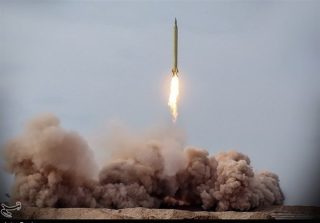
Apart from the Strait of Hormuz, the war has also extended to the Gulf region as Iran carried out attacks on its neighbours under claims of targeting U.S. interests. However, Iran’s targets included vital energy facilities including the Ras Laffan Industrial City in Qatar.
Iran carried out the first such attack on 2 March, prompting QatarEnergy to cease LNG production and then declare force majeure to its affected buyers on 4 March.
Iran carried out major attacks on 18 March on the site, knocking nearly 17 percent of Qatar’s export capacity offline while causing an estimated $20bn in lost annual revenue, as per figures Al-Kaabi had given it to Reuters following the attack.
At the time of the attack, Qatar also delivered a note to Iran’s embassy considering the military attache and the security attache at the embassy, in addition to the staff of the two attache offices “persona non grata”.
Qatar has repeatedly called for dialogue in order to reach a comprehensive solution to the U.S.-Israel war on Iran.
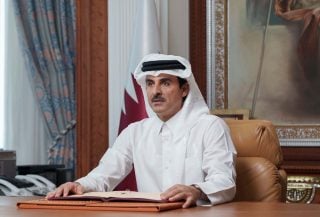
On 26 May, Qatar’s Amir Sheikh Tamim bin Hamad Al Thani held a phone call with Iran’s President Masoud Pezeshkian where they reviewed regional developments and de-escalation efforts.
“The Amir reaffirmed the State of Qatar’s firm position in favor of political and diplomatic solutions and stressed the need for all parties to exercise the utmost responsibility and prudence to spare the region the repercussions of further escalation,” a readout of the call by the Amiri Diwan said.
During his panel discussion, Sheikh Saoud echoed Qatar’s position in a peaceful solution to the current crisis.
“We want to set up a clear strategy and a clear approach with Iran in order to have a strategy for all the relationships that we have with Iran, including the trading strategy and also the political strategy,” Sheikh Saoud said.