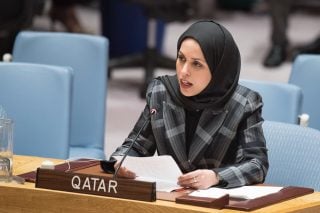
The Gulf state is currently ramping up its LNG production with its multi-billion-dollar North Field Expansion project, the largest of its kind.
Qatar’s Minister of State for Energy Affairs, Saad Al-Kaabi, headed the 27th ministerial meeting of the Gas Exporting Countries Forum (GECF) in Doha on Thursday, convening key energy ministers from member states to discuss the latest market trends and challenges.
In his opening remarks at the Sheraton Hotel, Al-Kaabi reaffirmed Qatar’s commitment to cooperating with GECF members in the pursuit of promoting “natural gas as a primary vehicle to achieve access to cleaner energy”.
He also placed great emphasis on the need to oppose “trade barriers and discriminatory measures that disadvantage energy products, especially natural gas”.
The Qatari energy minister’s remarks came a day after Qatar and the United States submitted a joint letter to the European Union, urging the bloc to reconsider its sustainability directive.
The letter voiced the two countries’ concerns over the Corporate Sustainability Due Diligence Directive (CSDDD), which included its “existential threat to the future growth, competitiveness, and resilience of the EU’s industrial economy”.
Qatar, the U.S., and Australia stand among the leading gas-exporting countries globally.
Qatar has played a critical role in the energy sector, especially following Russia’s invasion of Ukraine in 2022. The Gulf state has been supplying between 12 percent and 14 percent of Europe’s liquefied natural gas (LNG) since the beginning of the conflict as European countries sought alternatives to Russian gas, according to trade intelligence site Kpler.
The Gulf state is currently ramping up its LNG production with its multi-billion-dollar North Field Expansion project, the largest of its kind. The initial North Field East and the North Field South phases are set to increase LNG production from 77 mtpa (million tonnes per annum) to 126 mtpa by 2026.
Additionally, the North Field West project, which was unveiled in February 2024, will raise production to 142 mtpa by 2030, boosting output by 85 percent and strengthening Qatar’s economy.
Al-Kaabi noted that the outlook for natural gas, “and particularly LNG, is positive”.
“It is driven by economic growth in Asia, a growing desire for cleaner and more economic sources of energy, and booming power demand from data centers and artificial intelligence,” he explained.