At the edge of Qatar’s sporting spotlight, its national cricket team is quietly pushing for a place on the world stage.
The scorers sat near the dugout, their eyes flitting between the pitch and the ruled paper. Every ball bowled, every run taken, every dismissal was scribbled down by hand, then updated on the traditional flip scoreboard next to them.
Ankit Kumar Singh was one of them, in the fourth T-20 in the five-match series between Qatar and Saudi Arabia. When Singh arrived in Qatar a little over a year ago, it was not to score. Back home in Nepal, he had been scoring cricket matches since 2016.
It was only after a few months in Qatar that the Qatar Cricket Association came calling and he knew he had to find a way to make time beyond his day’s work. It was one of those days.
“It takes extreme focus,” Singh told Doha News, explaining how each ball must be tracked not just for runs, but for extras, strike rotations, and over counts. T-20 cricket requires repeating that process at least 240 times.
There was something about the meticulous, patient, mostly unnoticed job of the scorers that mirrored the state of Qatari cricket itself: present, persistent, and still carving its place in the larger order of things.

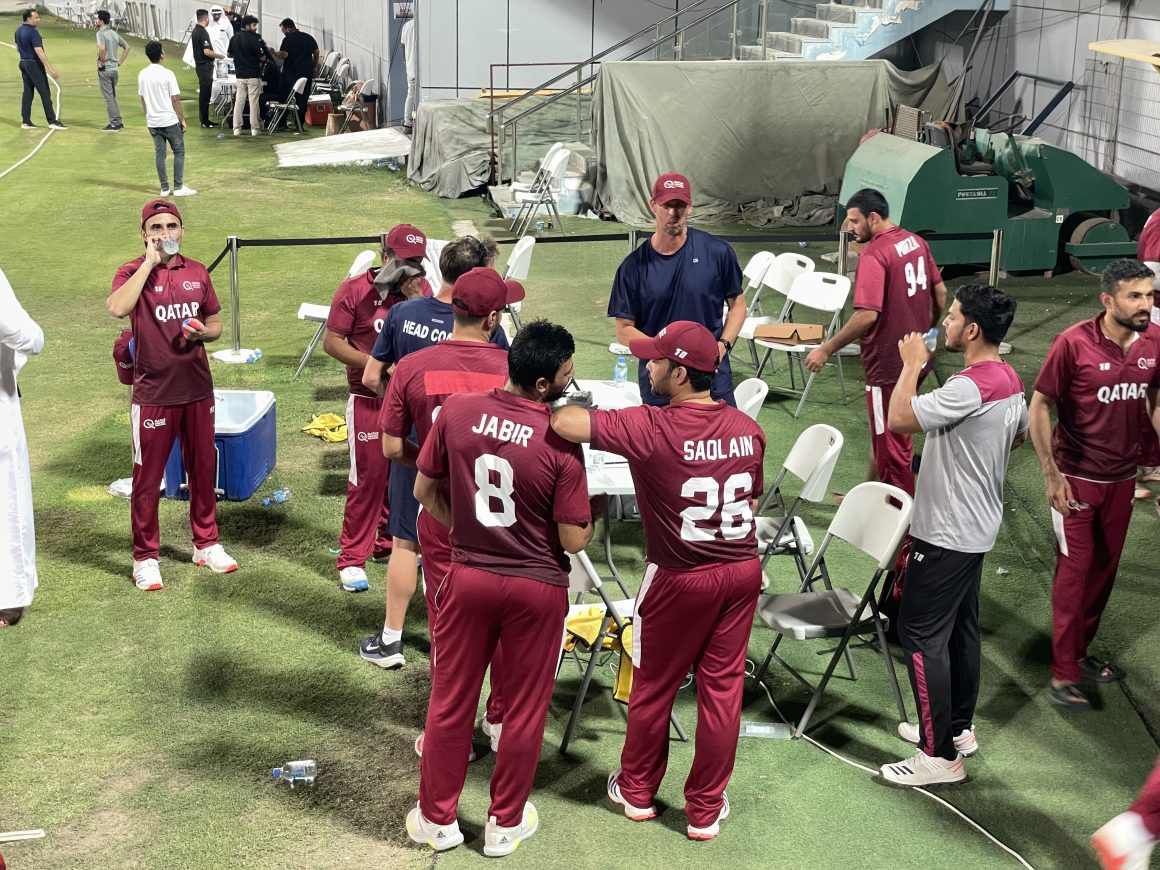
For today, Qatar’s effort to go big entailed posting a defendable total. A win today would seal the series victory over their neighbours, Saudi Arabia, another country nascent in the game. As sun began to set in the near-empty West End Park International Cricket Stadium, wedged between a mall and a motorway, the game got going.
Batting first, Qatar posted 177 on the board, a score built on captain Mirza Mohammed Baig’s 60 runs off 31 balls and Shahzaib Jamil’s late-innings cameo of 29 off 10 balls.
The floodlights were on by the time they set out to defend the total and they did not have to wait long to celebrate. A 32-run win sealed the series as the Saudis were bowled out for 145. Although the Saudis managed to win the last match in super over, it was a 3-2 series win for the Maroons.
As the men in Maroon exchanged handshakes, typical of a cricket match, a few members also remembered to thank those who had come to support them. It was a common practice, a person in the crowd said, familiar with the players.

It was a gesture that spoke volumes, as for all of cricket’s popularity in Qatar’s migrant communities, it still lives on the margins of the country’s sporting psyche. Contrary to the international footballing events that Qatar has held, where stadiums are usually louder, glossier, and packed, cricket is yet to have that privilege.
Its crowds are sporadic, the domestic league is still developing, and international matches are rarely noticed beyond a tight circle of diehards and those close to the players. More people play cricket in Qatar’s streets and sandy pitches than ever show up to watch it from the stands.
But things are changing, according to an official, who spoke to Doha News after the match. Having been around for years, the country’s cricketing body is now making deliberate moves toward professionalising the sport.
One such move included appointing English head coach Toby Bailey, who had filled several important positions in Scotland’s cricketing body before he arrived in Doha.
The former Northamptonshire wicketkeeper also oversaw the development of men’s and women’s cricket in Scotland. Both sides qualified for their respective ICC T-20 World Cups in 2024, with Bailey as the head of Performance.
The players, many of whom still maintain other jobs, are soon to be enrolled in a system that trains, contracts, and competes. The majority of them come from Pakistan, who came to work like Singh, the scorer, and stayed for the opportunity. Unlike football, it is not a practice scoffed at in cricket, with emerging nations frequently resorting to that option.
Some ground has already been broken on the international stage, however. That includes qualifying for the Asia-EAP Regional Final, set to be held in October, which will see Qatar compete for a spot in next year’s T-20 World Cup in India and Sri Lanka. With regional heavyweights such as the UAE, Nepal, Oman, and Papua New Guinea in contention, the World Cup is still a tough nut to crack, more so due to the limitations. The road is still long.
But there is a romance to this phase of Qatari cricket. It exists in the quiet, in the way the crowd is largely made up of familiar friends, in the gratitude when someone shows up to watch and in the scorers who jot every ball down even when no one is looking. There’s no fireworks here yet, but just ambition to grow.
As the victory celebrations ended, the stands stood empty. The players were preparing to leave. Instead of interviews and loud send-offs, there were handshakes, packed kits and the quiet rhythm of a team and a sport moving ahead.