Qatar reaffirmed its support for Pakistan-led mediation between the United States and Iran, while highlighting progress on Gaza talks and warning against continued Israeli attacks on Lebanon.
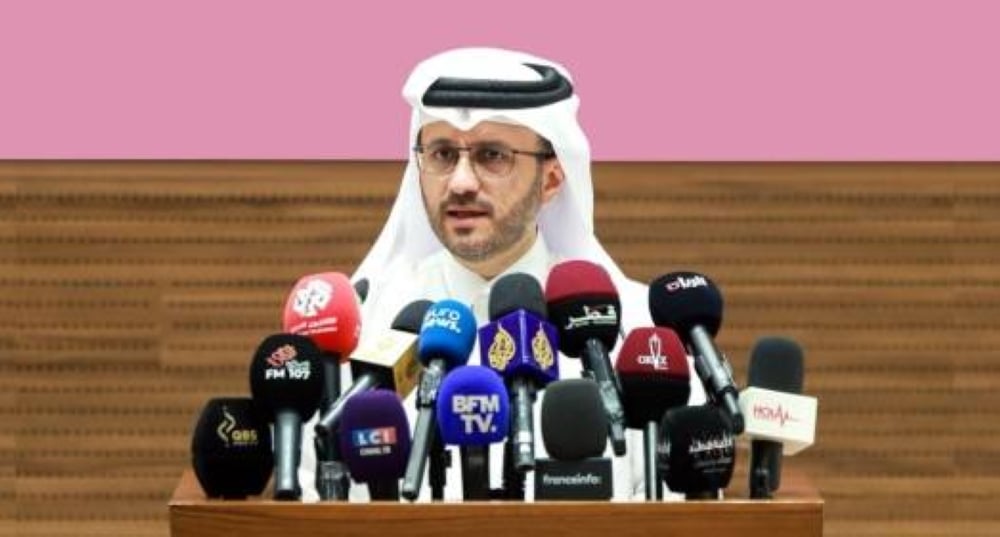
Qatar continues to support Pakistan-led mediation efforts between the United States and Iran and remains in contact with all parties to help secure the implementation of the recently agreed memorandum of understanding, Advisor to the Prime Minister and Official Spokesperson for the Ministry of Foreign Affairs Majed bin Mohammed Al-Ansari said on Tuesday.
Speaking during the ministry’s weekly media briefing, Al-Ansari stressed that Qatar was not conducting a separate mediation initiative and that Pakistan had remained the principal mediator between Washington and Tehran.
“Contacts between the parties are still ongoing, and Qatar continues, within the framework of its support for the Pakistani mediation, to communicate with the various parties in order to ensure the agreement reaches a successful outcome,” he said.
Al-Ansari added that no meetings involving the concerned parties or any other parties were currently taking place in Doha.
Addressing reports about the economic dimension of the agreement, Al-Ansari said discussions extended beyond reconstruction and included future investment opportunities following the conflict.
“We cannot comment on the details of the economic track, but any effort of this kind must be an international effort rather than a bilateral one,” he said. “It should come within the framework of full international coordination so that economic development in the region becomes a shared responsibility.”
He also rejected reports that Qatar had contributed funds as part of the arrangement.
“No Qatari money has been paid in this context. What is taking place is international coordination to address the consequences of this crisis,” he said.
Al-Ansari further denied media reports claiming that Qatar and Iran had reached an agreement on electricity interconnection.
“There is no agreement in this regard between the State of Qatar and the Islamic Republic of Iran,” he said, while acknowledging that the recent crisis had affected regional economies and energy security.
Reiterating Doha’s position, Al-Ansari said Qatar fully supported Pakistan’s role as the lead mediator between the United States and Iran.
“Qatar is supporting the mediation led by Pakistan, and there is no independent Qatari mediation in this file,” he said.
He described the negotiations as a complex process that had passed through difficult stages before reaching an agreement, praising Pakistan and the international teams involved for their efforts.
On Gaza, Al-Ansari said Qatar continued to work with mediators to end the war and support US President Donald Trump’s proposed plan for the territory.
He said recent meetings held in Egypt involving mediators, regional parties and Palestinian representatives had resulted in positive understandings on several outstanding issues, while efforts continued to secure full implementation of the proposed agreement.
Al-Ansari also said Lebanon was among the issues discussed as part of the US-Iran memorandum of understanding.
“There is no justification for the continued Israeli attacks on brotherly Lebanon, and Lebanon’s sovereignty is a red line for all of us in the region,” he said.
“These attacks cannot be justified under any circumstances.”
He warned that continued escalation across the region undermined ceasefire efforts and prospects for lasting peace.
“The escalation in Gaza, the targeting of civilians, violations of Lebanon’s sovereignty and incursions into Syrian territory all place the security of the entire region at risk and make peaceful outcomes more difficult to achieve,” he said.
Al-Ansari expressed confidence that continued engagement with the United States and regional and international partners could help secure ceasefires beyond the Gulf region, including in Lebanon, though he noted that progress would depend on Israel’s commitment to respecting ceasefire arrangements.
Looking ahead, Al-Ansari said the region could not simply return to the status quo that existed before the conflict.
“What we need now is to build a new reality based on rebuilding trust, reopening channels of communication and reaching a shared understanding of what the region should look like in the post-war phase,” he said.
“We cannot say that the region will return to what it was before, but there is a significant need for dialogue and consensus on how to guarantee the security of the region and its countries in the next phase,” he added.