The first edition of the two-day conference involves global and regional experts in evolving discourses about orientalist studies, both past and current.
Jointly organised by Qatar’s Ministry of Education and Higher Education and Qatar Debate, the International Conference on Orientalism, which began on Saturday, is bringing together more than 600 experts and researchers from across the globe to Msheireb Downtown Doha’s Alwadi Hotel.
Discussions ranging neo-orientalism to occidentalism and their implications across multiple facets will be held in the two-day-long conference, making it a one-of-a-kind event in the region, according to its organisers.
“We hope this event becomes one of the secure spaces for interactions that are deep enough to go beyond the dichotomy of East and the West,” said Lolwa Alkhater, Qatar’s Minister of Education and Higher Education and the conference chair, during the opening speech.
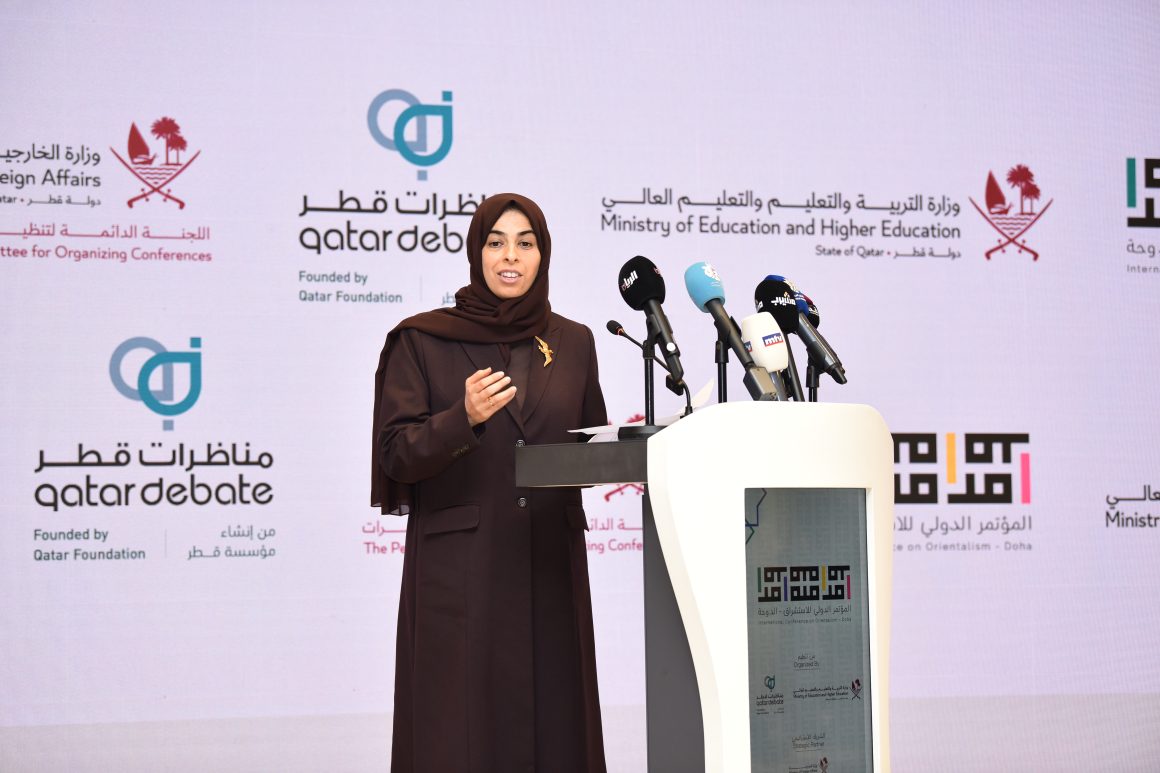
In its first edition, the conference will include several keynote speeches, panel discussions and breakout sessions until Sunday, involving international and regional experts.
The first of such high-level panel discussions on Saturday featured Lebanon’s Minister of Culture, Ghassan Salamé, Oxford University’s Middle East Centre Director, Eugene Rogan, and The Gambia’s Minister of Foreign Affairs, Dr. Mamadou Tangara.
Chief of Turkey’s National Intelligence Organisation and Islamic scholar, Ibrahim Kalin, led the Guest of Honor speech.
Contextual reimagining
A major goal of the conference is to evoke discussions that aim to touch on evolving perspectives and debates in contemporary orientalism studies, according to Alkhater.
“The relationship between the West and the East requires reimagining,” she said on Saturday, warning against the approach of framing it as a “polemic war.”
Much has changed since most theories in the field were first introduced. And while seminal works such as Edward Said’s ‘Orientalism’ continue serve as essential pillars, modern-day discussions should broaden their scope to include more “civisilational dimensions,” Alkhater said.
“If the old orientalist was engaged with the text, the new orientalist is engaged with context,” she added, underscoring the importance of self-representation.
Salamé, the Lebanese Minister of Culture, said that the process of overcoming orientalist lenses, marred by the tainted history of colonialism, should not come at the cost of identity.
“To identify your place in the new system, you must return to your identity,” Salamé said in the opening day’s first panel, which was moderated by Jamal Elshayyal, Manager of Content Strategy at Al Jazeera 360.
Crafting one’s own narrative
Dr. Tangara, The Gambia’s Minister of Foreign Affairs, emphasised the importance of education in overcoming orientalist perspectives.
“The most fundamental thing is having your own university to train your own people. To break the vicious cycle, there is only one solution: education, education, education,” he said.
In the Guest of Honor Speech, Turkish scholar Kalin also touched on the issue.

“I see no contradiction between returning to our roots and being open to others,” he said, also urging Islamic scholars against using the same imposed orientalist lens.
“Embrace openness confidently,” Kalin added. “Connecting with other civilisations while remaining firmly rooted in one’s own tradition.”
Summing up the discourses of the day, Lebanese Minister Salamé later told Doha News that crafting one’s narrative is more important than ever during a time where universal values and international law have been “blurred” due to the ongoing genocide in Gaza.
“There will be a before and after Gaza,” he said. “Hence, it is more important than ever on the face of everything that is going on, the rise of neo-orientalism as well as the technological advancements, to have our narrative come from among ourselves. This could be one such platform to do so.”