The initiative supports Syria’s national goals to rebuild critical infrastructure, strengthen energy security, and drive economic growth.
The Syrian government has signed a $7 billion memorandum of understanding with a consortium of international companies led by Qatar-based UCC Holding to develop major power generation projects, in a deal endorsed by President Ahmed Al-Sharaa.
This initiative aligns with the national agenda to rebuild Syria’s core infrastructure, enhance energy security, and support economic development. It reflects the President’s clear direction toward establishing a development model based on self-reliance, regional cooperation, and long-term sustainability.
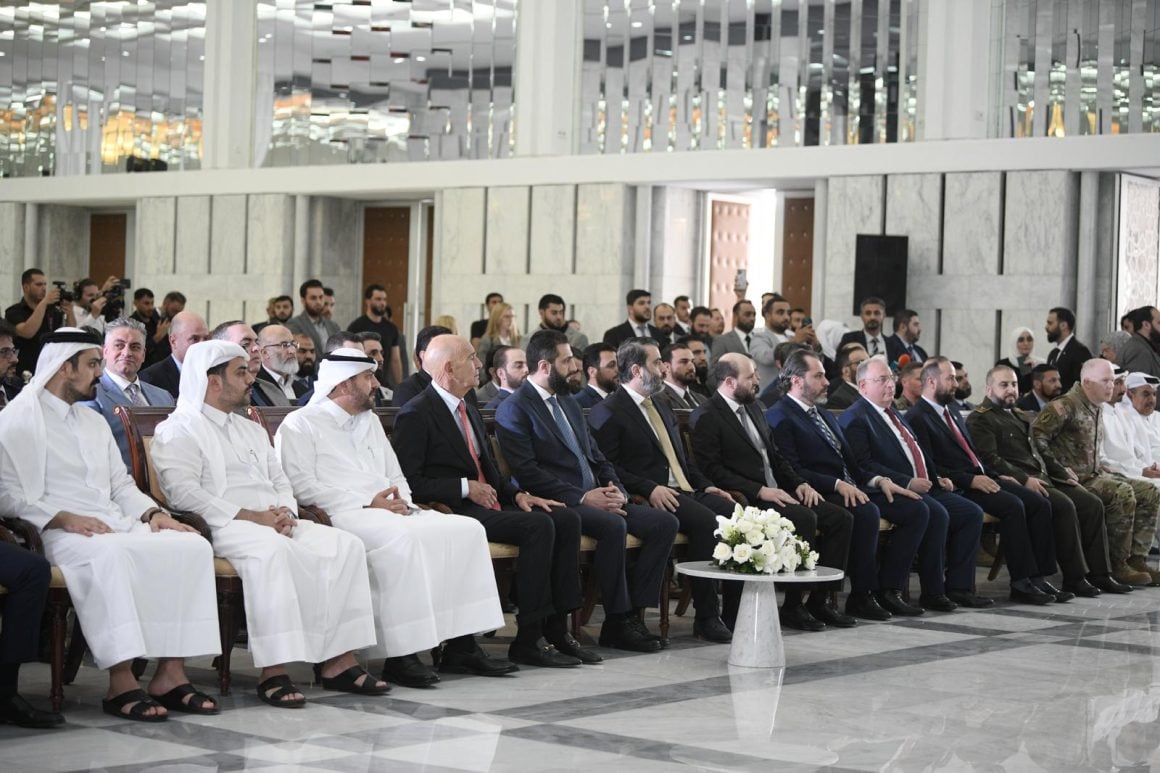
The signing ceremony took place in Damascus, in the presence of Tom Barrack, U.S. Special Envoy for Syria; Khalifa Abdullah Al Mahmoud Al Sharif, Chargé d’Affaires at the Qatari Embassy in Damascus; and Burhan Koroglu, Turkish Ambassador to Syria.
The agreement was signed by Mohamed Moutaz Al-Khyyat, Chairman of UCC Holding; Mehemt Cengiz, Chairman of Cengiz Energy; Orhan Cemal Kalyoncu, Chairman of Kalyon Energy; and Mazen Al-Sbeti, CEO of Power International USA.
The signing was also attended by a number of managers and representatives from the companies, including Ramez Al-Khyyat, President & CEO of UCC Holding; Mohamed Al-Khyyat, Board Member of UCC Concessions Investments; Ahmet Cengiz, Vice Chairman of Cengiz Energy; and Lutfi Elvan, CEO of Kalyon Energy.
The consortium is led by UCC Holding through its subsidiary, UCC Concessions Investment, a Qatari company specialising in energy concessions and construction.
It includes Power International USA LLC, an American firm focused on strategic energy investments; Kalyon GES Enerji Yatırımları A.Ş., a Turkish investor and developer in renewable energy; and Cengiz Enerji San. ve Tic. A.Ş., a Turkish company engaged in energy development and operations.
The alliance highlights Qatar’s role, under the leadership of Amir Sheikh Tamim bin Hamad Al Thani, in supporting Syria’s economic recovery and contributing to efforts aimed at rebuilding the country’s energy sector and advancing self-sufficiency.
The agreement covers the development of four combined-cycle gas turbine (CCGT) power plants in Traifawi (Homs), Zayzoun (Hama), Deir-Azzour, and Mehardeh (Hama), with an approximate installed generation capacity of 4,000 MW, using American and European technologies, and a 1,000 MW solar power plant in Wedian Alrabee, located in the southern region of Syria.
These projects will be implemented under Build-Own-Operate (BOO) and Build-Operate-Transfer (BOT) models with the corresponding power purchase agreements. Construction is expected to begin following final agreements and financial close, with completion targeted within 3 years for the gas plants and less than 2 years for the solar plant.
The signing of the $7 billion memorandum of understanding was hailed by regional and international stakeholders as a significant step toward Syria’s reconstruction and energy recovery.
Tom Barrack, U.S. Special Envoy for Syria, described the deal as “a landmark step in Syria’s path to reconstruction and energy security,” highlighting the U.S. administration’s support for efforts aimed at creating “commerce, not chaos.” He noted that the initiative aligns with President Donald Trump’s broader strategy of working with regional partners to build “a prosperous and stable Syria at peace with itself and its neighbours,” citing the recent lifting of U.S. sanctions as part of that approach.
Syria’s Minister of Energy, Mohammed Al Bashir, called the agreement “a crucial step” in the country’s infrastructure recovery, emphasising that it will “strengthen our national grid, expand access to electricity, and help meet growing demand.” He underscored the importance of international partnerships that align with Syria’s national priorities.
Ramez Al Khayyat, President and Group CEO of UCC Holding, said “This MoU reflects our vision for sustainable and impactful infrastructure development in the region. We are proud to lead this initiative through our concession arm, in collaboration with our consortium partners. These projects represent a model of effective public-private partnership, integrating both conventional and renewable power solutions to support Syria’s energy transition and long-term economic resilience.”
Cemal Kalyoncu, Chairman of Türkiye’s Kalyon Holding, one of the consortium members, echoed that sentiment, saying: “As Türkiye’s largest investor in renewable energy, we are proud to contribute to the development and improvement of the infrastructure of our neighbouring country, Syria.”