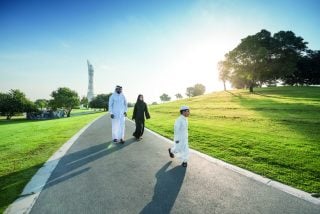
The ‘Ramadan Scenes’ photo exhibition in Katara encapsulates the country’s Ramadan atmosphere by offering different perspectives.
The word “tradition” rings out in unison when photographers Manjri Saxena and Arnab Sarkar were asked what they like from their photographs that currently hang inside Katara Cultural Village’s Building 18.
Organised by the Qatar Photography Center in collaboration with Qatar’s Ministry of Culture, the ongoing “Ramadan Scenes” photo exhibition features more than 70 photos that aim to capture moments of the holy month.
A call was made to over 500 club members for submissions, with up to five entries each, showcasing Islamic architecture, traditions, and the spirit of the holy month.
“This is the perfect time where you can find harmony among the people,” Sarkar, an architect, as talks about his photo which has made it to the final exhibition. “That is what I tried to capture here and throughout Ramadan, that is what I’m seeking to do this year too.”
His photo is a portrait of a man reading the Quran inside a seemingly quiet mosque prayer room, evoking a sense of intimacy and spirituality.
“As a photographer, I prefer to take photos in natural light — that creates drama,” Sarkar explained.

The works of both Qatari and non-Qatari photographers are displayed in the corridors. Photos range from shots depicting Garangao — a favourite pastime that aims to reward children for fasting half of Ramadan — to iftar cannons, prayers and stunning examples of Islamic architecture, including the Education City Mosque and Turkiye’s Hagia Sophia.
Two of the photos in the wide-ranging display belong to Saxena — a known name in the local photography scene, having already served as a juror in last year’s Tasweer Image Awards.
One of Saxena’s pictures depicts a group of young boys reciting the Quran around an Imam in the prayer hall of the mosque a stone’s throw away from the exhibition hall.
“Maybe we will not be able to see a scene like this in a few years,” she says of the picture, alluding to the rise of e-books and other technologies that can potentially replace physical copies of the Quran.
“I wanted to capture that — there are not a lot of instances where you can find the young generation come together in a traditional setting like this. I find it very interesting that during this time of the year, the younger generation in a metropole like Doha is encouraged to participate in these values,” she adds.
The picture also alludes to the discipline as well as the dedication that lies at the core of the practices during the holy month, according to Saxena.
Her other picture on display, however, is the opposite in terms of scale. The wide shot depicts thousands of worshippers praying at the Education City stadium. It was the first time the doors of the Qatar World Cup 2022 stadium were opened to the public for Eid prayers in 2023.

For Saxena, the exhibition is a collection of perspectives, each captured through lenses and viewfinders, with every image made unique by the eye behind the camera.
“Doha is a [lively] place during Ramadan,” she says. “There are iftar cannons, various festivals and fairs — but what is the story behind it? What unique perspective can you offer? The answer lies in each picture that hangs on these walls.”
Sarkar agrees, noting that taking photos during Ramadan not only satisfies the inner photographer’s passion, but also offers a unique opportunity to explore the tradition from an outsider’s perspective.
“It is a time where people come together for a binding tradition, which is to do good,” Sarkar said. “Through these pictures, I am glad that I am a part of that, because in this day and age, the world does need some good and solace.”
The exhibition is currently ongoing at Building 18, Katara, and can be visited for free everyday after iftar.