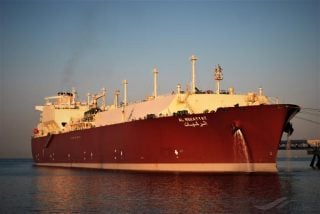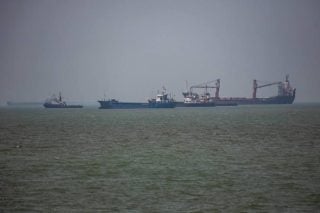
He also addressed restrictions in the Strait of Hormuz, saying the waterway is not completely closed but barred to American and allied ships, while others are allowed to pass.
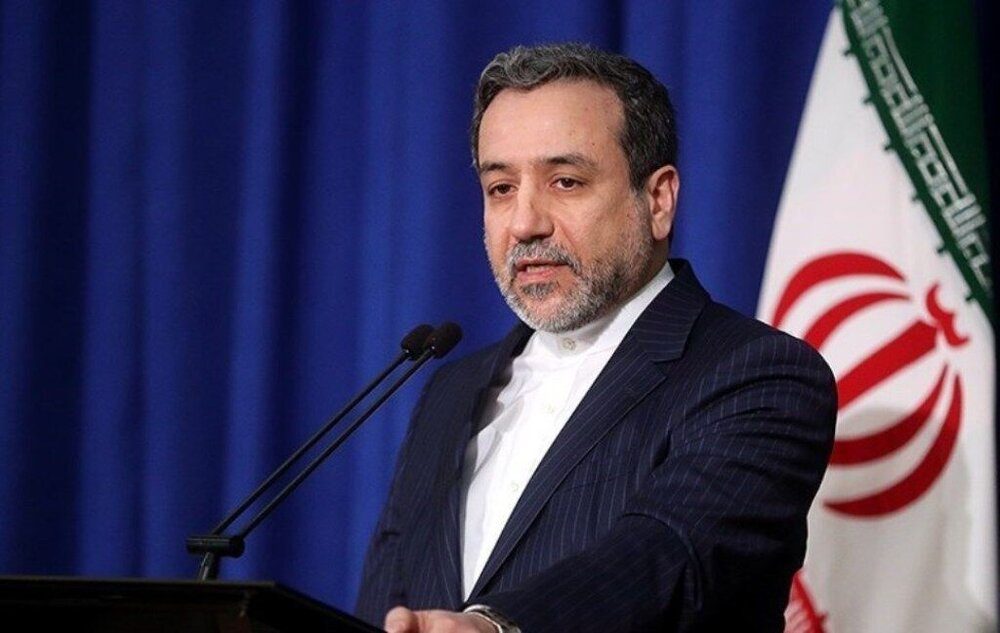
Iran’s Foreign Minister Abbas Araghchi proposed a joint investigation with regional countries into the strikes to determine which targets were struck and whether they are American-linked. He said that the U.S. developed drones similar to Iranian models used in strikes on Arab countries.
“We have also recently received information suggesting that the United States and Israel launch attacks toward Arab countries from specific points,” Araghchi told Al-Araby Al-Jadeed on Sunday, maintaining Iran has been targeting U.S. interests in the region.
“The Americans, for example, have developed a drone similar to our Shahed drone, called ‘Lucas’. It is used to strike targets in Arab countries. We are studying this information, but I believe Israel may be targeting civilian sites to damage our relations with our Arab friends,” he explained.
His remarks echoed accusations by Ebrahim Zolfaghari, spokesperson for Iran’s Khatam Al-Anbiya Central Headquarters, who alleged a “diabolical plot” by the U.S. and Israel to falsely blame the Islamic Republic for the attacks on the region.
Iran has attacked what it claimed to be American interests in the region since the U.S. and Israel launched the first attacks on its territory on 28 February, triggering the current regional escalation.
“We have not attacked any residential or civilian targets. There may have been collateral damage in residential areas, which is normal in any war, but we took every precaution to prevent it,” Araghchi said.
Qatar—a country that has repeatedly served as an intermediary between Washington and Tehran—said Iran has been targeting some civilian sites.
Iran had targeted a water tank belonging to a power plant in Mesaieed and an energy facility in Ras Laffan Industrial City belonging to QatarEnergy.
In a phone call with Araghchi on 4 March, Qatar’s Prime Minister and Minister of Foreign Affairs Sheikh Mohammed bin Abdulrahman Al Thani rejected Iran’s claims that its attacks were not aimed at Doha.
He also said that Iran targeted areas in the vicinity of the Hamad International Airport.
Araghchi told Al-Araby Al-Jadeed that diplomatic contacts with Qatar, Oman and Saudi Arabia were ongoing. He added that any proposal worth studying must guarantee a complete end to the war. However, he noted that no concrete proposal is currently on the table.
The Iranian official also highlighted Iran’s “eye-for-an-eye” policy. He said that if factories and banks in Iran are targeted, similar facilities owned by U.S. companies will be targeted in return.
He pointed to Iran’s attacks on Citibank in Manama and Dubai in response to the attack on Sepah Bank in Tehran on 11 March.
He also addressed restrictions in the Strait of Hormuz, saying the waterway was not completely closed but barred to American and allied ships, while others are allowed to pass.
The Strait of Hormuz, located between Oman and Iran, is one of the world’s most critical routes for crude oil shipments.