Qatar has condemned Iran’s attacks on Jordan, Bahrain and Kuwait as violations of their sovereignty, as the United States and Iran exchanged fresh strikes and regional tensions continued to escalate.
Qatar strongly condemned Iran’s repeated attacks on Jordan, Bahrain and Kuwait on Thursday, calling them a “blatant violation” of the three countries’ sovereignty and a breach of international law as fighting between the United States and Iran intensified across the region.
In a statement, Qatar’s Ministry of Foreign Affairs said the region must be spared the consequences of the “unjustified attacks” and called for dialogue, diplomacy and de-escalation.
The ministry reiterated Qatar’s “full solidarity” with Jordan, Bahrain and Kuwait and expressed support for measures taken by the three countries to protect their sovereignty and security.
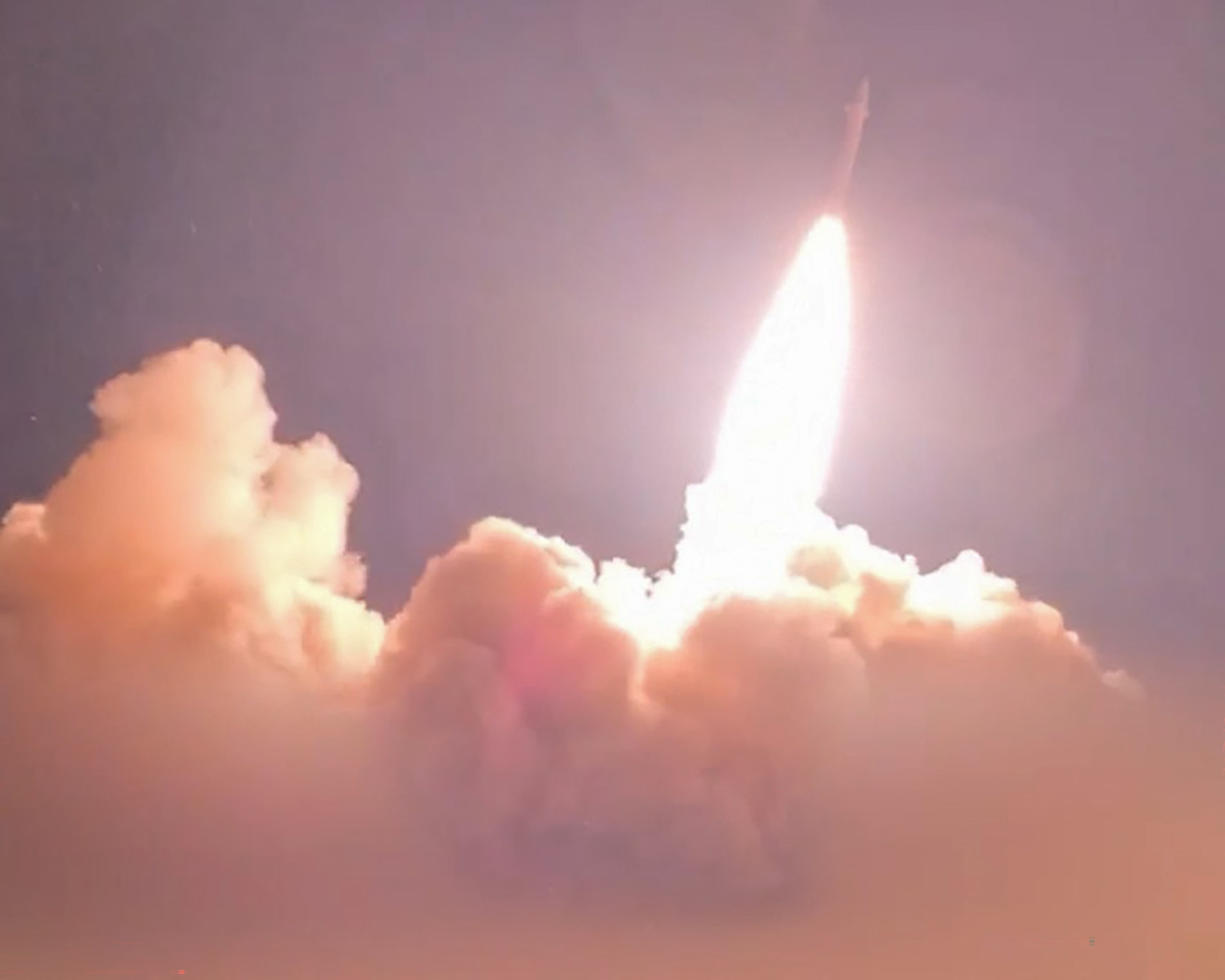
The statement came as Iran claimed fresh attacks on U.S. military assets in Jordan, Bahrain and Kuwait, while Washington continued striking targets across Iran, including areas closer to Tehran.
Jordan said its air defences intercepted eight Iranian missiles on Thursday. Iranian forces said they had targeted U.S. communications systems, fuel depots and a military gathering point at Jordan’s Al-Azraq Air Base.
Iran’s military also claimed attacks on the Ali Al Salem Air Base in Kuwait, targeting radar systems, Patriot air defences and fuel tanks used by U.S. forces.
In Bahrain, Iranian drones reportedly targeted radar and Patriot defence systems at the Sheikh Isa Air Base.
Iran maintains that its attacks are directed at U.S. military infrastructure, though regional governments have accused Tehran of endangering civilians and striking sovereign territory.
The latest attacks followed another wave of U.S. strikes on Iran. U.S. Central Command said it targeted Iranian command centres, air defence sites, missile and drone capabilities and coastal surveillance facilities.
Strikes were reported in several locations, including Bandar Abbas, Qeshm Island, Sirik, Chabahar, Konarak, Rask, Khorramabad and Semnan. Air defences were also activated in Tehran and nearby areas.
CENTCOM said it had also disabled an oil tanker attempting to sail toward Iran’s Kharg Island as part of a naval blockade reimposed by U.S. President Donald Trump earlier this week.
At least 35 people have been killed and more than 300 wounded since the latest wave of attacks began last week, according to reports.
Iranian officials also accused the U.S. of carrying out a strike near a children’s cancer hospital in the southwestern city of Ahvaz.
Iranian Foreign Ministry spokesperson Esmaeil Baghaei said 211 patients undergoing treatment were evacuated from Shahid Baghaei Specialised Hospital after a nearby blast.
Hospital officials said the explosion was so close that staff initially believed the facility itself had been hit. Patients, including children receiving chemotherapy and others on oxygen or ventilators, were moved from the hospital.
Baghaei described the attack as a “cowardly war crime,” while Iranian Foreign Minister Abbas Araghchi accused Washington of violating the United Nations Charter and international law.
The U.S. has not commented directly on the reported impact near the hospital.
The escalation has further undermined prospects for a negotiated end to the conflict. Iran’s parliament speaker and lead negotiator, Mohammad Ghalibaf, said Tehran was prepared for a wider military confrontation if Washington failed to honour the terms of an interim agreement.
The Islamic Revolutionary Guard Corps has also threatened to halt regional energy exports in response to the U.S. naval blockade.
Trump, meanwhile, said Iran was seeking an agreement but warned that Washington could intensify its campaign if talks failed.
“They do want to settle,” he said on Wednesday. “We’ll find out whether or not we settle with them, or we just finish it off.”