As Qatar gears up to host the FIBA Basketball World Cup 2027, we take a look back at the Gulf state’s efforts to revive its basketball scene.
Qatar will host the FIBA Basketball World Cup in 2027, marking the first time the tournament will take place in the Middle East.
After a seven-year absence, Qatar’s national team returned to the FIBA Asia Cup in 2025. Qatar’s team lost all three group games to Lebanon, South Korea and Australia, finishing 13th out of 16 teams.
The Qatar Basketball Federation and partner organisations, including Be Sport Academy, have launched school competitions and development programs to increase youth participation. These initiatives aim to develop competitive players and increase engagement to raise the nation’s international profile in basketball.
Past success and the decline
Qatar’s national team qualified for the 2006 FIBA World Championship in Japan in 2005, marking Qatar’s first appearance at the tournament, where they lost all five preliminary games and finished 21st.
In 2003 and 2005, the team won two bronze medals at the FIBA Asia Championship. Qatar’s medals remain among the highest finishes for Arab teams in Asia Cup history.
Qatar’s men’s national 3×3 team also won the 2014 FIBA 3×3 World Championship title as the first Arab nation to capture a senior world basketball title.
Qatar’s national team returned to the FIBA Asia Cup in 2025 after failing to qualify in the 2022 tournament. The team sealed its 2025 qualification with a 92-71 victory over Kazakhstan in the Asia Cup qualifiers.
Former national team player and captain, Yassin Ismail Mohamoud, won more than 40 domestic and regional titles with Al Rayyan SC and played internationally for over 20 years. After retiring in 2016, Mohamoud became the General Manager of the Qatar Basketball Federation and President of Basketball Operations at Al Rayyan Sports Club.
“I was the top scorer of the Under-19 World Cup in Portugal,” Musa said. “We won the first Asian Cup in 2002, and I won the World Cup in 2014 in Russia. Those were some of my best moments.”
Mohamoud said basketball in Qatar had a strong era when his generation played together. “We were top three in Asia and top three in Arab countries,” he said. “That success doesn’t just happen. It came from discipline, consistency and chemistry within the team.”
According to Mohamoud, the team’s level declined after Musa and his generation retired around 2016. Qatar’s 5×5 national team struggled to maintain the same level of success and did not qualify for several international tournaments before returning to the Asia Cup in 2025.
“What Yassin did during his time was incredible,” Ghassan Hajar, 20, a current national team player, said. “He left a mark in Qatar basketball history that will be very hard to repeat.”
Women’s participation in basketball
Former national team captain, Amal Mohammed Saleh, said basketball has changed for women in Qatar.
“When I first started my basketball journey the sport was still developing and opportunities were limited, especially for women,” Saleh said. “Today, basketball is much more visible and organized.”
Saleh said she sees more young girls interested in basketball now than when she was playing. “There are more youth programs, school competitions and community initiatives that encourage participation,” according to Saleh.
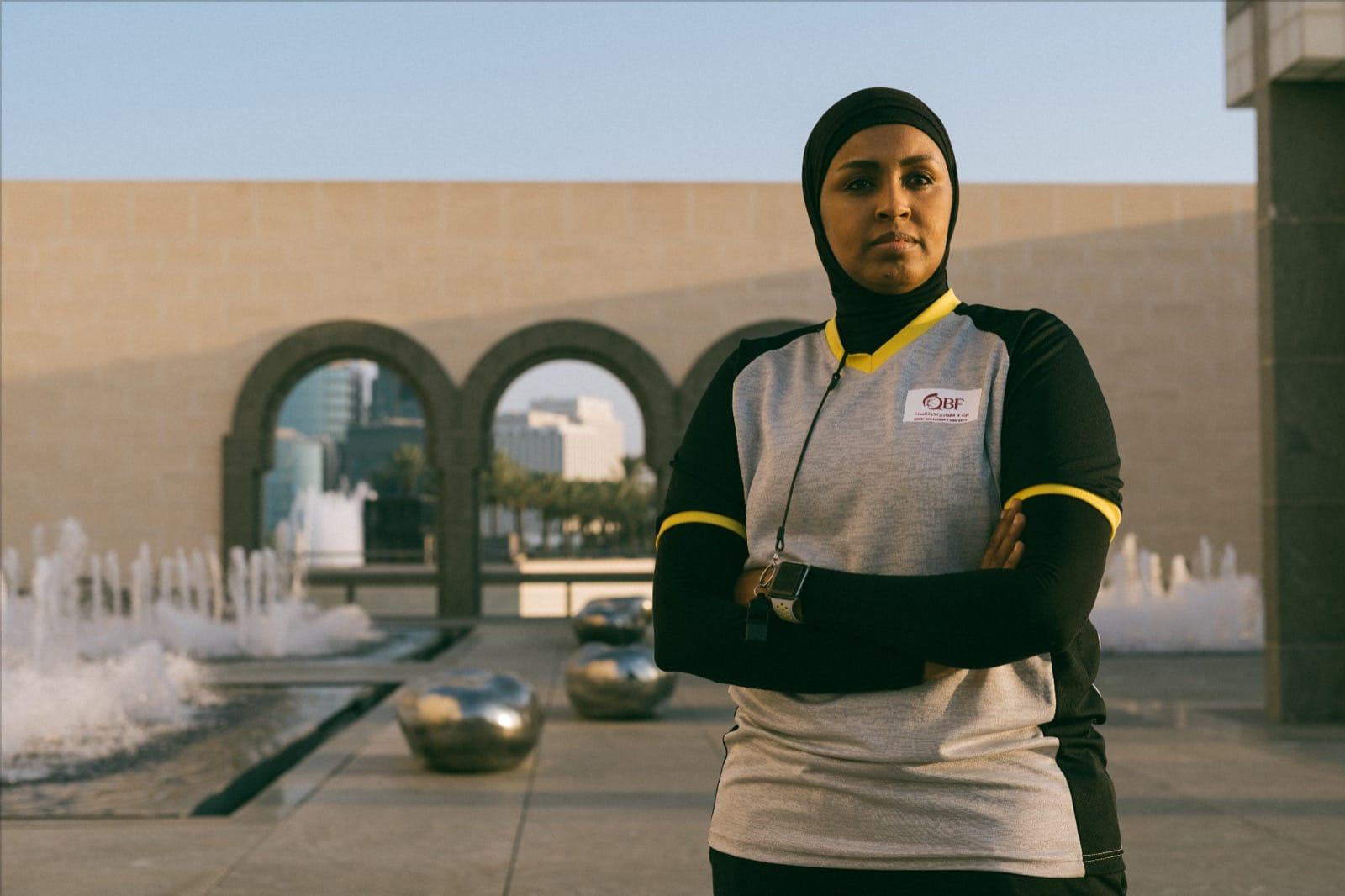
In 2023, the Qatar’s Basketball Federation launched its first women’s basketball league for six local teams to compete.
The women’s and girls’ competitions expanded for the 2024-25 season, adding under-15 and under-18 divisions to the league. This was part of a broader strategy to give female players more opportunities.
In early 2026, the federation also organised Girls’ Buds Festivals. These were weekly events aimed at players born between 2014 and 2019 to help discover talent and teach fundamentals in a structured and competitive environment.
Qatar’s women’s teams also compete regionally. The women’s 3×3 national team finished fourth in the 2025 Gulf 3×3 Basketball Championship in Oman.
Youth development and grassroots programs
Qatar’s youth basketball scene has grown in recent years, with structured programs drawing hundreds of young players into the sport.
Organisations like Be Sport Academy and Qatar Basketball Federation have focused on youth development programs and school competitions to build the next generation of players.
Ben Smith, founder of Be Basketball Academy, said he has witnessed significant growth in the sport during his 17 years in Qatar.
“When I came here around 2010, basketball was really becoming popular,” Smith said. “Now there are more competitions, more involvement.”
Smith said the academy works with players from as young as four years old and has helped develop athletes who later progressed to national team and professional pathways.
Smith added that Qatar’s international school system has helped expand participation in basketball.
“We probably have 26 different nationalities in our academy,” Smith said. “You learn a lot from the kids.”
He added that it gives young players the opportunity to develop alongside people from many different backgrounds.
The Qatar Basketball Federation organised a Junior Basketball Festival in 2024-25 with over 300 young players and a Mini‑Basketball Festival in 2025‑26 with more than 140 participants, aimed at giving youth competitive match experience.
The Jr. NBA/Jr. WNBA Qatar League brought together more than 1,000 boys and girls from across the country in its second season, roughly double the participation of its first year, with 68 teams competing across under‑12 and under‑14 divisions.
Doha will host the first Basketball Mini World Cup in the Middle East in 2027, a competition featuring 32 secondary school teams under the FIBA and QBF School Olympic Program. This World Cup simulation is taking place over two seasons, 2025-26 and 2026-27.
Looking ahead: the 2027 World Cup and beyond
Qatar will host the 2027 FIBA Basketball World Cup from August 27 to September 12, with 32 national teams expected to compete.
Hajar said that since the Qatar Basketball Federation secured the 2027 World Cup, youth programs have grown and the men’s teams are playing more competitive games.
“The competition in the Division One League has risen, and high‑level professional players are coming to the league,” Hajar said.
With the 2027 World Cup approaching, players and officials hope the tournament will help grow the sport across the region.
“I believe moments like this can inspire the next generation of athletes and help continue the growth of basketball in the country,” Saleh said.
However, awareness of the event may still be developing. In an online survey of 35 Education City students conducted in March 2026, 45.7% said they considered basketball popular in Qatar, while 74.3% were unaware that Qatar will host the 2027 World Cup.
“It’s a great opportunity for not only Qatar, but for the whole Middle East,” Yassin Mohamoud added.