While Qatar’s airspace remains closed, the airline is set to begin operations in nearby cities to help those who are stranded due to the US-Israel and Iran conflict.
The U.S. and Israeli attack on Iran continues to cause severe disruption to flights throughout the Middle East and beyond from Sunday, creating uncertainty for hundreds of thousands of travellers.
Countries across the region closed their airspace, and three of the key airports that connect Europe, Africa and the west to Asia halted operations.
Thousands of travellers are stranded in the Middle East after the cancellation of thousands of flights.
More than 11,000 flights scheduled to depart from major airports in 10 countries have been cancelled, CNN reports.
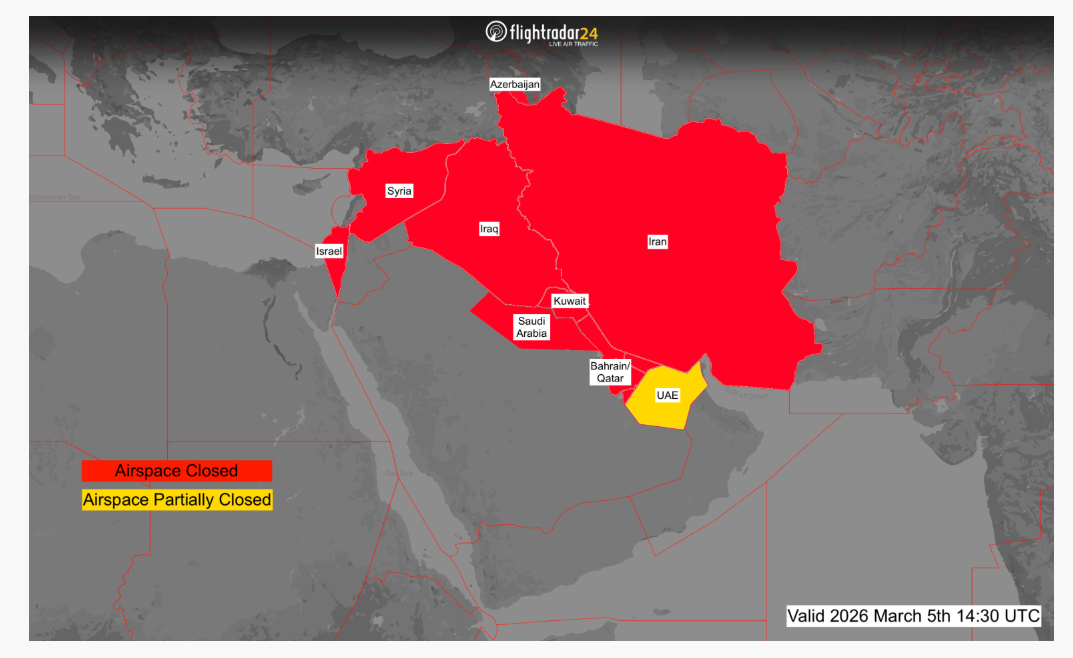
Travellers were either stranded or diverted to other airports after Israel, Qatar, Syria, Iran, Iraq, Kuwait and Bahrain shut their airspace.
That led to the cancellation of thousands of flights by major Middle Eastern and global airlines, including British Airways and Virgin Atlantic, CNN reports.
As of 4th March, 10 countries had totally or partially closed their airspace since the strikes began on February 28, according to CNN reports citing data from FlightRadar24, ICAO, FAA, World Bank.
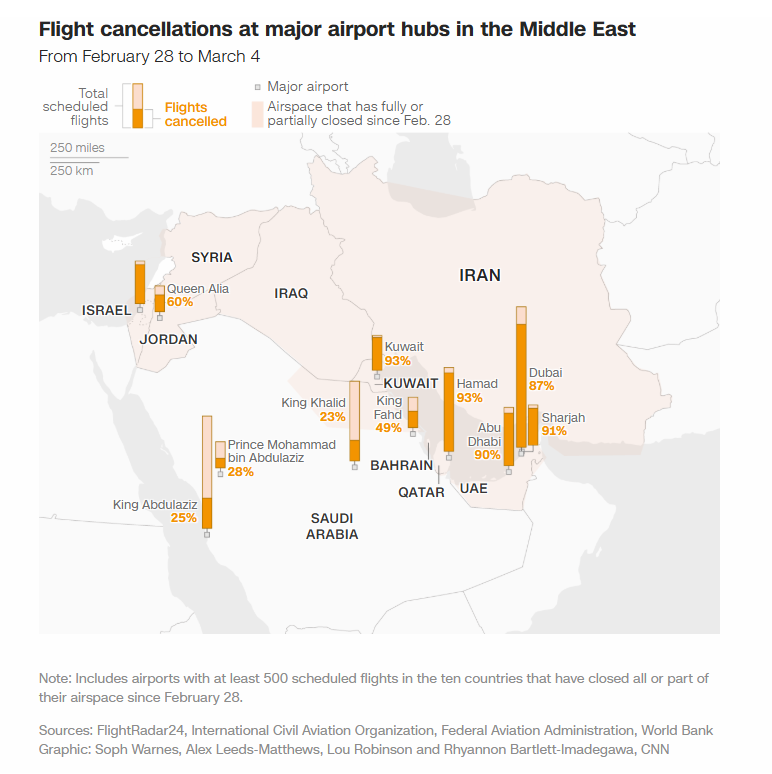
Hamad International Airport in Qatar, has dropped 93% of its scheduled flights since then.
In February alone, Hamad International Airport handled 4.2 million passengers, according to the Centre for Aviation (CAPA), in February 2025.
Dubai International Airport in the United Arab Emirates, has dropped 87% of its scheduled flights since February 28.
In February, the airport handled 4.9 million seats, according to the Official Aviation Guide, a reference for air travel data.
Flights have been cancelled at high rates at other airports in the region, including around 91% of flights from Sharjah, Kuwait 93%.
Despite the ongoing uncertainty in the region, some airports began resuming flights on Wednesday, including Dubai, Abu Dhabi and King Khalid International near Riyadh, Saudi Arabia.
While Qatar’s airspace remains closed, the airline is set to begin operations in nearby cities to help those who are stranded due to the US-Israel and Iran conflict.
Latest on Airspace closures and evacuation flights
As of Thursday, according to the FlightRadar24, Oman’s airspace (OOMM) remains open and Muscat has become the preferred airport among airlines in the region to perform relief flights, among them Qatar Airways.
Israel’s airspace (LLLL) remains closed with the exception of military flights and civilian operators with prior permission.
Jordan’s airspace (OJAC) remains open but aircraft are advised to carry extra fuel in case of delays.
In Saudi Arabia (OEJD), a partial closure is affecting areas bordering Iraq and the Persian Gulf, expired at 2200 UTC on 5 March.
Iran (OIIX) and Iraq (ORBB) have implemented total airspace closures, set to expire at 0830 UTC and 0900 UTC on 7 March, respectively.
Qatar (OTDF), Bahrain (OBBB) and Kuwait (OKAC) have also imposed total airspace closures, all expiring at 1600 UTC on 7 March.
In Syria (OSTT), a total closure is in place until 2100 UTC on 7 March.
The United Arab Emirates (OMAE) has introduced closures through Emergency Security Control of Air Traffic (ESCAT) zones, with all restrictions expiring at 1200 UTC on 6 March.
Meanwhile, Israel (LLLL) has ordered a total airspace closure until 1000 UTC on 9 March.