Despite his admission of facing backlash for speaking out, Humza Yousaf remains undeterred.
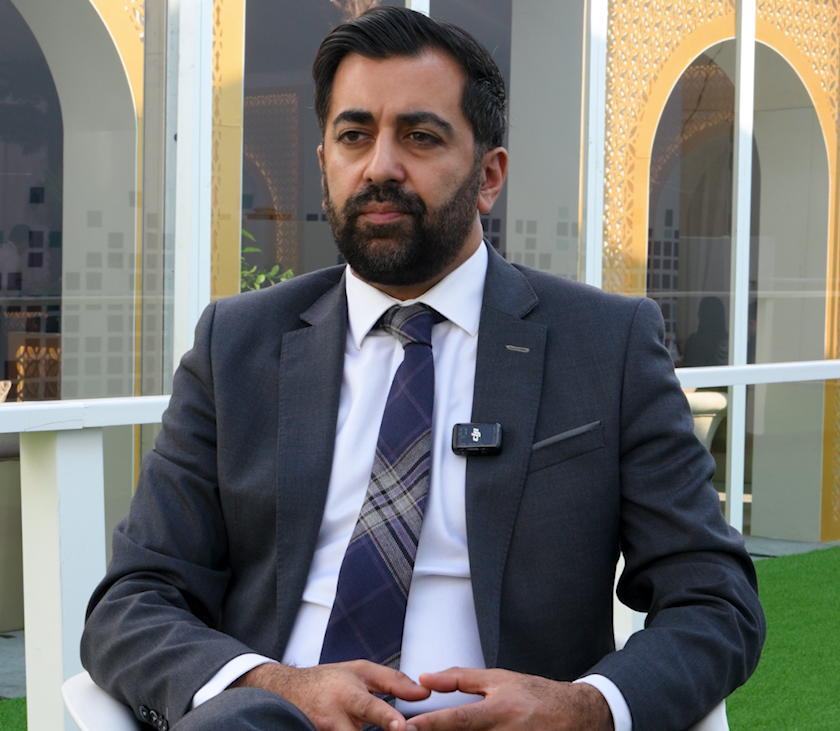
Whilst navigating his way through the iconic Sheraton Grand Doha Resort, the venue of Doha Forum, the former Scottish First Minister is stopped by numerous former heads of state, current ministers and a prominent U.S. chief of staff. The Scottish lion of a statesman has notoriety and is no stranger to breaking ceilings, both as the first Muslim to lead a Western nation and as the youngest ever First Minister of Scotland.
Sitting down to speak exclusively to Doha News, wearing one of his trademark tartan ties, Yousaf began the conversation fiercely unapologetic for being the first European leader to call out the genocide in Gaza: “The Scottish people have been very strong in their support, and therefore, the government has also been very supportive of the Palestinian people. Not because they’re pro-Palestinian, or pro-Muslim, or pro-Arab – this is about being pro-humanity. When 20,000 children are being killed in front of your eyes, 70,000 people slaughtered, and a genocide is being live-streamed. Then it is your obligation and your moral duty to speak out.”
In keeping with Doha Forum 2025’s theme of ‘Justice in Action: Beyond Promises to Progress,’ – Yousaf claims he is in the “precise arena” that brings voices together to be part of a peaceful narrative, remarking: “we have forgotten the art of diplomacy, the art of dialogue, the art of understanding each other in peaceful co-existence.” His arrival in Qatar comes after an extensive trip to the United States in November, where he was hosted by the Muslim Public Affairs Council (MPAC) and various entities to discuss combating what he terms “far-right extremism”.
His native UK has a documented problem with Islamophobia. According to data published by the United Kingdom’s Home Office (Interior Ministry), hate crimes are on the rise, and of the total religious hate crime offences recorded until the year ending March 2025, where the targeted religion was known, 45% of the victims were Muslim. It’s an endemic across all echelons of society, marked by Baroness Sayeeda Warsi (the first Muslim to serve in a British cabinet)’s resignation from the opposition Conservative Party in the past 18 months, an entity that she claims was attempting to “demonise” her for challenging Islamophobia.
The British Muslim community’s historic relationship with Number 10 is complicated. In the early 2000s, Tony Blair’s government ostracised the Muslim Council of Britain over its public opposition to the Iraq War. Following the election of British Prime Minister Keir Starmer’s government in July 2024, the then Faith Minister Lord Wajid Khan commissioned the Anti-Muslim Hatred/Islamophobia Definition Working Group and an abundance of various new organisations, such as The British Muslim Network, Community Exchange Hub, and think tank Equi, have surfaced eager to have the ear of the British government. But as 2026 approaches, the future for British Muslims remains uncertain, with no defined leadership, nor consensus on strategy beyond the government’s ‘Protective Security for Mosques Scheme’ delivered to aid in protecting Muslim places of worship across the UK following an arson attack on Peacehaven mosque in October this year, where two worshippers had to run through fire to escape.
Despite his admission of facing backlash for speaking out, including repeated death threats, Humza Yousaf remains undeterred to tackle those who he believes are “trying to create a divisive narrative [and] who are putting Muslims in the crosshairs”, adding “they share their resources, they share their funding, they literally share talking points and scripts.” The former First Minister regards the issue as requiring a transatlantic solution, confirming he is leading an independent initiative to build a transatlantic alliance of “serious players coordinating the efforts in the United Kingdom and the United States” to combat what he deems a “common enemy and a common problem.”
Over the past decade, a Memorandum of Understanding between Türkiye, Malaysia and Pakistan strived to tackle Islamophobia head-on but fizzled out after successive changes in governments. And whilst entities such as the The Concordia Forum founded by Muddassar Ahmed have long facilitated a fellowship to Muslim leaders Across The Pond, if successfully enacted and launched, Humza Yousaf’s transatlantic alliance to tackle Islamophobia will be a world first that could spark a wider shift in civil rights as per his vision – “there’s enough wealth, resources, expertise, talent amongst just the Muslim community, let alone our allies, in order to tackle this pervasive hatred. And why it has to be our allies because although Muslims are in the crosshairs today, it will be somebody else tomorrow.”