As the second day concluded, leaders and innovators build on a powerful opening that placed human values and educational justice at the centre of global reform.
The World Innovation Summit for Education (WISE) continued in Doha today following a dynamic opening that brought together more than 4,000 policymakers, educators, researchers, and youth from over 150 countries.
Held under the theme “Humanity.io: Human Values at the Heart of Education,” the 12th edition of WISE has set an urgent tone for rethinking learning in an era defined by rapid technological acceleration.
The Summit, hosted by Qatar Foundation and held at Qatar National Convention Centre, was inaugurated on Monday in the presence of Sheikha Moza bint Nasser, Chairperson of Qatar Foundation, and Sheikha Hind bint Hamad Al Thani, Vice Chairperson and CEO of Qatar Foundation, alongside Lolwah Al-Khater, Minister of Education and Higher Education.
The second day of the WISE 12 Summit in Doha opened with the participation of notable international figures, including Latifa Al-Droubi, wife of the current Syrian President Ahmed Al-Sharaa, marking a high-profile appearance at the Summit’s opening ceremony.
Sheikha Moza: Education must not become a commodity
In her powerful opening remarks, Sheikha Moza bint Nasser stressed, “WISE was created to be a space that stirs our minds and ignites our thoughts, encouraging us to break through existing moulds and think outside the box when it comes to education”.
She added, “at WISE, we believe education is not a public-sector service like any other; it is an inalienable right, without doubt. It is a fundamental pillar of human dignity, justice and progress. Education should not be a commodity, nor a privilege, nor a favour to be granted”.
She highlighted widening global knowledge disparities, particularly across the Arab region, Africa, Asia, and Latin America, where institutional and scientific imbalances continue to hinder participation in global innovation.
She announced the upcoming launch of a new WISE index designed to measure the quality of education by integrating not only academic performance but also the social and cultural values essential to the educational process.
She also cautioned against the unchecked expansion of artificial intelligence, saying that without strong ethical frameworks, the world risks sliding into “technological dependency”.
Minister Lolwah Al-Khater: Youth and values at the centre of national progress
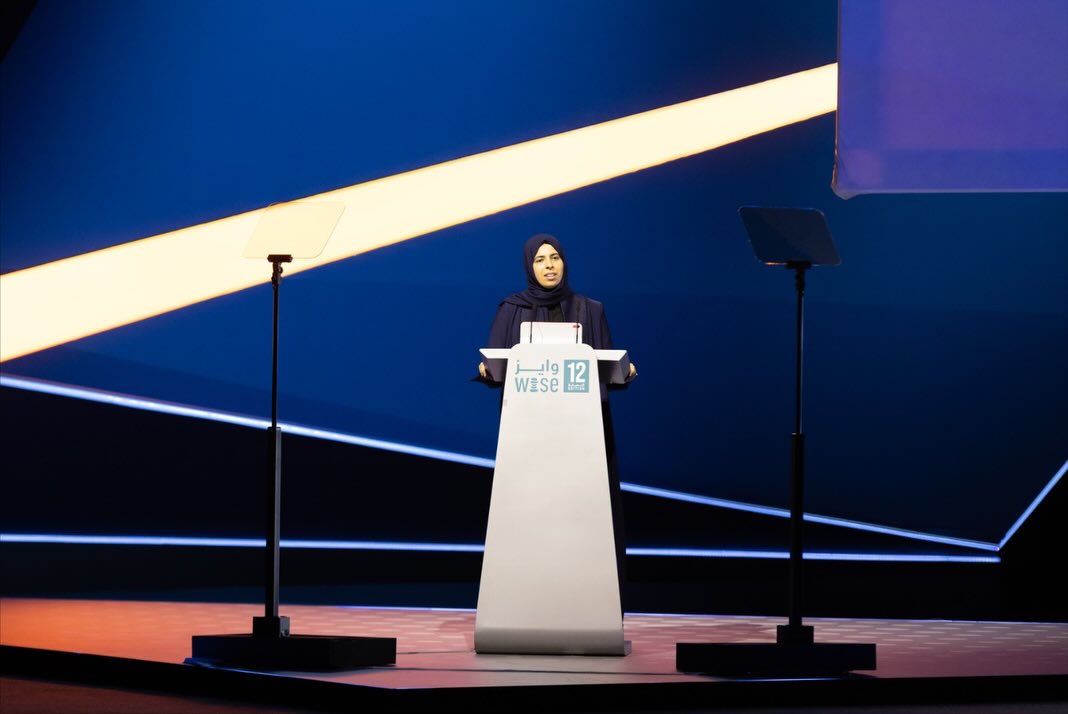
During the opening ceremony, Lolwah Al-Khater also delivered her ministry’s keynote as a strategic partner of WISE 12.
She reaffirmed that placing the human being at the core of education is the foundation of national development, emphasising that technology must remain guided by human values and collective purpose.
The Minister highlighted the evolution of Qatar’s education system, from the establishment of the Ministry of Knowledge in the 1950s to the research and university ecosystem strengthened under the Father Amir, and the current phase under the Amir Sheikh Tamim bin Hamad Al Thani, which anchors national progress in human empowerment.
She underscored that the Education Strategy 2024–2030 is grounded in equitable education, a safe digital ecosystem, and preparing learners capable of making informed, independent decisions.
On the sidelines of the summit, visitors also explored a variety of international and local institutions, highlighting innovative approaches, human-centred learning models, and forward-looking educational strategies.
These exhibitions reflect the Summit’s broader mission to share knowledge, inspire collaboration, and spotlight scalable solutions that place human values at the heart of education.