Running for three days at Education City, the AFLI 2025 Conference brings together hundreds of experts, researchers, and policymakers to explore digital justice, sustainability, and the future of knowledge institutions in the Arab world.
The 36th Conference of the Arab Federation for Libraries and Information (AFLI) kicked off today at Qatar National Library, running from 23 to 25 November at Multaqa in Education City.
The event explores the intersection of digital justice, global citizenship and the knowledge economy under the theme: “Digital Justice and Arab Information Institutions: Fostering Partnerships, Sustainability, and Transformation”.
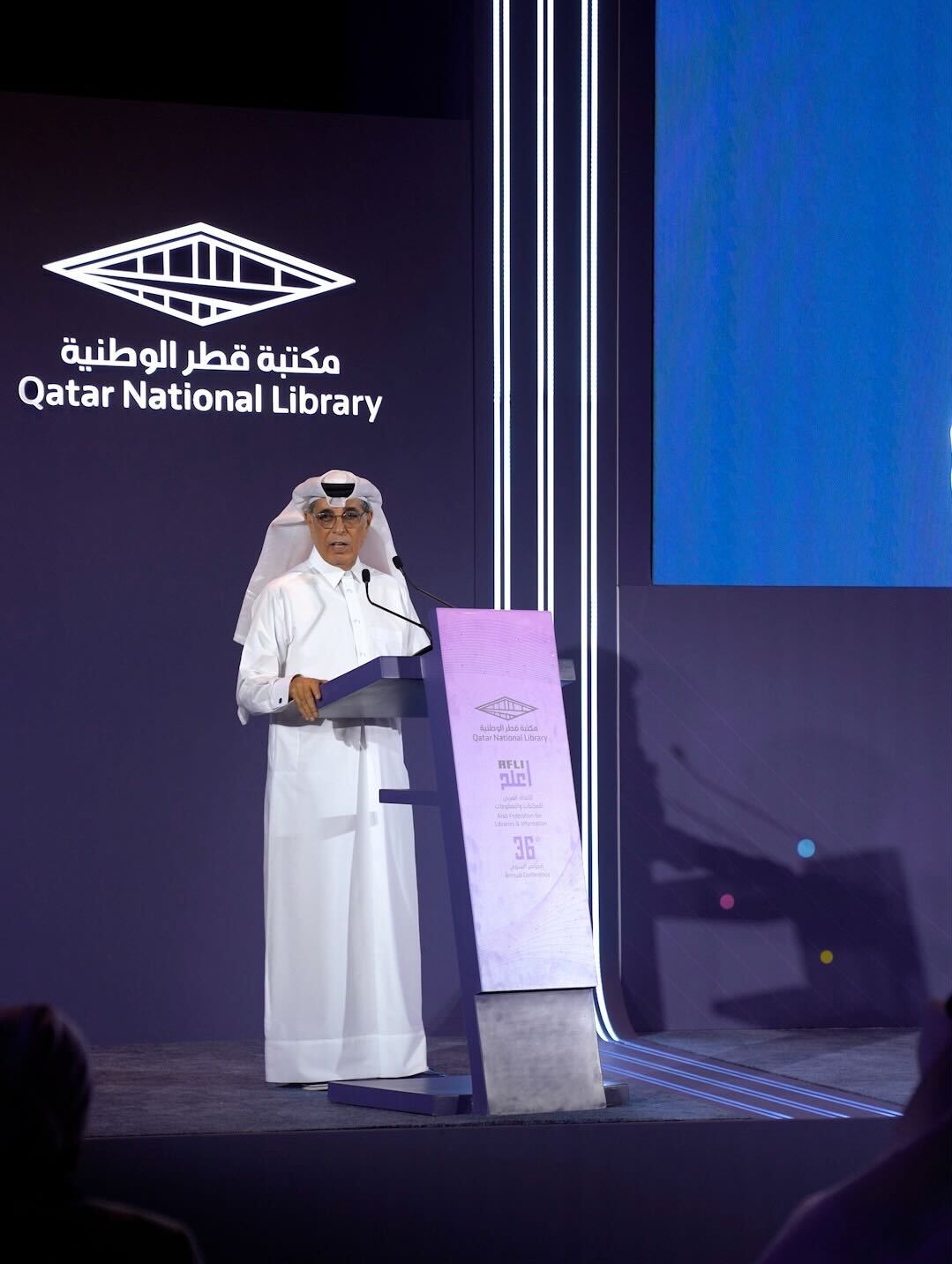
Sheikha Hind bint Hamad Al Thani, Vice Chairperson of Qatar Foundation and Chairperson of Qatar National Library’s Board of Trustees, attended the opening ceremony, alongside Hamad bin Abdulaziz Al-Kawari, Minister of State and President of QNL, and Nabhan Al-Harrasi, AFLI President.
Hamad bin Abdulaziz Al-Kawari, in his keynote address, highlighted the urgency of this year’s theme. He said: “This year’s theme speaks directly to the critical juncture at which our region stands. Digital justice is no longer an abstract ideal but an urgent imperative, vital not only for safeguarding our identity, but for transforming the Arab world from a passive consumer of knowledge into an active architect of it”.
“To realise this vision, we must look beyond simply increasing Arabic content online; we need to forge unified strategies and institutionalise open access policies that guarantee knowledge as a fundamental right for all,” he added.
Describing the conference as “a watershed moment for regional collaboration,” Al-Kawari said he hoped it would reinvigorate collective efforts to advance digital justice, support Arabic scholarship, and promote sustainable professional practices across the Arab world.
The conference has drawn broad participation from national and public libraries, universities, research institutions and information professionals from across the Arab world.
Participants will spend the next three days examining six core themes, including equitable access to knowledge, sustainable practices for advancing digital justice, open science, global citizenship, cross-disciplinary information science and Arab experiences in shaping an inclusive digital future.
Conference discussions will explore how technologies like artificial intelligence, big data, and open data platforms can bridge the digital divide, curb algorithmic bias, and expand access to information, while highlighting the role of cross-sector collaboration in promoting sustainable and inclusive digital practices.
Abeer Al Kuwari, Director of National Collections and Special Initiatives at Qatar National Library, told Doha News that hosting the conference is a major milestone for the region. “We are so happy here at QNL to be the main host of this conference. This is one of the biggest conferences in the region for the library and information sector,” she said, adding that over 500 experts have come together to share insights and propose ways to advance libraries and information in the digital world.
Al Kuwari highlighted the importance of this year’s theme in light of rapid technological change. “Digital justice is the theme for this year, and over the coming three days we will have workshops and lectures to exchange ideas and develop recommendations,” she said.
She also pointed to the strong academic component of the conference. “More than 100 researchers had their papers accepted, and they will present their studies to share experiences and advance the sector in general.”
She further stressed QNL’s commitment to supporting digital advancement in the region. “At Qatar National Library, we see ourselves as an integral part of the Arab knowledge fabric, and Qatar’s wise leadership has been keen to position the country as an active player in the Arab world, stemming from our pride in our identity and culture.”
As the largest annual Arab gathering dedicated to libraries and information science, the AFLI conference remains a key platform for shaping regional strategies and strengthening professional cooperation.
This year’s edition continues that mission by examining the evolving role of libraries as hubs of digital literacy, sustainability and intercultural understanding. With a packed agenda, record participation and a growing regional mandate, the conference is expected to conclude with a series of actionable recommendations that will guide the next phase of digital development across Arab knowledge institutions.