Israeli forces killed Hind in 2024, firing 335 bullets from a close range at the car where she was trapped alongside the bodies of her relatives in the Gaza Strip.
Kaouther Ben Hania’s The Voice of Hind Rajab has been one of the week’s standout moments in Qatar, premiering at the Doha Film Festival in its first-ever screening in the Middle East.
Despite it being a Friday afternoon, a time when many families in Doha are usually visiting loved ones or enjoying the breezy weather outdoors, the screening still drew crowds, becoming a clear priority for many.
Outside of the Katara Cultural Village’s Building 16, a long queue of excited viewers stood– for a single purpose.
Each person came with a symbol representing Palestine, whether by wearing the Palestinian Keffiyeh, a piece of traditional embroidery or the colours of Palestine’s flags.
For the audience, this was more than a screening, it felt like a mission. The film captured the painful final moments of five-year-old Hind Rajab, a story the world had already witnessed with heartbreak on January 29, 2024.
The theatre’s lights went off and the film opened with a backgrounder on the incident, instantly drawing the audience’s attention, before cutting to the opening scene from Palestinian Red Crescent in the West Bank.
The scene with Omar Alqam, played by Motaz Malhees, out having a smoke with his colleagues in the open air showed a different life than the horrific scenes in Gaza under Israel’s genocide.
Yet, the crimes in the West Bank could still be seen from the brief scenes of the staff receiving calls from Palestinians in the background. Within this scene, the reality of life under Israel’s occupation of Palestine was depicted, where there is hardly any moment of peace for Palestinians.
The film then transitions to the recording of Hind’s initial emergency call, where she identifies herself using her childhood nickname, “Hanood.”
The scene immediately drew the audience into an instinctive, desperate hope for her survival, marking the true beginning of Hind’s ordeal on screen.
Ben Hania’s choice of using the original recordings instantly captured the audience’s attention, as it is a voice that has continued to echo in people’s consciousness as the world failed to save her.
The theatre was filled with the sound of sniffles as Hind sobbed, “I’m so scared, please come”.
Suddenly, everyone was in the shoes of Alqam and his colleagues Rana Faqih, portrayed by Saja Kilani; Nisreen Qawas, played by Clara Khoury; and Mahdi Aljamal, portrayed by Amer Hlehel.
Even though viewers knew how the story ended, they experienced it through the eyes of the Palestinian Red Crescent, almost as if they were in the room themselves, hearing Hind’s trembling voice whisper, “I am alone”.
One of the film’s most powerful choices was its focus on Aljamal, the man forced to make impossible decisions, whether to immediately send his team in Gaza into life-threatening danger or wait for approval from the Israeli occupation.
The key detail was able to highlight the reality in Palestine, that even saving lives requires a long approval process by the occupation.
In order to save Hind, the Palestinian Red Crescent had to contact the Red Cross to communicate with Israel’s military to give the necessary clearance to reach the targeted vehicle.
The frustration that Faqih and Alqam had over the delay mirrored the actual global outrage towards the reality of the occupation and global agencies in not moving swiftly to save Palestinians in Gaza.
This has also echoed the frustration the public have had towards the West in its complicity in the genocide and the occupation of Palestine for more than seven decades.
The core focus remained on the effort to save Hind’s life, even as all these details were being brought to light.
Ben Hania’s choice of continuously cutting from the actual recordings of the conversation between Hind, her mother Wessam Hamada and the Palestinian Red Crescent has maintained the film’s authenticity in being able to accurately tell the story.
Despite knowing the actual story, the viewers for a moment forgot its ending, thinking that Hind was going to be saved.
In fact, the brief feeling of hope kept building up to the moment the Palestinian Red Crescent team received the approval to save Hind, but when the ambulance stopped and the Israeli airstrike’s sound appeared, reality hit again.
Then came the painful last moments of Hind’s disappearing voice, before she lost her last heart beat with the last of 335 bullets Israel fired at her car.
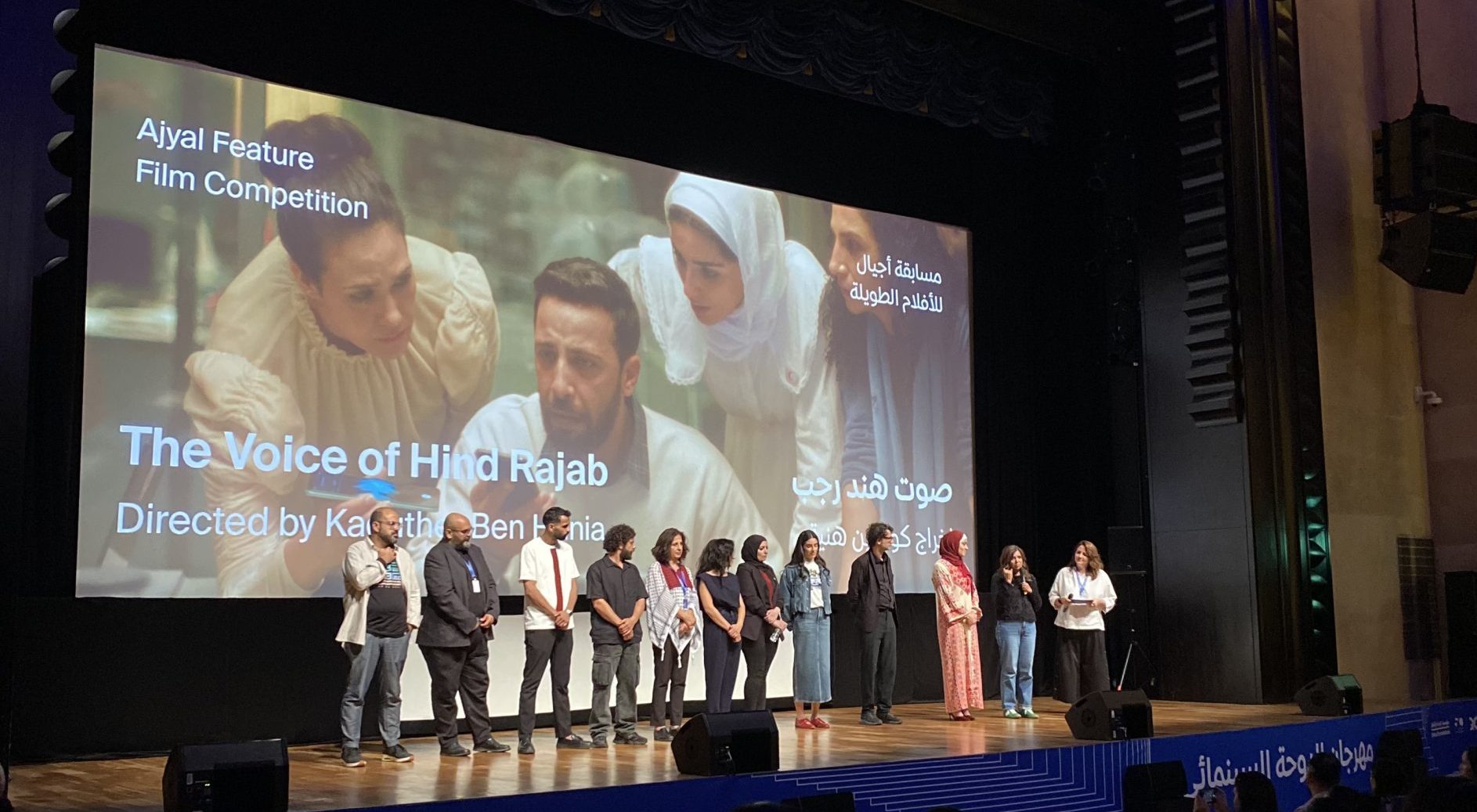
Back in the theatre, the sniffles only became louder and accompanied with deep sighs. The lights were turned on and silence filled the room, even with the full cast and actual Palestinian Red Crescent staff went up the stage.
During the Q&A session, the audience struggled to find words; their voices felt heavy and their thoughts scattered, made even more overwhelming by the presence of Hind’s mother standing alongside the film’s crew.
Instead, she was receiving hugs from an audience whose tears uncontrollably streamed down their faces.
All the feelings conveyed by Ben Hania’s work indicated the film’s success, but it was not merely about its artistic decisions, it was rather its ability to preserve the story’s authenticity by involving the real characters, letting them also tell their story.
The Voice of Hind Rajab immerses the viewers into a dense story, one of pain, hope and despair.