For almost two years, Gaza’s livestreamed suffering has shaken parents worldwide, as Israeli airstrikes continue and grief spreads far beyond the Strip.
For over 700 days, people across the world have carried Gaza’s pain in their pockets, swiping through live-streamed funerals, watching parents scream over tiny shrouds. It has altered the very way people see themselves, their children, their safety.
It always begins with a scream. The loudest one. The one that a parent recognises.
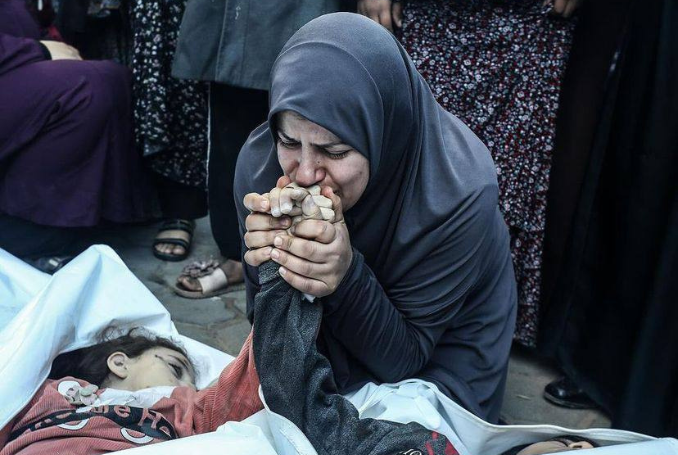
“My soul, my heart, my beloved one. She is gone. Oh, mother’s heart!” A Palestinian mother wails over the lifeless body of her baby, killed in an Israeli airstrike on Gaza.
Another mother, clutching a small bag of remains, shouts into the void: “O people, my children were killed. Here they are.”
In Khan Younis, a father recalls his son’s innocent dream: “He wanted a rocket to explore the moon… not knowing the rocket would come and kill him.”
A mother who sent her child out to buy water runs frantically toward the rubble of a school: “I told him not to go. They bombed my child.”
These cries of grief rise from Gaza’s shattered neighbourhoods and travel through millions of phone screens, reaching living rooms in Doha and beyond, piercing hearts everywhere, but weighing heaviest on mothers and fathers.
Because when you are a parent, every child feels like your own.
Gaza has set terrifying records: the only genocide in history livestreamed to the world. The highest per capita number of child amputees ever recorded. The most heavily bombed place on earth within such a short span.
According to Oxfam, more men, women, and children were killed in Gaza in a single year than in any other recent war. UNICEF has called it “hell on earth for children.” Human rights groups like Amnesty International now describe it bluntly: a livestreamed genocide, first of its kind the history of human existence.
For those watching, especially parents, the psychological toll is crushing.
Livestreamed genocide: “The images are always in my head”
Lajla Padalo, an architect and mother of three, says the past two years have hollowed her out.
“I look at burnt children, children without limbs, children left without anyone in the entire world, shaking from pain, fear and hunger. When I put my own kids to sleep, I know I am lucky to be in a safer part of the world… but sadness is always in the corner.
She calls Gaza “a painful lesson in gratitude and shame” feeling ashamed to have food, water and safety while she cannot ease the pain of Palestinian children.
“When I feed my kids, and sometimes they are picky, I remind them that kids in Gaza would do anything for a piece of their food.”
Valentina, a mother of a four-year-old boy, admits she sometimes cries for hours after watching videos from Gaza: “It makes me hold my own child tighter, overwhelmed by fear and grief.”
Valentina says that whenever she sees a 4-year-old boy with blonde curls, she sees her own son, Matteo. The pain is unbearable. “I will never forget a mother in the morgue, frantically searching for her son, asking everyone if they had seen a little boy named Yusuf with curly blonde hair.”
“Watching her run, breathless… it was as if I were running alongside her. I could feel the depth of her fear and pain… Even now, that anguish remains unbearable.”
As Valentina celebrates Matteo’s fifth birthday, a Gazan mother discovers her little Yussuf, also with blonde curls, lifeless in the morgue.
For Valentina, the weight of pain, grief, and anger is often unbearable, and the constant comparisons only deepen her sorrow
Vicarious trauma: “It is human nature to stand against wrong”
PHCC Psychologist Paula Di Bello, working in Doha, says the phenomenon is called vicarious trauma, explaining that constant exposure to extreme violence overwhelms the nervous system.
“For parents especially, the protective instinct is so strong that when they see a child suffering, their mind and heart project their own child into that scene. The suffering feels like it is happening within their own family.”
For Muslims, she adds, the identification runs even deeper: “Palestine is sacred ground, where all religions began. To see it desecrated feels like a wound in one’s own home.”
And yet, she stresses, this empathetic pain is not weakness. “It is human nature to stand against wrong. Even people without direct ties to Gaza feel this deeply, because injustice awakens something universal.”
Many parents confess to feelings of guilt, for being safe, for being able to feed their children.
Di Bello explains: “Guilt can be healthy when it awakens compassion, but it becomes damaging when it paralyzes. The challenge is to transform guilt into constructive action: supporting causes, educating others, small acts of kindness. That way, guilt becomes moral energy.”
Others describe becoming numb. She calls this a natural defence: “Numbness protects us from overload. But it becomes harmful when it leads to total disconnection — when compassion dies. Healthy numbness is a pause to breathe; harmful numbness is permanent detachment.”
So how can people balance staying informed about injustice with protecting their own psychological wellbeing?
“Setting limits is the key,” she says. “That means creating intentional rhythms: deciding when and how long to watch news, choosing reliable sources, and scheduling breaks for rest, prayer, and meaningful activity. Balance is about keeping our eyes open to reality while also allowing ourselves to ‘close our eyes’ for rest and self-care.”
For Di Bello, caring for one’s own health is not just practical, but spiritual: “From a faith perspective, protecting our wellbeing is a responsibility. It enables us to serve others better while also honouring our bodies and minds as a trust from God, an amana.”
“Is this a dream or for real?”
One video, now etched into the memory of millions, shows a little girl pulled from the rubble of her home. Dust-covered, lying on a stretcher, she looks up at a paramedic: “Uncle, I want to ask you something.” “Ask, my dear.” “Is this a dream or for real?”
The question lingers, unbearable. For her, and for us. For some, faith is a lifeline. For others, it falters under the weight of horror.
Di Bello says both are natural: “Faith can protect by giving meaning and hope. But prolonged suffering can bring doubts, a very human reaction. Processing those doubts, reconnecting to values and community, transforms questioning into resilience.”
She points to the Palestinians themselves: “Their sumud, steadfastness is extraordinary. Despite unimaginable loss, many continue to hope, to pray, to live. They remind us that resilience is possible, even in the darkest times.”
And she closes with a hadith: “Whoever of you sees a wrong, let him change it with his hand; if he cannot, then with his tongue; and if he cannot, then with his heart. And that is the lowest level of faith.”
For over 700 days, people across the world have carried Gaza’s pain in their pockets, swiping through live-streamed funerals, watching parents scream over tiny shrouds.
It has altered the very way people see themselves, their children, their safety. Some turn off the screen in despair. Others watch and weep.
But all are changed by it. Because when you are a parent, every child is yours.