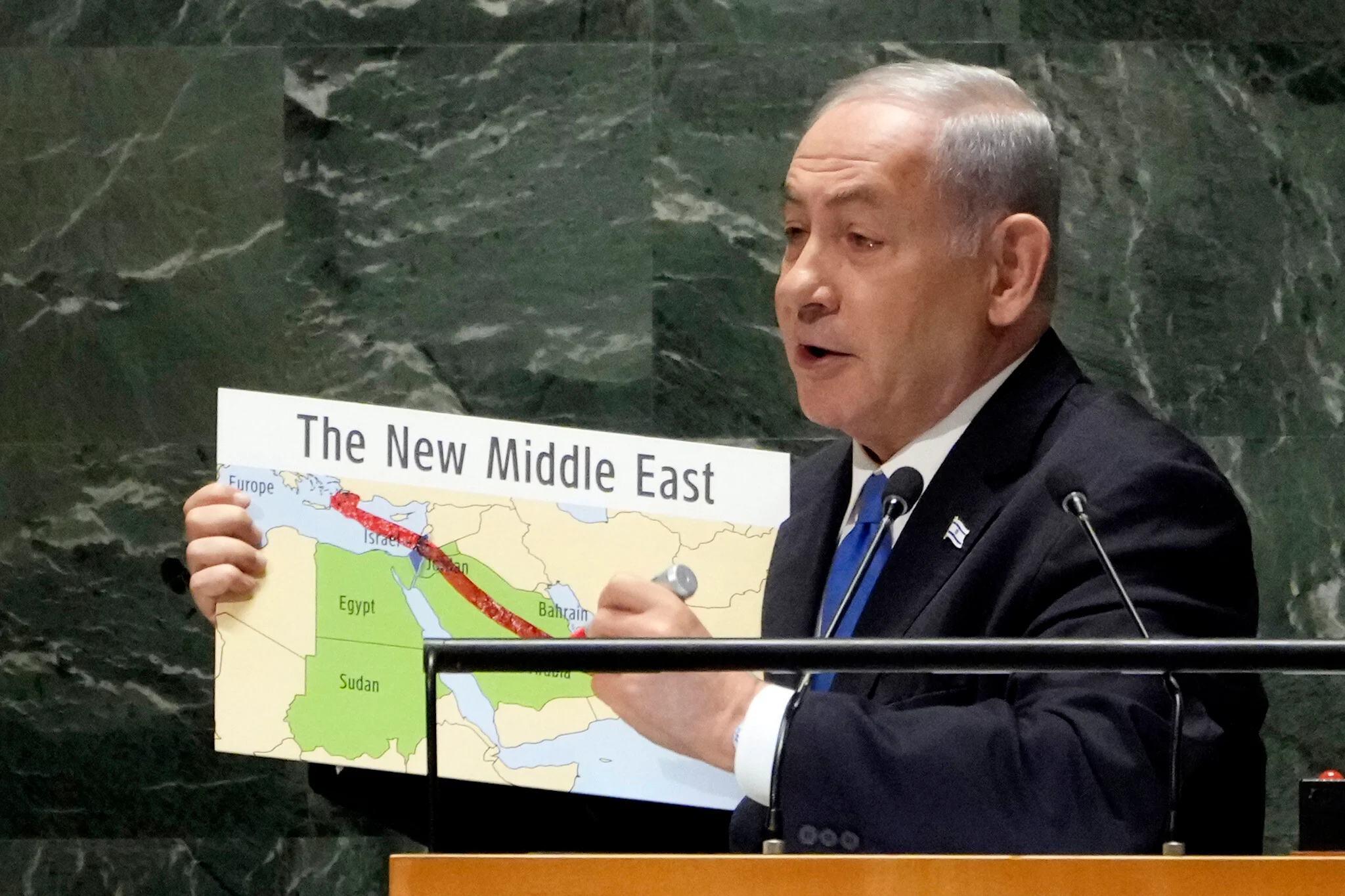
In this op-ed, Mohamad Elmasry argues that Israel’s strike on Iran, coordinated with the U.S., was a deliberate move to derail nuclear diplomacy, suppress resistance, and advance a long-standing expansionist project rooted in the vision of Greater Israel.
Israeli leaders claim that their latest attack on Iran is motivated by self-preservation. The circumstances and timing of the attack, however, suggest something different – that it is yet another attempt by Israel and the United States to sabotage peace to facilitate a higher-order objective: the so-called ‘Greater Israel’.
Importantly, this weekend’s unprecedented attack on Iran was launched during the height of U.S.-Iran nuclear negotiations, about which there had been at least some hope.
U.S. and Iranian leaders were scheduled to meet for another round of nuclear talks in Muscat this weekend. Israel’s assault shuttered the latest round of talks before they could get off the ground. The attack against Iran was coordinated with the U.S., something which suggests that Washington hasn’t been negotiating with Iran in good faith.
Israel’s pattern of sabotage is longstanding and extends well beyond the conflict with Iran. Israel has also derailed peace efforts in Palestine, Lebanon, and Syria, among other places, always with at least tacit U.S. support.
Gaza, Lebanon, and Syria
Throughout its current war on Gaza, Israel has undermined efforts to secure a durable ceasefire.
For example, during a temporary ceasefire in November 2023, Israel initiated a massive escalation against Palestinians in the West Bank and continued to fire on Palestinians in Gaza. Statements made by Israeli political leaders during that time made it clear that Israel would not pursue a permanent end to the war, effectively killing the ceasefire momentum.
The July 2024 war period was especially instructive. Throughout much of that month, reports suggested that mediators Qatar and Egypt were close to negotiating a Gaza ceasefire agreement that could end the war.
Yet, Israel again chose escalation, intensifying its bombings of so-called “safe zones” in Gaza and attacking several UN schools.
As negotiations were heating up near the end of the month, Israeli Prime Minister Benjamin Netanyahu delivered a defiant speech to the U.S. Congress, vowing to continue the Gaza war at all costs. On the last day of July, Israel assassinated Hamas leader Ismail Haniyeh, who had been in charge of ceasefire negotiations, in what the BBC called a “hammer” to the entire ceasefire process.
During that period, Israeli actions were closely coordinated with the administration of former U.S. President Joe Biden. In addition to supplying Israel with most of its weaponry and vetoing several ceasefire resolutions at the UN Security Council, the Biden administration also avoided putting real pressure on Israel to end the war.
Israel was forced by the administration of new U.S. President Donald Trump to accept a temporary ceasefire in January 2025. However, it unilaterally broke the agreement in March, likely with full U.S. backing, undermining what had been the most promising opportunity yet to end the war on Gaza, which has already been widely classified as a genocide by human rights and international humanitarian law experts.
Israel has also repeatedly violated ceasefire agreements with both Hezbollah and the Lebanese state. Its most recent bombings in Lebanon occurred in Beirut just over a week ago, on the eve of Eid Al-Adha, a major Muslim holiday. To date, Israel has reportedly committed more than 2,700 violations of the November 2024 ceasefire it signed with Hezbollah.
Israel’s relationship with Syria has followed a different pattern, marked by largely unilateral Israeli aggression. Shortly after the December 2024 fall of the Bashar Al-Assad dictatorship, Israel launched several hundred unprovoked attacks on Syrian territory. Israel continues to attack Syria in what appears to be an attempt to destabilise the country, weaken its transitional government, and ignite a new war where there isn’t one.
Sabotaging mediation
Just as Israel sabotages peace through military action, it also works to undermine diplomacy by demonising the mediators who make it possible, most notably, Qatar.
Israel has orchestrated a comprehensive propaganda campaign to demonise Qatar, in part by systematically distorting facts associated with its relationship with Hamas. It has falsely accused Qatar of sponsoring terrorism and being a biased mediator, despite Qatar’s global reputation as a credible broker of regional peace, and the Israeli media’s own description of Qatar as an “indispensable mediator” on Gaza.
Israel has also shut down Al-Jazeera, which is owned by the Qatari government, in both Israel and the West Bank, absurdly labelling it a “terror channel“.
This is not just diplomatic posturing. Rather, it is a deliberate effort to neutralise the only meaningful political actor with influence over Hamas.
Greater Israel
Importantly, all of Israel’s military and diplomatic strategies serve the same goal: territorial expansion and regional hegemony.
“Greater Israel” refers to the Zionist belief that all land in between the Euphrates River and the Nile River has been promised by God to Jews. This vision is deeply embedded not only in Zionist ideology, but also in Israeli political discourse and society more broadly.
Trump’s January suggestion of expelling all Palestinians from Gaza was greeted with overwhelming acceptance by Israelis. According to a poll by the Jewish People Policy Institute (JPPI), 82% of Israeli Jews viewed the mass expulsion of Palestinians as “desirable.”
The pursuit of Greater Israel has driven Israel’s decades-long West Bank settlement and outpost expansion program, as well as its destruction of Gaza, which leaders hope will lead to full Israeli control over the territory and the removal of its Palestinian population.
Israel also occupies parts of Lebanon and Syria and is actively expanding in both countries. Its attacks on Iran are more about consolidating hegemony and suppressing resistance.
A key moment
Israel faces mounting global pressure: it stands accused of genocide, and global opinion increasingly sees it as a pariah. Yet it remains defiant, determined to pursue an expansionist agenda that has left tens of thousands dead and diplomacy in ruins.
Given the nature of the current escalation against Iran, there is a real risk of a much wider regional, or even global, war. This risk cannot be lost on Western powers.
The question now is whether Israel’s allies — particularly in Washington — will continue to enable its sabotage of peace and its destructive expansionism. Or will this moment finally compel them to say ‘enough’?
Mohamad Elmasry is a professor of Media Studies at the Doha Institute for Graduate Studies.
This article is an opinion piece and does not necessarily reflect the views of Doha News, its editorial board, or staff.