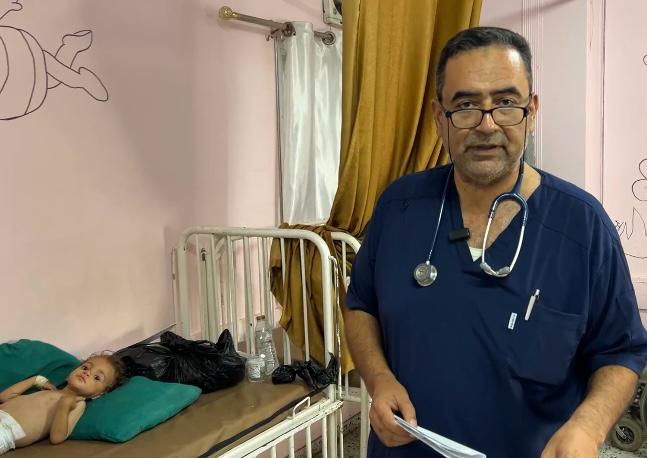
Hours before Israeli strikes killed journalists and medics at Gaza’s Nasser Hospital, doctors there were warning of a spiralling child famine amid a man-made humanitarian catastrophe.
Just hours before Israeli forces bombed Al Nasser Medical Complex in Gaza on Monday, Dr. Ahmed Al Farra was briefing journalists on the dire humanitarian crisis at the hospital, where children were suffering from severe malnutrition.
Among the reporters was Moaz Abu Taha.
“Moaz was here in this department just a few hours before he was killed. He was visiting children and collecting information on child malnutrition,” Dr. Al Farra told Doha News, speaking shortly after the attack as he returned to his duties.
The first strike hit the hospital, and as rescue teams rushed in, a second strike followed, killing more people, including medical staff and journalists documenting the child malnutrition crisis.
Cameras, equipment, and personal belongings were left soaked in blood.
Just metres from the blast site, the hospital’s paediatric and maternity departments continue to care for children suffering from severe acute malnutrition.
A few hours after the attack, Dr. Al Farra, head of paediatrics and maternity at Nasser Medical Complex, was back at work. “We have dozens of children with severe acute malnutrition every day, but we lack the resources to save them,” he said.
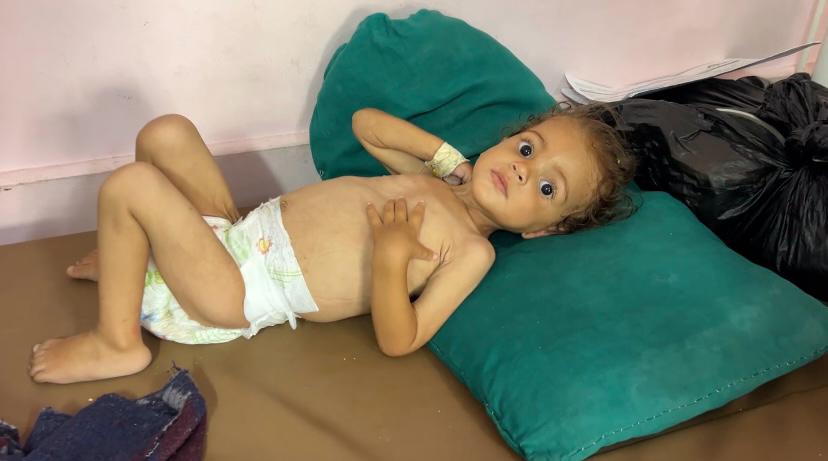
Inside the stabilisation centre, the situation is dire. One-year-old Naja Hade weighs just 7.5 kilograms, far below the expected 11–12 kilograms for her age. “She has lost muscle and fat. She has just the skeleton covered by skin. Her abdomen is distended due to severe acute malnutrition,” Dr. Al Farra explained.
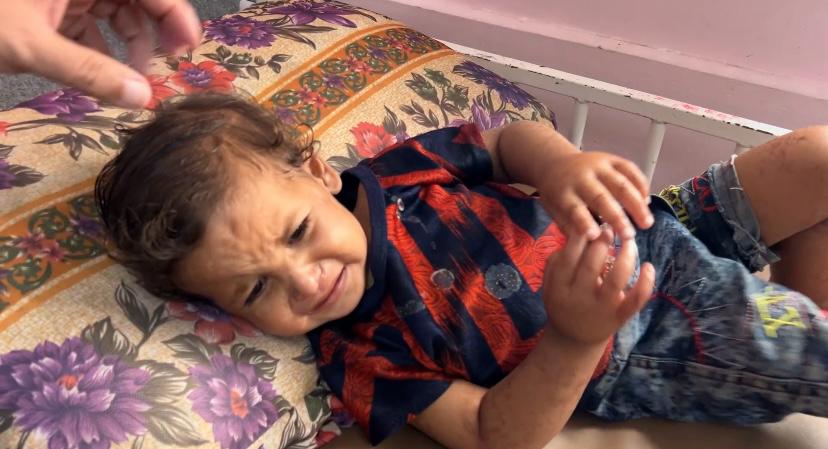
Another child, one-year-old May Abu Arar, suffers from pitting oedema in her lower limbs, a swelling caused by fluid build-up, common in starving children. “She has dermatosis, her hair is falling easily, you can see that she has apathy, and she is irritable and weak,” Dr. Al Farra said.
The crisis extends far beyond the hospital walls.
According to the UN-backed Integrated Food Security Phase Classification (IPC), famine has been confirmed in northern Gaza, affecting more than half a million people.
As of 26 August, at least 303 people, including over 117 children, have died from starvation under Israel’s blockade. Famine conditions are expected to spread across Gaza, with 640,000 people projected to face catastrophic food insecurity (IPC Phase 5) by the end of September. Over 1.14 million are already in Phase 4, and 396,000 in Phase 3.
UN Secretary-General António Guterres described the crisis as “a man-made disaster, a moral indictment and a failure of humanity itself. Famine is not about food; it is the deliberate collapse of the systems needed for human survival,” he stated on X.
UN agencies have warned that hundreds of thousands of people in Gaza go days without food, calling for immediate, full-scale humanitarian access.
Malnutrition among children is accelerating at a catastrophic pace.
In July alone, over 12,000 children were identified as acutely malnourished, marking the highest monthly figure ever recorded and a six-fold increase since the start of the year.
UN human rights chief Volker Türk condemned the famine as a “direct result” of Israeli policies, saying: “It is a war crime to use starvation as a method of warfare, and the resulting deaths may also amount to the war crime of wilful killing.”
With nearly 98 percent of cropland damaged or inaccessible and nine in ten people displaced, Gaza is now experiencing the first officially confirmed famine in the Middle East.
Back inside Nasser Hospital, Dr. Al Farra continues to treat children amid the devastation. “We’re seeing more cases every day, and we simply can’t keep up,” he said.