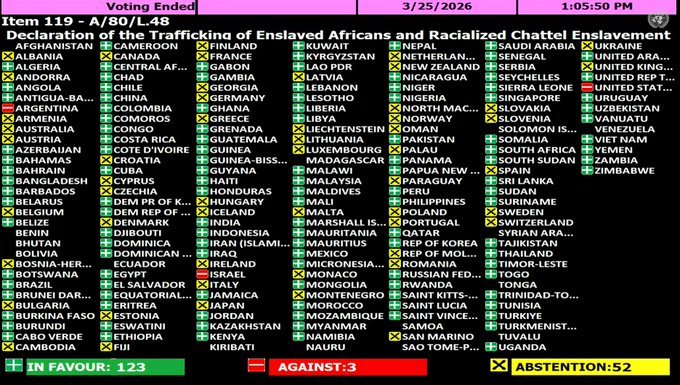
Qatar was among 123 countries that voted in favour of a UN General Assembly resolution on Wednesday, declaring the trafficking of enslaved Africans and the enslavement of Africans on racial grounds “the most inhumane and enduring injustice against humanity.”
The resolution, presented by Ghana and nearly 60 co‑sponsors, was opposed by three states — the United States, Israel and Argentina — with 52 abstentions. Arab countries involved in presenting the text included Tunisia, Algeria, Comoros, Djibouti, Sudan, Somalia, Egypt, Morocco and Mauritania.
The resolution stresses the need to address historical injustices through measures that uphold justice, human rights and dignity. It calls on member states to engage in dialogue on reparatory justice, including formal apologies, compensation, rehabilitation and guarantees of non‑repetition.
It also encourages voluntary contributions to education about the transatlantic slave trade and calls for collaboration with the African Union, the Caribbean Community, and the Organization of American States to support reparatory justice and reconciliation.
The United Nations Secretary-General highlighted the scale of the transatlantic slave trade, noting that millions of Africans were abducted and transported under harsh conditions across the Atlantic, with generations exploited in the Americas.
He described the system, which lasted over 400 years, as having a lasting impact on the world today and called on nations to confront the ongoing legacy of inequality and racism.
Ghanaian President John Dramani Mahama, a key architect of the resolution, said the vote honoured the memory of the victims and represented a collective commitment to justice, noting that “today, we come together in solemn solidarity to affirm truth and pursue a route to healing and reparative justice.”
Some countries expressed concerns about aspects of the resolution, including the United States, which opposed ranking crimes against humanity and disputed claims of legal entitlement to reparations for historical wrongs.
The European Union also raised concerns regarding interpretations of historical events and the application of international law.
The resolution’s adoption was widely applauded, with diplomats highlighting the importance of remembering the “devastating consequences and long-lasting impacts” of slavery. It reinforces the international community’s commitment to addressing historical injustices and ongoing discrimination against people of African descent.