People often rely on trusted community networks during crises: local organisations, neighbourhood groups, religious leaders, and other community figures.
In discussions about conflict and civilian protection, attention usually focuses on physical security: shelters, air defence systems, evacuation routes, and humanitarian assistance.
But one element is often overlooked: emergency public information, and the ways in which it can be protective.
Over the past days in Qatar, as the country has faced security threats and interceptions of missiles and drones from Iran, it has been possible to observe how structured and transparent public communication can help reduce panic, counter misinformation, and enable civilians to make safer decisions.
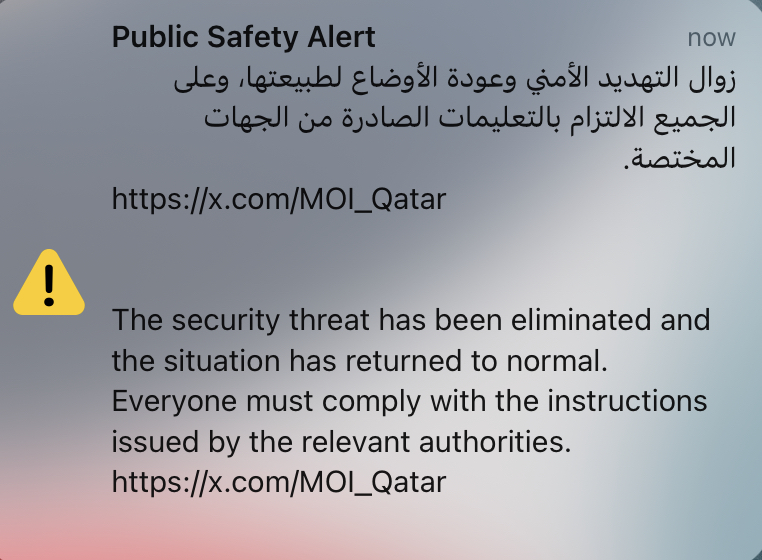
Since the escalation began on February 28 2026, residents, as well as visitors and tourists, have received immediate alerts on their mobile phones with loud notifications and clear instructions delivered in both Arabic and English: shelter in place, avoid unnecessary movement, stay away from windows, move to internal areas for safety.
Communication has been frequent and coordinated across institutions. Security updates have come from the Ministry of Interior and Ministry of Defence, while other ministries have communicated guidance from time to time, relevant to daily life.
Ministry of Labour and authorities have provided updates on remote work arrangements. Education authorities have guided distance learning. The Government Communications Office has shared concise information, including animated videos and infographics through various forms of mass communication including social media, explaining what people are hearing and experiencing, from interceptions to explosions.
Importantly, authorities have also anticipated the concerns that naturally arise in times of crisis. Early on, communication reassured residents that essential supplies such as water and food remain available. Supermarkets were instructed to remain open for extended hours to maintain access. Guidance has also been shared with families on how to speak with children about what is happening and how to reassure them.
One notable feature has been the speed with which information is clarified after incidents.
When explosions are heard, speculation could easily fill the gap. Instead, Qatari authorities have provided updates within minutes explaining what happened — confirming interceptions, providing context, and reiterating safety guidance. Once the threat is ‘eliminated’, residents are informed on their mobile phones.
In many crisis settings, this is precisely where many problems emerge otherwise.
Information gaps allow rumors, misinformation, and speculation to spread quickly. Panic follows. Trust erodes. People make decisions based on incomplete or incorrect information.
Having spent time working in and around conflict-affected contexts, I know this level of consistent, coordinated communication is not always the norm. Yet it illustrates an important point: crisis emergency communication is not simply about public messaging. It is a core component of civilian protection.
When people understand the risks they face and what actions to take, they are better able to protect themselves and their families.
The question, however, is how such practices can be sustained and institutionalised beyond individual crises.
Based on what we are seeing here — and lessons from other contexts — several elements appear important.
1. Institutionalised crisis communication protocols
Effective crisis emergency communication should not depend on improvisation. Governments need predefined protocols that clarify which institutions communicate what, through which channels, and at what frequency during emergencies.
Prepared communication structures allow information to flow quickly and consistently when crises occur.
In November 2025, Qatar’s National Command Center (NCC) conducted a public emergency alert test through the WATAN system, sending an emergency tone and message to mobile phones across the country. This test was part of the country’s efforts to strengthen public safety and ensure that in real emergencies, alerts can reach residents quickly and efficiently.
2. Trusted and rapid public alert systems
Alert systems that reach people immediately, such as SMS or cell broadcast notifications, are essential for providing actionable safety guidance in real time.
Equally important is ensuring messages are clear, concise, behavior-focused, and multilingual.
3. Partnerships with responsible local media
In times of crisis and emergency, local media outlets can serve as critical amplifiers of verified information. In such situations, people often turn to familiar and trusted sources within their own information environment. In Qatar, local outlets such as Doha News seems to have become reference points for many residents seeking reliable updates, helping relay verified information and guidance.
Pre-established coordination with trusted media organisations can help ensure accurate information circulates rapidly while reducing the space for speculation.
Beyond traditional media, responsible influencers and independent digital personalities have also played an important role. In Qatar, some social media figures who typically focus on lifestyle content have shifted quickly to sharing verified information, amplifying official guidance, and helping translate key messages for their audiences.
This also reflects an increasingly important reality: crisis emergency communication today often depends on a broader information ecosystem where trusted digital voices can help reinforce responsible messaging and reach audiences that official channels may not always reach directly.
4. Community-centered communication
People often rely on trusted community networks during crises: local organisations, neighborhood groups, religious leaders, and other community figures.
Engaging these actors in crisis emergency communication frameworks helps ensure messages reach diverse populations, including those who may have limited access to official digital channels.
5. Proactive efforts to counter misinformation
Combating misinformation cannot begin only when a crisis starts. It requires long-term investment in information resilience: media literacy, trusted official communication channels, rapid myth-busting mechanisms, and consistent transparency that builds credibility over time.
In fact, transparency is often the most effective antidote to rumours.
When authorities acknowledge incidents quickly, explain what is known and what remains uncertain, and provide updates as situations evolve, they reduce the space for speculation and misinformation.
6. Communication that addresses daily life and psychological wellbeing
Crisis emergency communication should not focus solely on security incidents. Information about essential supplies, education, work arrangements, and family wellbeing helps people maintain stability during uncertain times.
Providing guidance to parents on how to speak with children, for example, recognises that protecting civilians also includes addressing psychological stress.
Ultimately, effective public communication builds something that is invaluable during crises and emergencies: public trust.
When authorities communicate consistently, transparently, and responsibly, people are more likely to follow guidance, avoid panic, and rely on verified sources rather than speculation.
In a world where misinformation can spread faster than facts, this is not a secondary consideration.
It is a critical pillar of protecting civilians.
Hajer Naili is Director of Communications at Center for Civilians in Conflict (CIVIC).
This article is an opinion piece and does not necessarily reflect the views of Doha News, its editorial board, or staff.