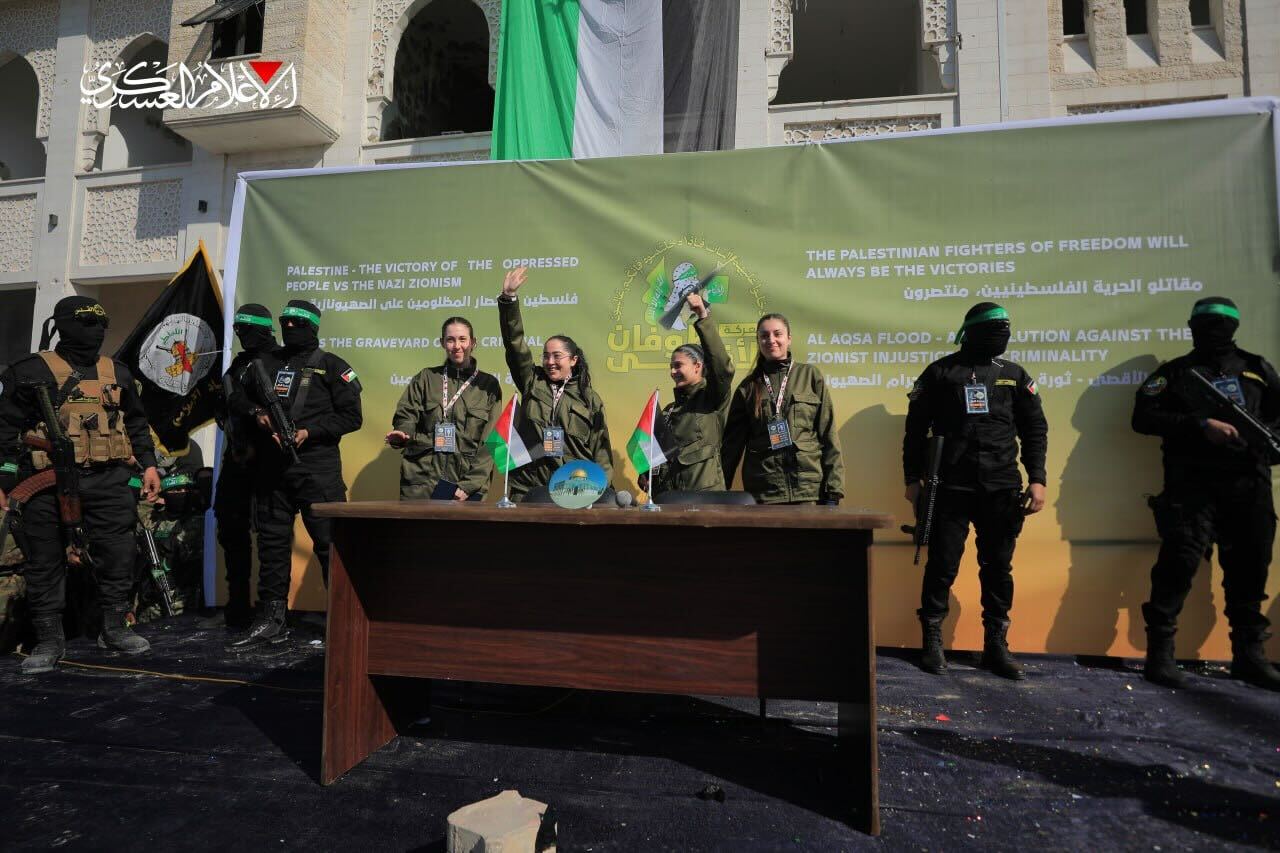
Hamas has asked the international community to urge Israel to honour the ceasefire after Netanyahu postponed the release of Palestinian prisoners.
Israel has announced that it will delay the release of more than 600 Palestinian detainees until the next group of Israeli captives is confirmed for release, despite Hamas freeing six captives on Saturday.
In official statement, Basem Naim, member of the Political Bureau of Hamas in Doha, highlighted that by postponing the release of Palestinian prisoners as per the phase one of the ceasefire agreement, Israel is “acting rampantly and exposing the entire agreement to grave danger”.
The decision comes in response to Hamas’ publicised release ceremonies, where a widely circulated video showed Israeli captive Omer Shem Tov kissing the foreheads of Hamas fighters on the dais during his release.
In another video released by the armed wing of Hamas, the Al-Qassam Brigades, Israeli soldier captives were shown standing before an old olive tree that was cut down by Israeli military forces during their genocide on the Strip. The captives said that the 100-year-old tree is older than Israel, which was established in 1948 after ethnically cleansing hundreds of thousands of Palestinians.
‘Netanyahu dragging his feet’
In a press release, Naim has held Israeli Prime Minister Benjamin Netanyahu responsible for continuously derailing the ceasefire between Hamas and Israel.
“Netanyahu and his government are dragging their feet and talking about flimsy excuses to sabotage the agreement while they have seriously breached the ceasefire agreement many times,” he said.
Naim called on the mediators of the ceasefire, especially the U.S., to urge “Netanyahu and his government to implement the agreement and immediately release our prisoners”.
This was echoed by Izzat Al-Rishq, a member of Hamas’s Political Bureau, who urged the mediators and the international community to take responsibility and ask Israel to implement the agreement and release the Palestinian prisoners without any further delay.
The Israeli prime minister has termed the release of captives as “humiliating ceremonies”.
Hamas has termed these accusations as a “baseless and weak excuse designed to avoid fulfilling the terms of the agreement”. They highlighted that the releasing procedure expresses “respect for captives in a manner consistent with Islamic values”.
The Palestinian movement also pointed out the stark difference between the released Israeli captives in the Gaza Strip and Palestinian prisoners held in Israeli jails. Palestinian prisoners are subjected to severe torture, beatings, and deliberate mistreatment until the very last moments before their release.
Hamas stated that Israel’s refusal to engage in the second phase of negotiations, which were set to begin on February 5 -16 days after the agreement was signed – indicates Israel’s intention to return to war and the bombing of Gaza.
So far, more than a hundred Palestinians have been killed since the ceasefire agreement was signed, and the entry of shelter supplies to the residents has been prevented.
Who were the Palestinian detainees slated for release on Saturday?
The Palestinian Prisoners’ Media Office says the Israeli refusal to release over 600 prisoners is an effort to play with the feeling of the detainees and their families “in a blatant violation of all human values and norms”.
The seventh and largest release of Palestinians from Israeli prisons – a total of 602 – was planned on Saturday. Among them were 445 individuals arrested from Gaza, including 100 women and minors under the age of 19.
Israeli media reported that these women and children were not involved in the October 7 attacks or the fighting in Gaza, leading activists to accuse Israel of using them as “bargaining chips”.
Notably, the list did not include Dr. Hussam Abu Safia, the director of Kamal Adwan Hospital in Gaza who was kidnapped on December 27, or any of the approximately 200 health workers from Gaza currently in Israeli detention.
As of now, 61 Israeli captives remain in Gaza from the original 251 captured on October 7, 2023. Out of these, Israel has declared 31 as deceased. Additionally, bodies of 40 deceased captives have been retrieved, and eight captives have been rescued alive. There are five non-Israelis still in captivity, including three Thais, one Nepalese, and one Tanzanian, with two of them (one Thai and one Nepalese) believed to be alive.
Phase one of the truce deal, set to run until March 1, includes Hamas releasing four more bodies of captives held in Gaza. In exchange, Israel will release the remaining Palestinian women and children detained during the war and allow 60,000 mobile homes into Gaza. Convoys carrying these homes are currently waiting for approval at the Rafah border crossing.