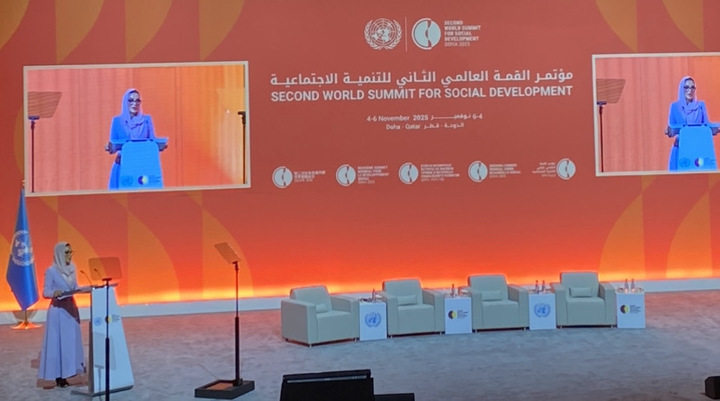
‘Education is the foundation of a fair and prosperous society’, said Sheikha Moza bint Nasser, Founder and Chair of the Education Above All Foundation, as she addressed Second World Summit for Social Development in Doha on Tuesday.
Education is essential even in conflict zones, including Gaza and Sudan, and is central to societal stability, development, and prosperity, Sheikha Moza bint Nasser, Founder and Chair of the Education Above All Foundation, emphasised on Tuesday.
Speaking at a high-level panel titled ‘Education as the Foundation of the New Social Contract: Reimagining Learning to End Poverty, Create Decent Work, Achieve Inclusion, and Harness the Opportunities of the Digital Age’, Sheikha Moza stressed on the transformative power of education.
In her remarks, Sheikha Moza highlighted the urgent need to address the challenges facing youth in conflict-affected regions such as Gaza and Sudan.
“Education is not a segment of social issues, it is the core of all societal progress,” she said, highlighting that without accessible and quality education, countries cannot hope to overcome poverty, inequality or social instability.
Sheikha Moza reflected on the critical role that education plays in human development, innovation and social cohesion, describing it as the bridge between current challenges and a sustainable future.
“In a world defined by digital transformation and artificial intelligence, we must ensure that young people are equipped to meet the demands of tomorrow,” she said, emphasising that education should not only impart knowledge but also empower students to become innovators, leaders, and responsible citizens.
Drawing attention to the Israel’s genocidal war in Gaza and people’s struggles, she stressed that education initiatives must continue alongside humanitarian efforts, highlighting that reconstruction and development cannot succeed without investing in learning opportunities for children and youth.
Similarly, Sheikha Moza called for support for students and communities affected by conflict in Sudan, stressing the importance of integrating education with broader social development programs.
UN Secretary-General António Guterres also addressed the panel, warning that millions of children around the world are being denied access to education and calling for global action to restore education as a universal right.
“Social development is not abstract, it is the story of every human being who seeks a chance to thrive in their society,” Guterres said.
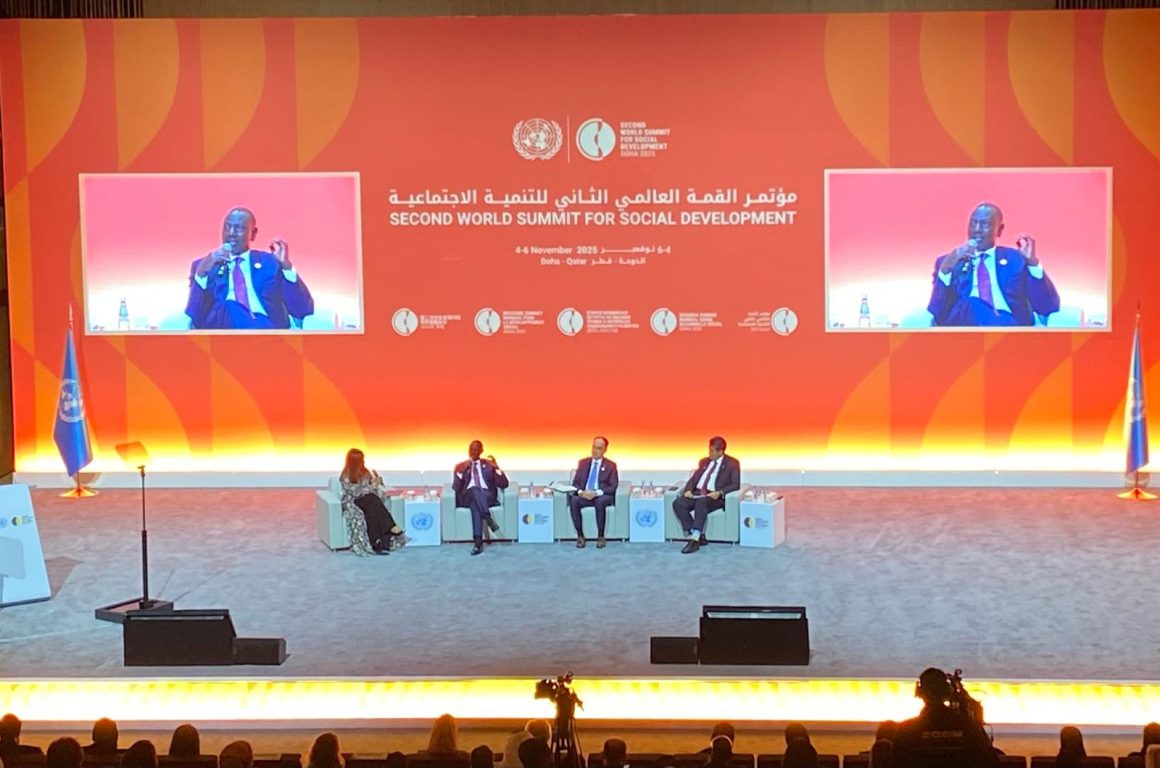
Panelists from across the globe shared complementary perspectives on the transformative power of education.
Kenyan President William Ruto highlighted his country’s efforts to democratise education through technology and teacher recruitment, noting that Kenya has hired over 100,000 teachers in the last two years and expanded its education budget significantly.
“In the next two years, we will have the largest university in Kenya, which is not only cost-effective but democratises education. Students from different parts of the country, and even from across the globe, will have access.”
Albanian President Bajram Begaj stressed that education is a right, not a privilege, and spoke about North-South and South-South cooperation as essential for sharing knowledge, strengthening institutions, and building capacity in developing countries.
“Knowledge empowers people, enabling them to face today’s challenges and contribute to building a better society.”
Palauan President Surangel Whipps Jr. shared a deeply personal story of his father’s struggle to access education, illustrating how barriers to learning affect generations.
“There is no doubt that education transforms lives. Reflecting on my father’s journey, who faced hunger and missed years of schooling, I see how critical access to education is.”
In Palau, President Whipps Jr. highlighted how technology has been leveraged to connect remote communities, ensuring that students on small islands have continued access to education.