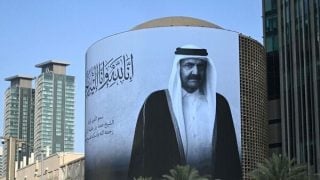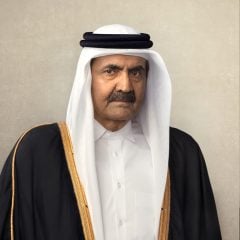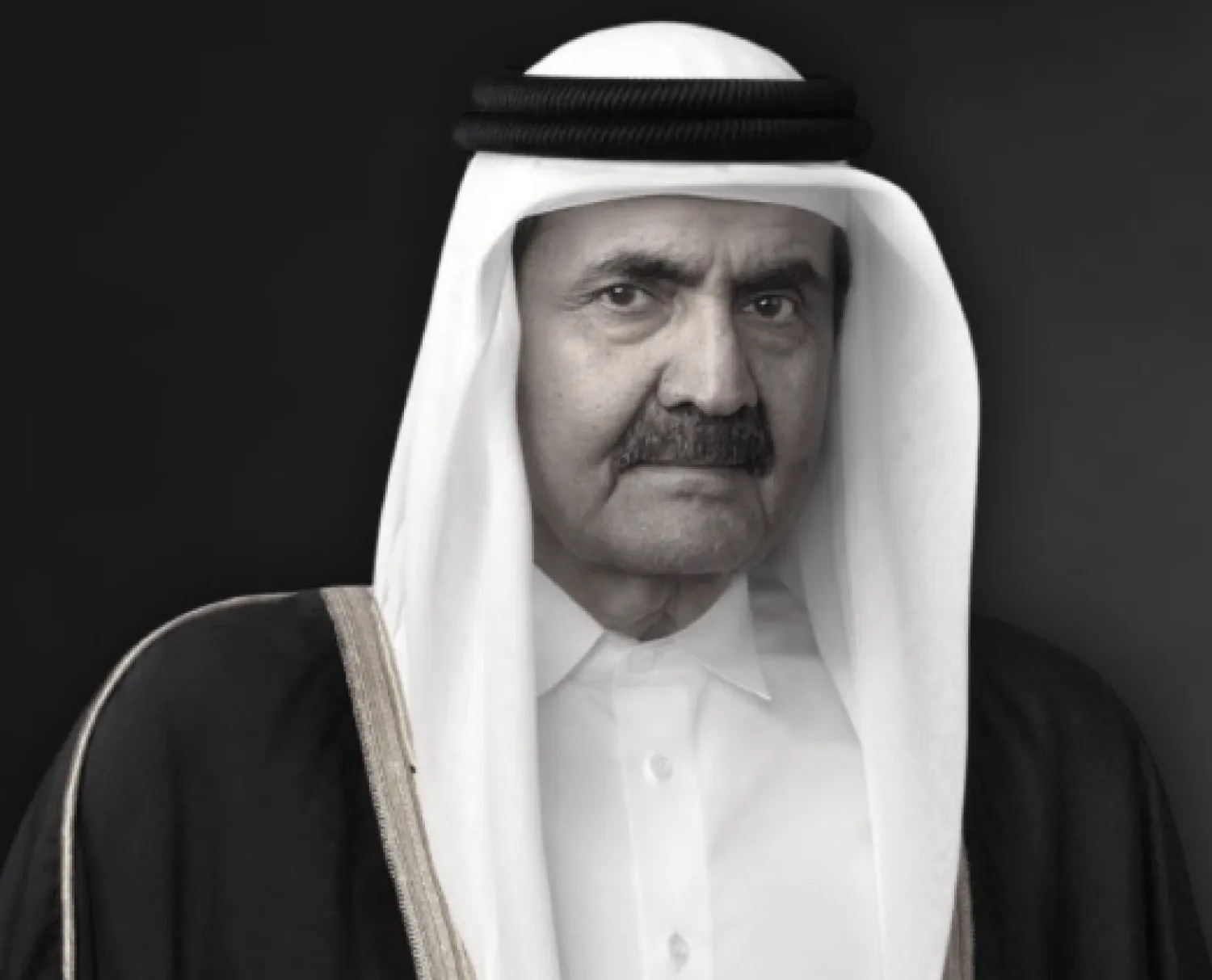
Deepest sympathy on the loss of the Father Amir of Qatar Sheikh Hamad bin Khalifa Al Thani
I never met the Father Amir. But I did see him, once. He came to Education City for his daughter’s graduation, and when the faculty and students entered the hall to embark on their own journeys, he rose to his feet and clapped. You did not have to feel the warmth in that hall — you could see it. The humility of an Amir standing for teachers. The pride he took in every graduate, Qatari and non-Qatari alike, as though each were his own. His smile kept perfect time with his enthusiastic applause. It was, and remains, an unforgettable sight.
And yet I had known him long before that moment — all my life. Some men you know by their voice, their presence, their actions. Others you know by what blooms in their wake. I knew him the way one knows the rain — not by touching it, but by the green that follows.
I knew him first in Sudan, as a child, in the face of a schoolteacher. Her salary ran out before the month did; she taught other people’s children while lying awake over her own. Then one day, an answer came from Doha: her application had been accepted. One envelope. One decision. And the entire arc of a life bent toward hope.
Years later, I stood with my mother at that teacher’s door, and my eyes refused to believe what my heart already understood. Where there had been dust, there were gardens. Where there had been worry, there were rooms full of light. She had built, brick by patient brick, a home that memory could not reconcile with the past — and the bridge between her two lives was one man’s open hand, extended across a region.
She was not alone. Whole neighborhoods rose the same way. One of them stands beside the Nile Bridge, and its people gave it a name: Doha. Pause on that. A community on the banks of the Nile, naming itself after a city on the Gulf. That is not geography. That is gratitude, carved into the earth, spoken aloud every time a child says where she is from.
I write this with a wound inside the wound. What he made possible in Sudan — the homes raised through years of honest labor in Doha, the gardens coaxed from dust, the neighborhood that proudly bears his capital’s name — warring parties in our country have destroyed and defiled. Decades of work that Doha made possible; a life back home that war has made impossible. But walls can fall and gardens burn, and still the gift is not undone. What he gave was never only brick and shade. It was the proof, carried in living memory, that a better life can be built — and what has been built once can be built again. Even war cannot unname a neighborhood called Doha.
The world will remember the statesman — the visionary who took a peninsula of sand and pearls and raised from it a nation of consequence. History will record the ledgers of gas and diplomacy, of summits and stadiums. But there is another ledger, kept in no archive: every accepted application a family lifted; every visa a roof raised; every remittance a child in school, a debt forgiven, a mother’s fear finally laid to rest. He did not merely build a country. He opened his country like a door, and through it thousands of families walked into new lives.
I saw it again, years later and a continent away, in Kerala. There, in the green and watered south of India, the same miracle unfolded before my eyes: graceful homes rising among the banana groves, bougainvillea pouring over garden walls in red, white, and orange — every blossom a quiet testimony to what a wage earned in Doha could become on the way home. In Kerala, as in Sudan, the money did not just build houses. It carried families — the nuclear and the extended, the elderly and the unborn. Two countries. Two continents. One signature of generosity. And I know that tonight, in villages I will never see — in the Philippines, in Nepal, in Egypt — strangers are mourning the same man I mourn, a man none of us ever met, in stories that rhyme with mine.
And then life gave the story back to me. After a lifetime in the United States, I was given the chance to live in Doha myself — and to teach there, in the Education City he willed into being, where world-class learning rose from the desert because one man believed his people, and the world’s people, deserved it. A schoolteacher from Sudan once carried his generosity home to the Nile; now I, a teacher too, stood in the very city she had told of, a beneficiary of the same open hand. So today I do not write merely as a witness to his vision. I write as one who lived inside it — grateful, like the many Sudanese who built one home in Doha and another in Khartoum, carrying his gift in both.
Today the commentators on Al Jazeera recount his achievements — his generosity, his brilliance, his daring. And they do so from within his own creation: the channel he built, a platform of world renown that gave voice to the voiceless and argument to a region long told to be silent. Even the eulogy is his handiwork. Even our mourning travels on airwaves he raised. What greater proof of a life well built — that we cannot even grieve him except through the things he made.
“Qatar deserves the best,” he believed. He never carved it into slogans. He never needed to. It was not announced; it was felt. Not proclaimed; lived. And it is lived still — in Lusail’s towers, yes, but also in a teacher’s garden by the Nile, and in bougainvillea climbing a wall in Kerala.
So on behalf of that teacher — on behalf of a neighborhood that carries his capital’s name — on behalf of every family, on every continent, that wakes today beneath a roof his vision made possible — I bow my head with his family, with the nation of Qatar, and with his true extended family: all of us, everywhere, whose lives he touched without ever learning our names.
They will lay him to rest in Lusail. But he will not stay there. Walk beside the Nile. Walk through the gardens of Kerala. He is everywhere he was needed. The rain has passed, and the green remains.
His loss is humanity’s loss, in its most tested times.
May Father Amir rest in eternal paradise.
Rogaia Mustafa Abusharaf is Professor of Anthropology at Georgetown University in Qatar, specialising in human rights, gender, migration, and African and Gulf studies, with a particular focus on Sudan. This article is an opinion piece and does not necessarily reflect the views of Doha News, its editorial board, or staff.