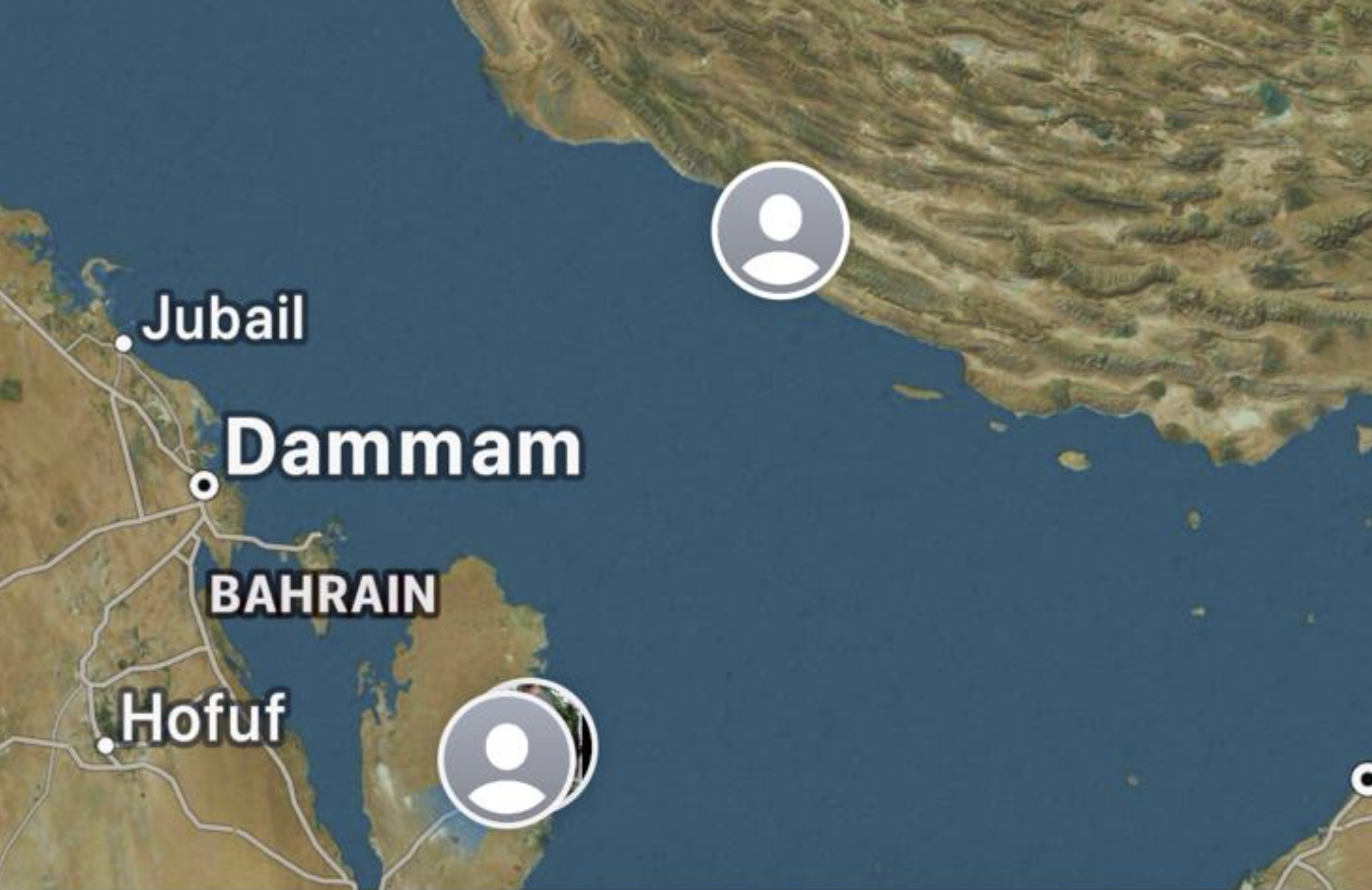
Qatar residents are reporting GPS glitches that experts link to regional spoofing campaigns likely tied to recent military tensions between Iran and Israel.
A ceasefire may have taken hold between Iran and Israel after Iran’s missile strike on the U.S. Al Udeid Air Base, but an unusual side effect of the conflict continues to play out in Qatar: many residents are still finding themselves, virtually, in Iran.
Since Israel’s airstrikes on Iran on June 13, users in Doha have been reporting strange technical glitches across platforms like Uber, food delivery apps, and even TV services.
The issue has gained traction on Reddit and Twitter, where users have shared stories of misdirected Global Positioning System (GPS) and erratic devices.
“One day, when I went to order an Uber, it said my GPS was in Iran,” one Reddit user posted. “And then just last night, my TV was bugging out.”
The glitch has puzzled residents and raised broader concerns about what might be happening behind the scenes.
GPS jamming or spoofing?
According to Dr. Gabriele Oligeri, Associate Professor at Hamad Bin Khalifa University, this is likely more than a simple software error. Two technical terms are circulating to explain the phenomenon: GPS jamming and GPS spoofing, often confused, but quite different.
“Jamming is performed to prevent the reception of radio messages, while spoofing is achieved by mimicking a fake position on a target device by sending forged messages to a receiver,” Oligeri explained.

This subtlety is what makes spoofing so difficult to detect, especially since civilian systems like GPS, GLONASS, and Galileo do not authenticate signals for non-military users.
“Your phone can’t tell the difference between a real satellite and a malicious transmitter on the ground,” he added.
Is it linked to the Iran-Israel conflict?
While there is no official confirmation of intent, experts note that GPS interference often coincides with spikes in regional tensions or active military operations.
“If many users report inconsistent location data, it’s likely that a spoofing campaign is underway,” Oligeri said.
A recent Reuters report documented nearly 1,000 ships in the Gulf experiencing “mass interference” with their GPS, with some even appearing on tracking platforms in rural Russia. Aviation networks have also reported irregularities likely tied to GPS spoofing.
Similar anomalies have been seen in other conflict zones or areas with active defence systems, and despite the recent ceasefire, interference appears to be ongoing.
Aviation and maritime trackers continue to show signs of spoofed signals across the Gulf.
The International Air Transport Association (IATA) and the European Union Aviation Safety Agency (EASA) have both acknowledged a rise in GPS disruptions in the Middle East and Eastern Europe.
They have launched joint efforts to improve pilot awareness and operational procedures to mitigate risks.
Why spoof GPS?
Spoofing is rarely aimed at civilians. It is often used to confuse or mislead autonomous military systems like drones or missiles, which rely on satellite navigation.
“It’s reasonable to assume it’s intentional and part of a broader defence strategy,” Oligeri said.
So, if your AirPods or smartphone suddenly show you in southern Iran, you are probably just collateral in a signal-distortion operation that was never meant for you.
Should I be worried?
Not really. While disorienting and inconvenient, GPS spoofing isn’t considered a threat to personal safety or infrastructure. Civilian transport systems, including aviation and maritime traffic, do not rely solely on GPS.
“Even in safety-critical scenarios like air or maritime traffic, GPS isn’t the only system in use,” Oligeri said. “Operators rely on multiple sources of information to detect and correct anomalies.”
Still, there is little civilians can do to shield themselves from spoofing. “Unfortunately, GPS jamming and spoofing are very difficult to mitigate with non-military equipment,” Oligeri said. “Location services are free, and thus come with no guarantees of reliability. Awareness plays an important role.”
For now, residents are advised to stay aware, report anomalies, and be patient. This may be a digital echo of a conflict that has not fully disappeared.